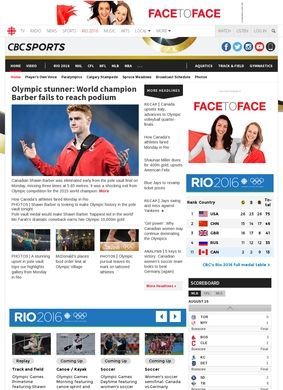
Canadian public broadcasting has always carried a sports mandate, and CBC Sports is where that mandate shows up in practice. It is the English-language sports section of the Canadian Broadcasting Corporation, which means it runs with editorial resources and official rights arrangements that no commercial startup can replicate. The front page on any given day mixes written match reports, video clips, live scores, standings, and schedules across a roster that runs from the NHL through the CFL, MLS, the Canadian national soccer teams, the NBA, track and field, curling, figure skating, and the full Olympic calendar. The range is not accidental; it reflects a genuine public-service brief to cover Canadian sport broadly rather than chasing whatever pulls the most clicks.
Hockey coverage split with CBC Gem
Hockey still gets the heaviest daily treatment. NHL coverage runs deep, and international hockey, including World Championship and World Junior material, gets treated as seriously as the domestic league rather than bumped to a sidebar. For a Canadian audience that grew up with Hockey Night in Canada as a cultural institution, the institutional memory behind that coverage is palpable. Broadcast rights have shifted over the years, and live game broadcasts now run through CBC Gem, the corporation's streaming platform, while the sports section handles text reporting, scores, and shorter video clips. It creates a mild split for someone chasing a full live broadcast, but the arrangement is sensible given how streaming and text publishing have diverged as products.
Olympic broadcast coverage
Where CBC Sports genuinely pulls ahead of commercial alternatives is the Olympic program. CBC and its French-language counterpart Radio-Canada hold official Canadian broadcast rights to the Games, and the editorial weight behind that commitment shows. Sports that attract attention roughly every four years on most outlets, speed skating, bobsled, biathlon, weightlifting, get covered with the same seriousness as an NHL playoff report. Feature journalism, documentary video work, and long-form athlete profiles appear in the weeks around major Games, and some of that material persists year-round for sports like curling and figure skating that have their own competitive seasons.
Building a national sports audience
That Olympic orientation shapes the audience CBC Sports is built for. It is not trying to out-resource ESPN or TSN on NHL daily content; it is trying to be the place a Canadian sports fan goes when the question is why the country cares about a given sport, beyond the last score. The editorial choices follow from a mandate to serve a national audience across regions, which means a curling report from a provincial championship sits next to an NBA recap without the site seeming confused about what it is.
Extending coverage into podcasts
CBC Sports also produces podcasts and on-demand audio, which rounds out the formats enough that the same story can reach readers, viewers, and listeners. The production quality on the longer documentary and podcast work is noticeably higher than a wire-service-dependent operation, partly because the public funding model does not require every piece to generate its own ad revenue within twenty-four hours.
Comparing coverage volume to competitors
Covering the NHL, CFL, multiple soccer competitions, the NBA, track, curling, skating, and the full Olympic calendar inside a single section is a lot to carry. On the major-league beats, CBC Sports competes against commercial outlets that dedicate far more staff to a single sport. Daily NHL coverage, for example, goes up against dedicated hockey media that publishes dozens of pieces a day. CBC Sports cannot match that volume, and it does not try to. What it offers instead is context, longer reporting cycles, and the occasional piece that a click-optimizing competitor would not commission.
That trade-off is real, and a reader who wants granular beat coverage of their CFL team five days a week will probably maintain a second destination. The breadth guarantees a Canadian sports fan will find something relevant here; it does not guarantee that every sport gets the same staffing and attention. The documentary and feature work is where the public-broadcaster model makes the strongest case for itself, because that material would not exist at all if the economics of commercial sports media were the only filter.
Reputation and accuracy record
Outside reputation data is limited. A search across review platforms turns up very few public ratings for CBC Sports specifically, which is common for editorial media properties that do not ask viewers to leave feedback the way a local business might. The broadcaster's overall reputation is well-established in Canada, and the sports section inherits that standing. CBC Sports puts out a daily volume of reportage that is checkable against the record of games played and results published, and the factual accuracy of scores and standings is as clean as any outlet in the category.
Taken together, CBC Sports is the right first stop for Olympic and amateur sport coverage in Canada, a reasonable daily read for hockey and soccer, and a slower but more considered alternative to the commercial machine on major-league beats. Its value is clearest when the subject is something a for-profit outlet would not bother covering at full depth.