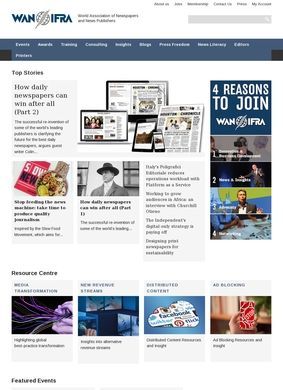
Better known in the trade by its working name WAN-IFRA, the World Association of Newspapers and News Publishers is an international professional body for the news media industry. It exists to serve the people who make and run the news: publishers, editors, newsroom executives, journalists, media-innovation leads and the suppliers who sell into all of them, worldwide.
The work splits into three broad streams, which are research and information, events, and member communities. Each of those has grown into a substantial operation in its own right, and together they cover most of what a working newsroom needs from an outside body: intelligence about the market, a place to meet peers, and a collective voice on the problems no single publisher can tackle alone.
That breadth is the point. The World Association of Newspapers and News Publishers is trying to be the connective tissue of a global industry under sustained financial and political pressure, and its output is organised around the problems that keep publishers awake at night, chiefly money and press freedom. Those two themes run through nearly everything the organisation touches. On the money side it is preoccupied with how newsrooms will pay for themselves as print declines, and on the freedom side with the legal and physical safety of the journalists doing the work.
A body that took only the commercial half seriously would be a lobbying shop; taking both is what gives this one its broader claim.
Research, events and the member networks
The clearest way to read the World Association of Newspapers and News Publishers is through what it produces and hosts. Three things stand out: a research operation, a calendar of large events, and a set of standing member groups. None of it is aimed at the general public. This is a trade body talking to its own industry, and each stream has real substance.
The audience is precise: publishers and editors at the top, newsroom executives and media-innovation leads in the middle, and the suppliers and technology vendors who sell into all of them around the edges. Content that speaks to that many roles at once has to be layered, and the site is arranged accordingly.
The Knowledge Hub and its research
On the information side there is a steady flow of industry news updates and a Knowledge Hub of downloadable reports. The research runs to named studies, such as a Future Newsrooms study and a FIPP Global Subscription Snapshot, the kind of benchmarking a publisher uses to see where it sits against its peers. Expert Panel contributions and a set of newsletters round out the reading. For a media executive trying to track where subscriptions, advertising and AI are heading, this is the sort of desk research that would otherwise cost a fortune from a consultancy.
The World Association of Newspapers and News Publishers effectively pools it and hands it back to the industry. The subject matter tracks the anxieties of the moment: subscription strategy, advertising revenue, and how artificial intelligence is reshaping the newsroom. A publisher reading a subscription snapshot next to a study on the future of newsrooms gets something close to a market briefing, assembled from data most individual titles could never gather on their own.
Whether any given report is deep or merely directional is impossible to judge from a listing, but the range on offer is plainly serious.
Congress, awards and study tours
The events arm is where the World Association of Newspapers and News Publishers is most visible. Its flagship is the World News Media Congress, the big annual gathering of the global newspaper business, heading next to Stockholm, and around it sit smaller conferences, networking events and study tours that take members to see other newsrooms in person. There are awards too: the Digital Media Awards for industry work, and the Golden Pen of Freedom, a press-freedom honour with real standing in the profession.
The Golden Pen in particular signals that the World Association of Newspapers and News Publishers sees itself as a defender of journalism, and something more than a club for the business side. Events are also where a body like this proves its convening power. Getting the leadership of the global newspaper business into one room, year after year, is a real asset, and the study tours in particular offer what reports cannot: the chance to walk through another newsroom and see how it actually runs.
The awards do double duty, rewarding good work and, in the Golden Pen's case, drawing attention to journalists under threat.
The member communities
Underneath the headline events sit the standing communities that the World Association of Newspapers and News Publishers runs, and these are arguably the most useful part of the whole thing. The Digital Revenue Network works on subscriptions and advertising strategy; the Newsroom AI Catalyst tackles practical AI implementation; the World Editors Forum, the World Printers Forum and Women in News each serve a distinct constituency, from senior editors to the presses to the drive for gender balance in the industry.
Press-freedom advocacy threads through all of it. Formal membership, sponsorship and advertising options, and even a set of industry job listings give people concrete reasons to keep coming back. The value of these groups is that they are ongoing, not one-off. A conference ends; a network like the Digital Revenue Network or Women in News keeps working between events, which is where the slow, unglamorous progress on revenue models or newsroom diversity tends to happen.
Splitting them by function, editors here, printers there, revenue people elsewhere, lets each group go deep on its own problems instead of talking past the others.
Judged as a resource, what the World Association of Newspapers and News Publishers offers is genuinely deep, and it is coherent: the research feeds the events, the events feed the communities, and press freedom runs through the lot. For anyone actually working in news media, the World Association of Newspapers and News Publishers is close to a default reference point, and the spread of what it covers, from AI to printing presses to editorial safety, is hard to match anywhere else.
There is a coherence here that plenty of industry bodies lack, where the parts feed one another instead of sitting in separate silos, and that integration is arguably the strongest thing the whole operation has going for it.
The honest limit is who it is for. Almost none of this is built for a casual reader. The World Association of Newspapers and News Publishers is a trade body, and its research, membership tiers and congresses assume you are inside the industry or selling to it. A student or an outsider will find the public news updates and the press-freedom material readable enough, but the real value, the Knowledge Hub reports, the member networks, the congress floor, sits behind membership and professional relevance.
For a publisher, editor or media supplier, the World Association of Newspapers and News Publishers is a serious and worthwhile institution. For everyone else, it is an impressive operation to watch from the outside more than to use. That is less a criticism than a description of scope: a body built to serve an industry does its job by serving that industry, and this one plainly does.
The reasonable expectation to set is professional, not casual. Approached as a working resource by someone in the trade, it delivers; approached as light reading by anyone else, most of the good material stays behind a membership and a context they do not have.