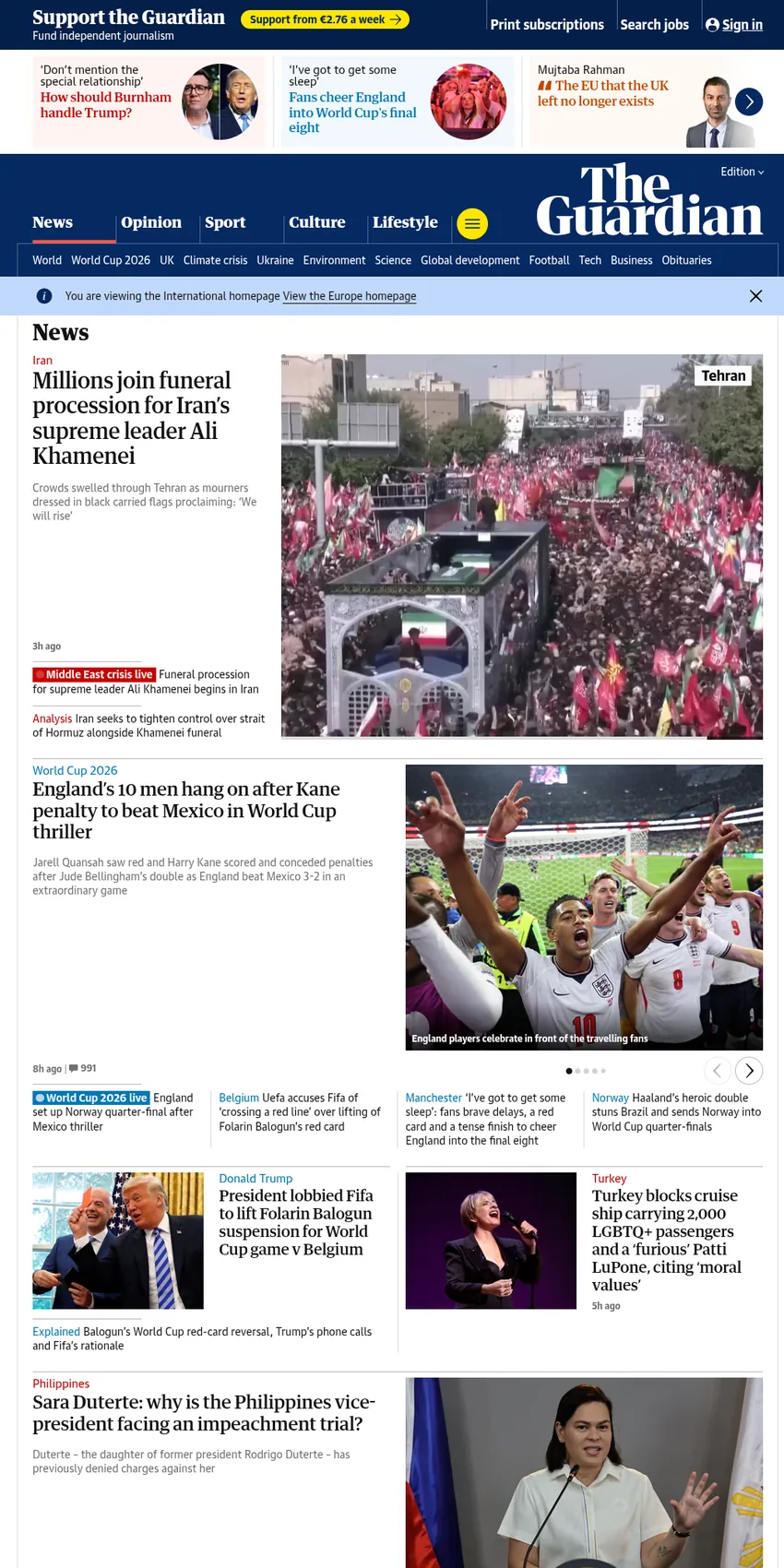
First Edition, the email briefing The Guardian sends out on weekday mornings, costs nothing to receive. The website it points back to runs on the same terms. No paywall interrupts an article, and the support page gives the reason in a single line: the paper is "not owned by a billionaire or shareholders" and is funded by what readers choose to give.
The masthead behind that arrangement is one of the oldest in British journalism. The Guardian was founded in Manchester by John Edward Taylor as The Manchester Guardian, then dropped the city from its title generations later. It has now been publishing for more than two centuries, long enough to become a national newspaper of record with a readership well beyond Britain. Katharine Viner is the editor-in-chief, and the title she edits now reaches readers in editions built for three other continents.
The present operation is a good deal bigger than the word newspaper suggests.
Five editions and five fronts
The Guardian keeps separate digital editions for the UK, the US, Australia, Europe and an international audience, switched through a picker in the page header. Typing the bare address settles nothing; the site reads a visitor's geography and chooses an edition on its own, and the header control is how anyone overrules it. Each of the five carries its own front page and its own running order, so the same masthead opens differently in New York and in Manchester; once a reader knows the picker exists, the choice of front page is theirs.
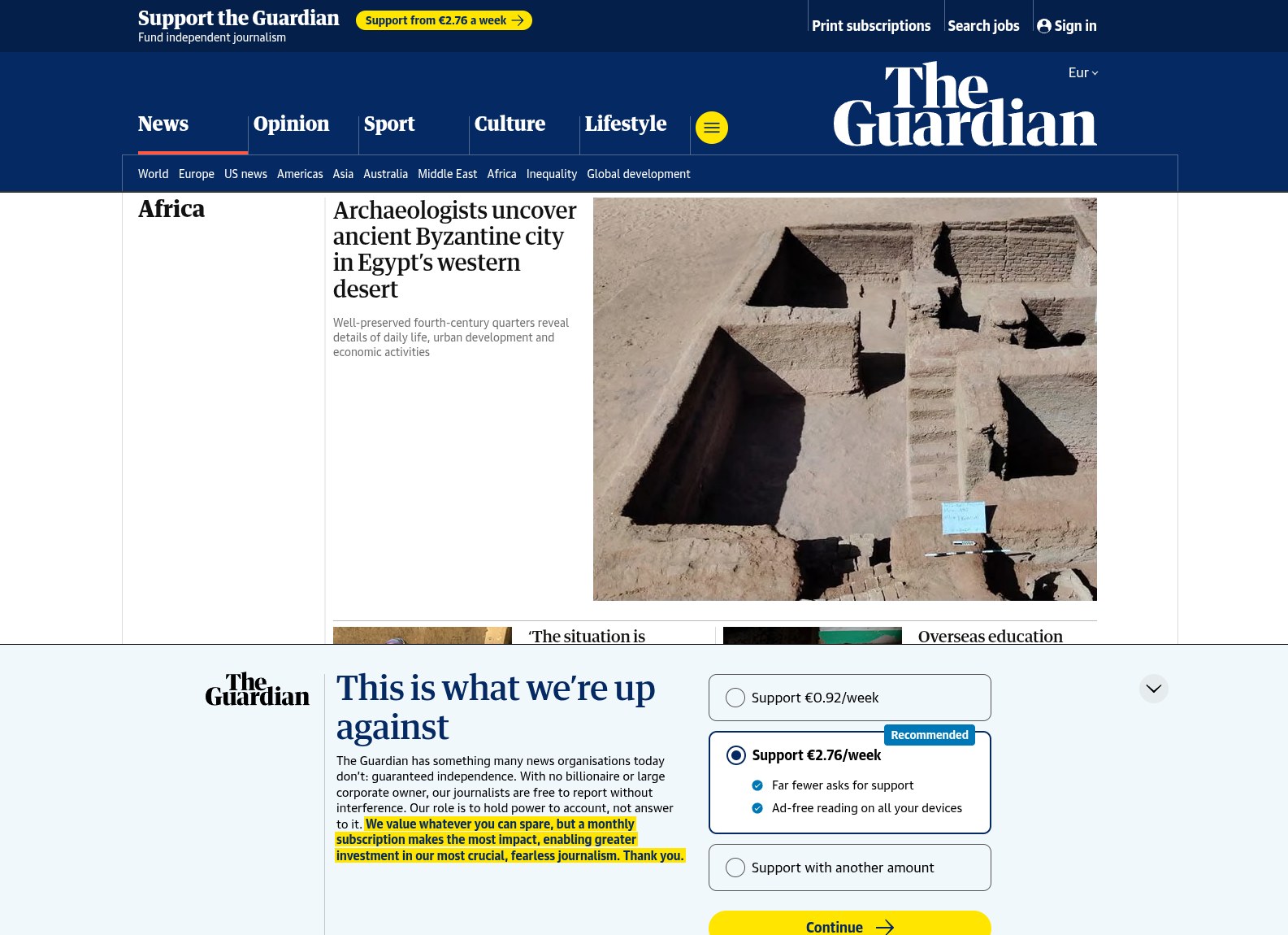
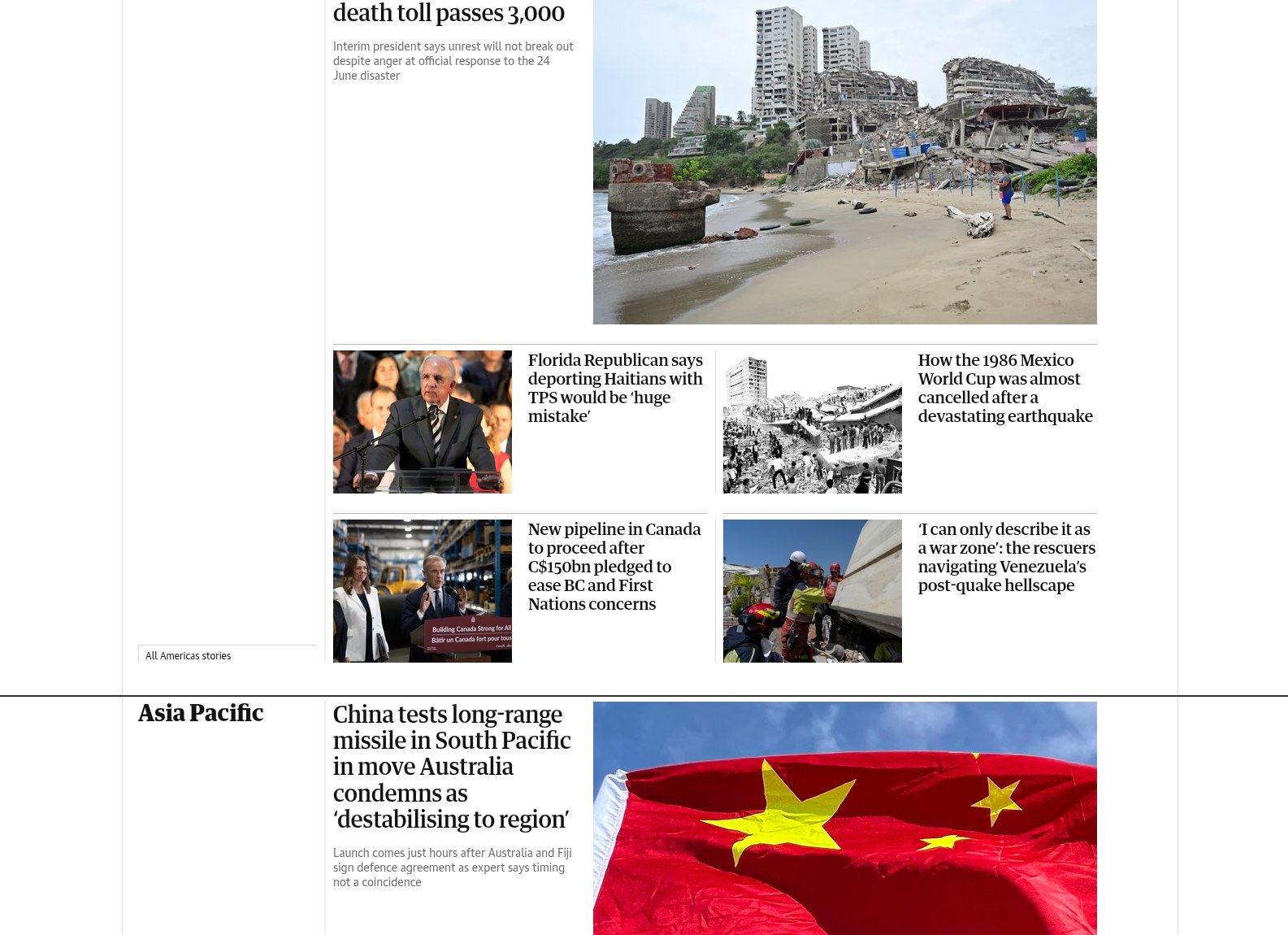
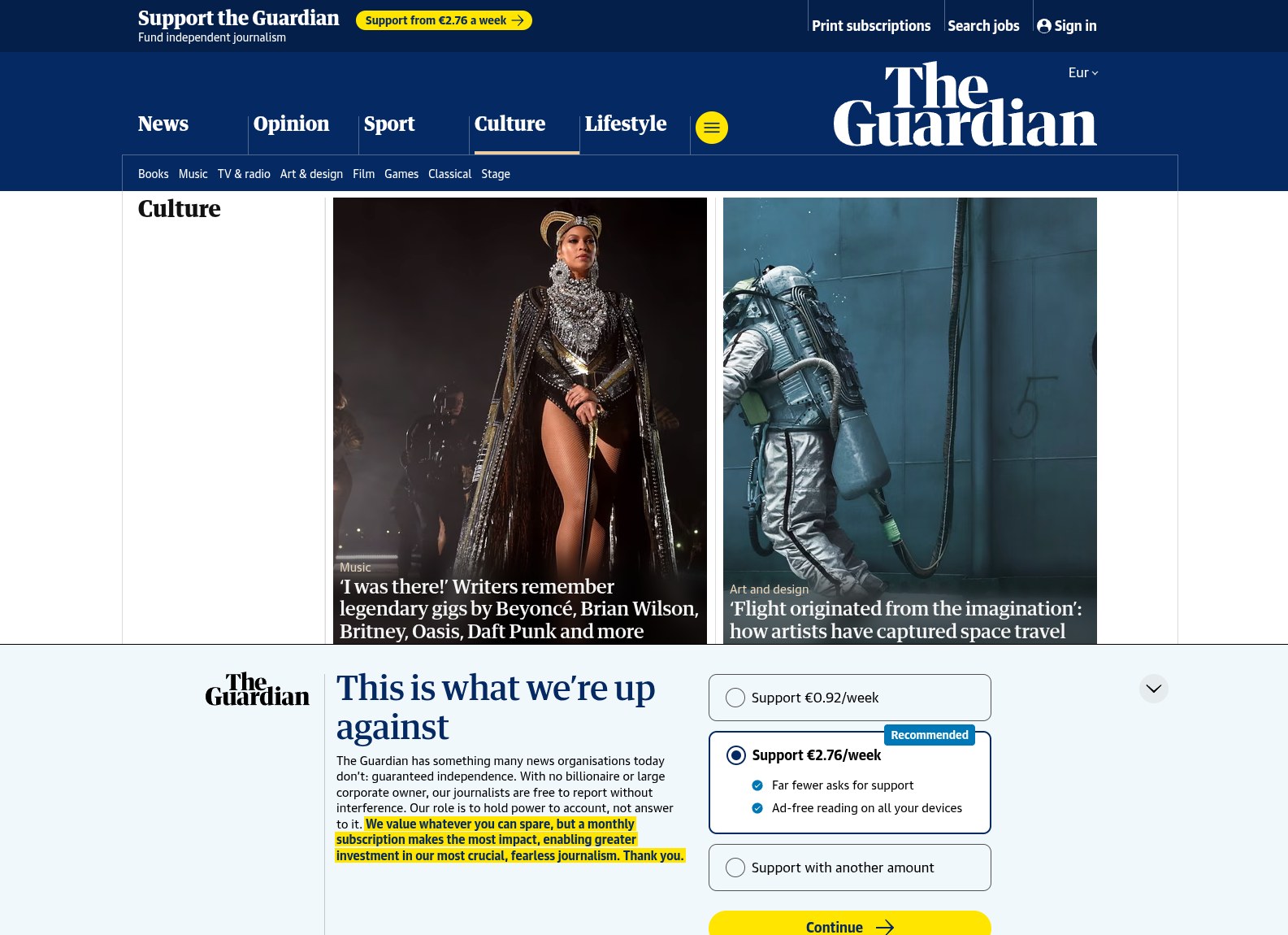
Underneath, the primary navigation stays constant: News, Opinion, Sport, Culture, Lifestyle. Behind those five sit the deeper desks of The Guardian, among them UK news, world news, business, environment, science, tech, football, global development and obituaries, and the world front alone is a regional grid carrying dozens of photo teasers. A general paper that still maintains a global development desk and a working obituaries section has made a decision about what a newspaper is for. Environment and science keep their own places in that lineup as well.
The front page is dense. One load of the international edition brings over a hundred image teasers, which says two things at once: the daily output of The Guardian is enormous, and the homepage is a heavy place to land on a slow connection, with a cookie consent banner in front of it all on a first visit. Some older conveniences survive alongside the weight; full RSS feeds still work, for anyone who prefers to pull headlines into a reader of their own choosing.
Comment is free
Opinion holds equal billing with news at the top of The Guardian, and the section's web address spells out a promise, comment is free. That is considerable architectural weight to give argument. The arrangement keeps reporting and commentary adjacent but separately shelved: columns and editorials get a front of their own, one click from the news they answer, and a reader always knows which of the two is on the screen. The promise in the name is kept at least in structure, with argument plentiful and clearly fenced off from the reporting it sits beside.
A sport front with live scores
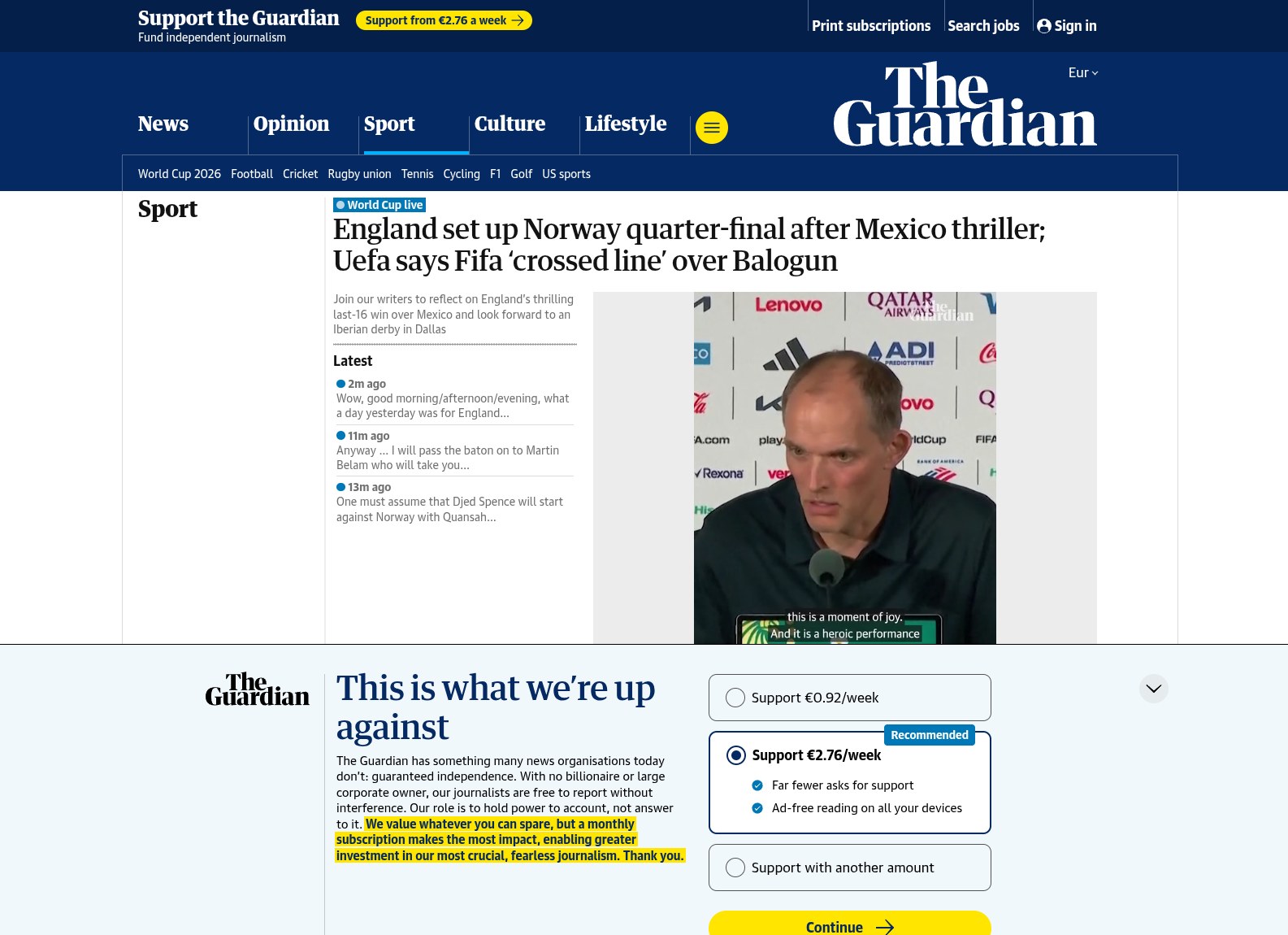
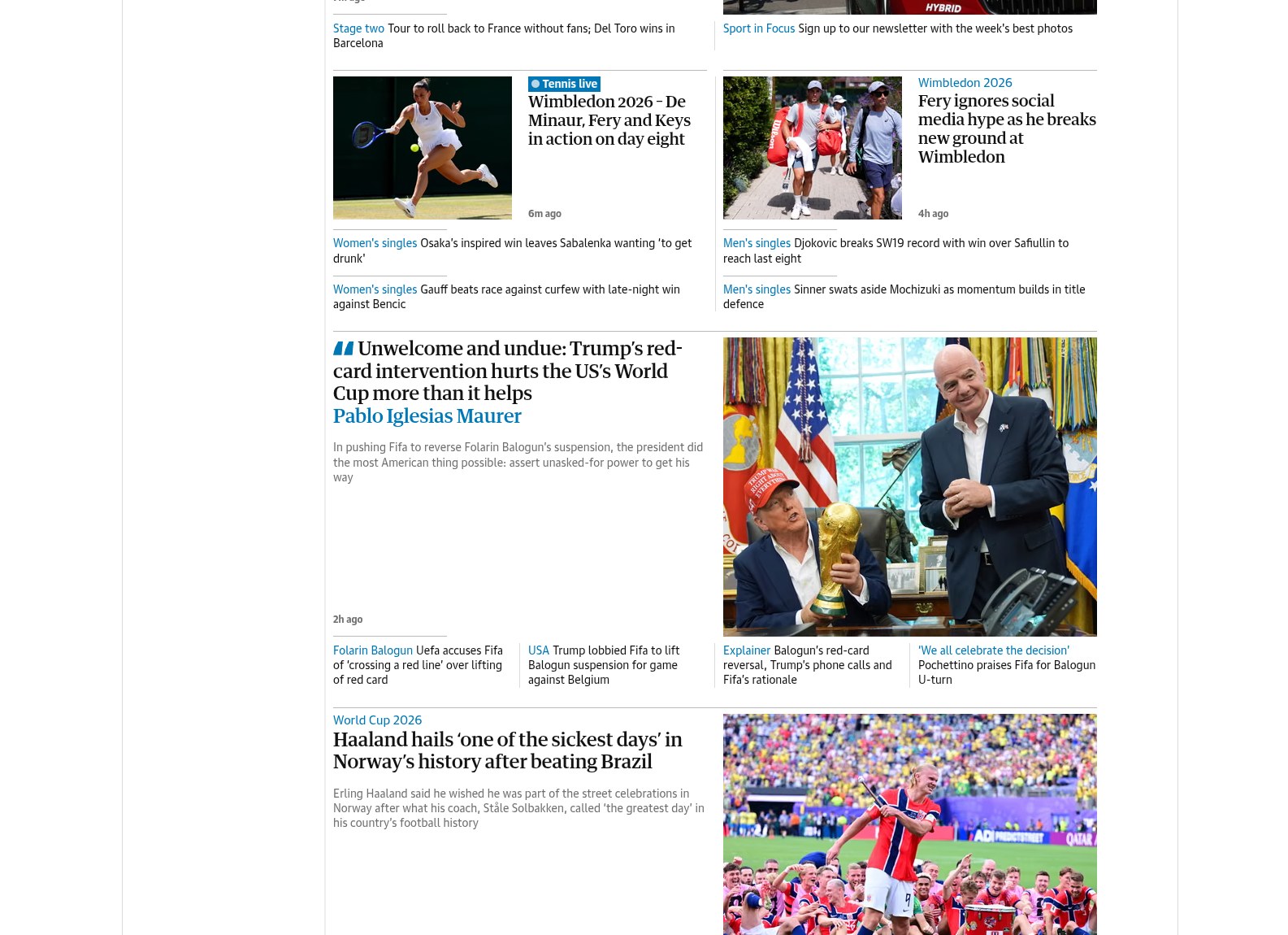
Sport opens on a live scores strip and runs deepest on football, with cricket and tennis in the next rank and fifty-odd photo teasers on the front at any given time. The scores strip alone makes the section usable as a daily utility before a single match report gets read. Taken by itself it would pass for a standalone sports site, but inside The Guardian it is one desk among five, which is a fair measure of the scale of everything else.
Culture, lifestyle and In Pictures
Culture at The Guardian pulls film, music, books, stage and art onto a single front, with posters and production stills doing much of the work. Lifestyle does the equivalent for food, health, fashion and relationships, recipes included, and neither front is thinner than the news pages beside them; the culture pages alone turn over enough material to fill a weekly magazine.
Photography has a desk of its own. An In Pictures hub collects the photo essays, weekend galleries run more than a dozen large captioned news images at full width, and a separate gallery format gives styled fashion shoots the same room. The environment front and the art and design pages draw on the same picture operation. For a site that charges nothing to read, the volume of original photo editing on display is unusual.
Newsletters, podcasts and a weekly in print
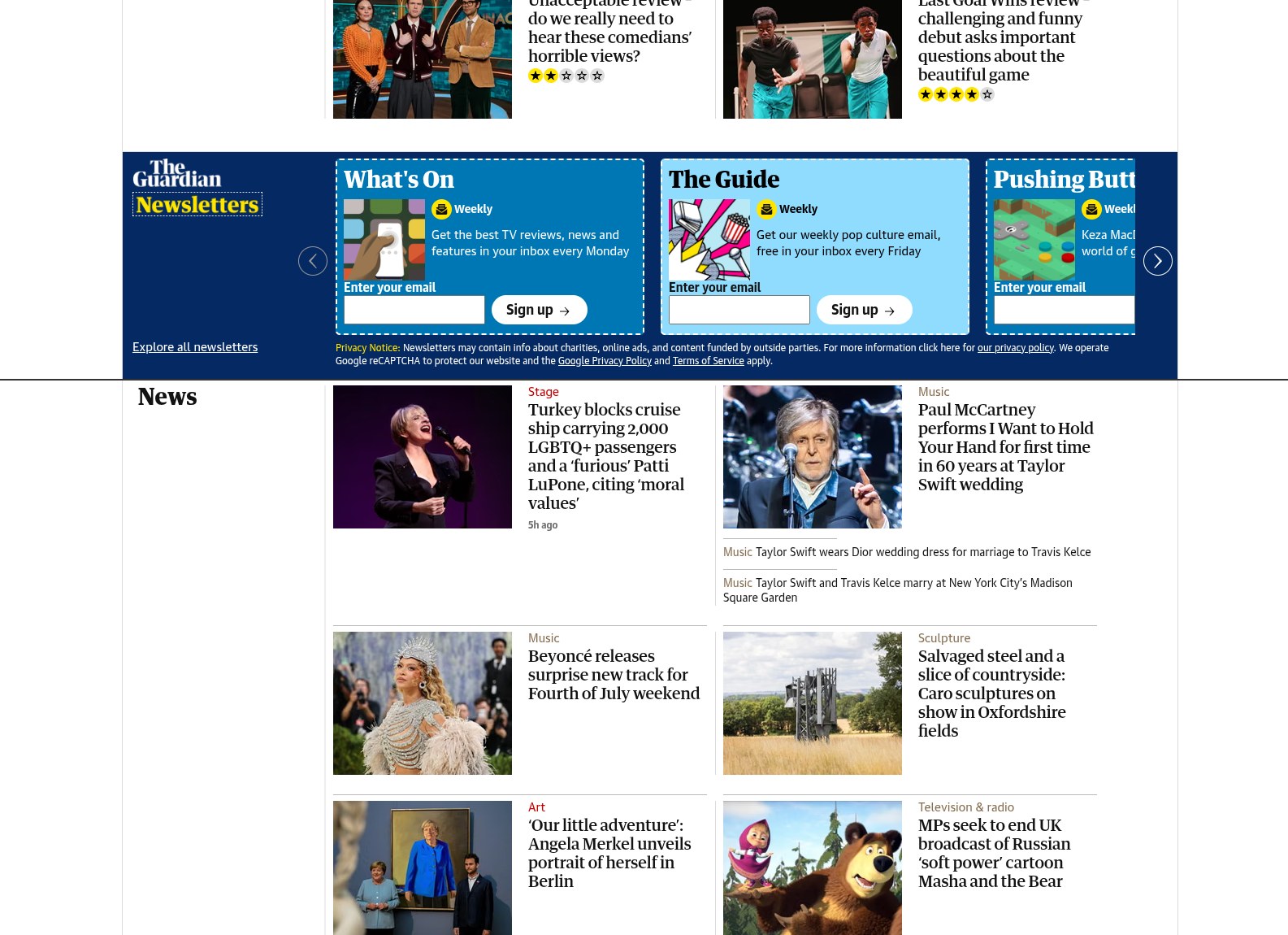
Email is the second front door. Beyond First Edition, The Guardian publishes Feast, a weekly recipes newsletter, with more titles besides, and the pattern holds across the list: signing up costs nothing, and the paper arrives in the inbox so the reader does not have to remember to visit. Feast alone would justify the signup for anyone who cooks.
Audio gets the same treatment. Today in Focus is the daily news podcast of The Guardian; Full Story and Football Weekly widen the slate, and the last of those does what its name promises.
Print carries on around the edges of all this. Guardian Weekly folds the week of The Guardian into an international print and digital digest, the edition aimed at readers a long way from a British newsstand, while The Observer, for decades the Sunday sister title, has been sold to Tortoise Media. The daily paper still appears, but the website is plainly where the operation now lives.
The Scott Trust and the missing paywall
Ownership explains more about this site than any design choice does. The Guardian is published by Guardian News and Media, part of Guardian Media Group, and the chain ends at the Scott Trust, a body that exists to guarantee the paper's editorial and financial independence in perpetuity. Guardian Media Group is the commercial layer; the trust above it is the reason the commercial layer cannot change what the paper is. There is no proprietor to please and no dividend to chase, and the trust has held the paper for the better part of a century with that single instruction attached.
Funding follows from the structure. A membership and subscription scheme runs alongside one-off and recurring reader contributions, and none of it locks the journalism away: those who pay nothing read the same articles as those who give every month. The Guardian makes its case for support on its own pages, at length and in plain terms, and then leaves the decision alone; the same page that asks for money is the one that explains who owns the paper, which is its own kind of disclosure.
None of this is new, either. The membership route has run for over a decade, long enough to count as a working answer instead of an experiment.
In effect, the paper is betting that openness collects more than a gate would.
The case for a visit is short. The Guardian carries the breadth of a full newsroom, five editions, sport and culture sections with real depth, a working photo desk, and no charge at any point of entry. Few newsrooms this size give the whole product away. For a first visit, the world front and the In Pictures hub are as good an entry point as the homepage itself.
The costs are the predictable ones. The homepage is heavy under all those teasers, the geographic redirect will hand a traveller the wrong edition until the picker corrects it, and the same openness that makes The Guardian easy to read makes it just as easy to read for years without paying.
That last point is where an honest account of the site has to end, because the paper has made it the hinge of its own future. More than two centuries on from Manchester, The Guardian depends on readers who are never forced to pay and are trusted to pay anyway, and the journalism keeps arriving daily, in five editions, either way. So the Scott Trust structure quietly hands every regular visitor a personal question: when the reporting stays free because a trust, and no billionaire, sets the terms, is what arrives each morning something worth paying to keep?
Business address
Guardian News & Media Limited
Kings Place, 90 York Way,
London,
N1 9GU
United Kingdom
Contact details
Phone: 020 3353 2000
Award-winning novelist celebrates late partner’s love of birds with gift to establish the Graeme Gibson chair in avian biologyIf…
Israel and the US have used AI to kill in Gaza and Iran, while law enforcement uses it in surveillance and arrests. The future is…
Watch the official trailer for NAZA, an award-winning documentary produced by the Guardian that details the systems behind…
Would you pay thousands to meet the love of your life? In an age of app fatigue, many singles are hiring coaches to help them…