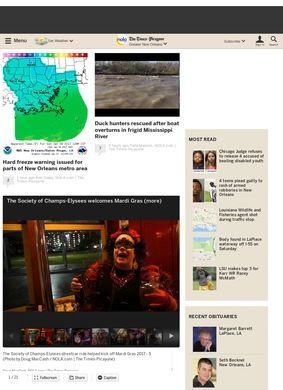
NOLA.com is the digital home of the New Orleans Times Picayune, the city's daily paper now operating under The Advocate, which runs the largest news operation in Louisiana. What lands on the homepage is a general-interest hub for the metro and the Gulf Coast: state politics beside restaurant reviews, crime courts beside prep sports, and a whole weather section that gets treated as a running beat and not a sidebar, which is exactly right for a city where a tropical system can eat a week of news coverage.
Beat-driven news structure
The news structure is beat-driven and broad. Crime, courts, business, education, environment, and politics each carry their own reporters and filing rhythm. That breadth is the real case for the New Orleans Times Picayune as a daily read, because a single visit covers local stories that national outlets do not staff: a courthouse ruling, a school board vote, a levee authority meeting. None of that finds its way onto national aggregators, and the New Orleans Times Picayune is the obvious place a local reader goes to find it.
Sports coverage across all levels
Sports gets serious real estate, proportional to how much the city cares. The Saints and the Pelicans each have dedicated coverage, and the paper does not stop at the professional level. LSU Tigers and Tulane Green Wave content pulls in the college crowd, and high school athletics rounds it out for anyone following a neighbourhood school or a specific team in a local district. Stacking all of that in one place is something a wire service does not do, and it is a practical reason to bookmark the page during football season.
This kind of depth is what keeps a regional paper in the daily rotation. National sports sites cover the Saints; they do not staff a Tulane midweek game or a prep playoff bracket. The New Orleans Times Picayune does both, and the difference is obvious once you are looking for it.
Entertainment rooted in New Orleans
The entertainment and lifestyle section leans hard into the city itself. Dining, arts, music, home and garden, and Mardi Gras coverage share the same section, and the Mardi Gras and New Orleans society features give the New Orleans Times Picayune a texture that makes no sense transplanted anywhere else. That local specificity carries through the food writing in particular, which goes well past listing restaurant openings and closings.
Digital products and subscription model
The publication has built out a reasonable set of digital products alongside the reporting. There is a subscriber-gated e-edition, a page-by-page replica of the print paper for readers who want that format. Email newsletters, photo galleries, and multimedia packages round out how the New Orleans Times Picayune reaches readers who prefer not to browse a homepage every morning.
Opinion columns and letters to the editor occupy their own section, keeping editorial voice clearly separated from the news report. Classifieds still carry public notices, job listings, and home sales databases, which says something about how a metro paper holds onto civic and transactional functions that have largely moved online. An online merchandise store is available for readers who want it, though that is obviously not the draw.
Account management and reader tools
The account management side is functional and unpretentious, which is appropriate. Subscribers can manage billing, flag delivery problems, and adjust their account settings through a dedicated portal. A paper that still runs a physical print operation needs that infrastructure in place, and the New Orleans Times Picayune has it. None of it is novel, but it works, and a paying reader expects it to work.
A fair caution: a substantial portion of the depth, the e-edition and the more detailed reporting in particular, sits behind a paywall. That is standard practice for a regional paper of this size, and the New Orleans Times Picayune is upfront about where the meter kicks in. A casual visitor will hit it before long. How much value the site delivers depends heavily on whether someone is reading the free local headlines or paying in for the full archive and replica edition.
Outside reputation is limited. A search across Google reviews and Yelp turns up a small number of entries, mostly about print delivery complaints rather than the journalism itself, and no aggregate score gives a useful signal about the editorial product. For a newspaper, that gap in third-party coverage is normal; readers rarely leave star ratings for news operations the way they do for restaurants.
Where the New Orleans Times Picayune is hardest to fault is local specificity. Crime and courts, Saints and Pelicans, hurricane tracking, Mardi Gras, the food scene: the reporting is rooted in one metro area and the Gulf Coast around it. A reader in New Orleans, or someone planning to move there, gets a fuller picture from this single source than from any national outlet, because the staff covers the courthouse, the school board, and the high school field, rather than only the stories that happen to go national.
The verdict is solid with one clear qualification. As a regional newspaper, the New Orleans Times Picayune does what it should: local news with real depth, genuine sports breadth across pro and college and high school levels, lifestyle writing tuned to the city, and a working set of digital tools. The reservation is the paywall, which is reasonable but cuts the experience in two. The free tier and the subscriber tier are not the same product, and anyone trying to evaluate the New Orleans Times Picayune from outside the paywall is only seeing part of it. Pay in, and the depth is there.