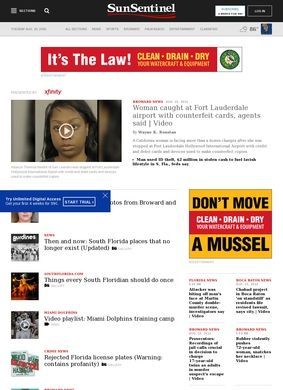
A paid digital subscription sits alongside the printed paper at the Sun-Sentinel, giving readers two routes into the same newsroom. The publication, known in full as the South Florida Sun Sentinel, is the daily that covers Broward, Palm Beach and Miami-Dade counties, and that three-county patch is what defines it. This is a regional metro daily, and the subscription is the paying front door to everything its reporters produce. Between the two formats, a reader can follow the region on paper over breakfast or on a phone through the working day.
A daily built for South Florida
The core product of the Sun-Sentinel is easy to state: daily journalism for the southern end of Florida, delivered in print and online. Its coverage runs across local and regional news, sports, entertainment and business, the standard spread a full metropolitan newspaper is expected to carry, and it is aimed squarely at the residents of the counties it serves. A reader anywhere can get the national headlines; the point of a metro daily is the local layer the national outlets skip.
For a reader in Fort Lauderdale, Boca Raton or Hollywood, that local focus is the entire point. National headlines are available in a hundred places; what the Sun-Sentinel supplies is the county commission vote, the school board decision, the high-school football result, the hurricane track and the courthouse verdict that a national outlet will never bother to run.
The Better Business Bureau files the Sun-Sentinel plainly under the category Newspaper, and the operation works from a Deerfield Beach headquarters, with a separate Fort Lauderdale office also on the record. That physical footprint inside the market it reports on is part of what a local daily is.
The reach across three counties is unusual in itself. Broward, Palm Beach and Miami-Dade together hold several million people, and a single daily trying to serve all three is covering a spread of city governments, school districts and sports markets that would keep several smaller papers busy.
Sports and entertainment matter a great deal in a place like South Florida, where professional franchises, a crowded events calendar and a year-round tourism economy give a daily plenty to write about, and business coverage tracks the developers, employers and property market driving the region. The Sun-Sentinel sits in the middle of all of it as the established local paper of record, the one a household in the area is most likely to name if asked.
Holding that position across so wide a footprint is the Sun-Sentinel's real claim, and it is the thing a newer, thinner rival would find hardest to copy.
Print and digital subscriptions
The Sun-Sentinel carries both a print edition and a paid digital subscription, so a reader can take the physical paper, the online version, or both together. That paywall is how a regional daily like this one funds its journalism now, with subscription income standing in for the classified and display advertising that used to pay for newsrooms. It also means the relationship between paper and reader is an ongoing paid arrangement, and that is where the Sun-Sentinel draws its sharpest criticism.
The Better Business Bureau complaints file for the Sun-Sentinel includes subscribers unhappy about subscription rate increases that landed without warning, the recurring grievance of the paid-subscription model right across the industry. It is a fixable irritation, but a real one, and anyone signing up should read the renewal terms closely and watch what the price does once any introductory rate runs out.
For a household that wants the paper every morning and the website through the day, the combined print-and-digital option is the natural pick, and it is also the one where the renewal figure deserves the closest attention. A reader who mostly wants the website may prefer a digital-only tier, while anyone who values the physical paper on the doorstep has to weigh the print cost against how often it actually gets opened. The choice is straightforward; the billing that follows it is the part to nail down.
How it rates for credibility and service
On the measure that counts most for a newspaper, the Sun-Sentinel comes out well. Media Bias/Fact Check, which assesses outlets for political slant and factual accuracy rather than for customer satisfaction, rates the paper Least Biased on bias and High on factual reporting. For a reader deciding whether to trust what a paper prints, that pairing is a more useful grade than any star rating, and the Sun-Sentinel lands on the reassuring side of both halves of it. A local daily that reports straight and gets its facts right is doing the job a newspaper exists to do.
The service and business record is more mixed, and it needs reading with a little care. The Better Business Bureau lists the Sun-Sentinel as an accredited business with an A-plus rating, which reflects how the company handles complaints and keeps its BBB standing more than the quality of the reporting. A Yelp listing for the Sun-Sentinel's Fort Lauderdale location carries 131 reviews. Between them, those two point at the customer-facing and billing side of the operation, a separate thing from the newsroom's output.
Read together, the A-plus accreditation and the credibility grades suggest a paper that is professionally run on both the editorial and the corporate side, whatever friction turns up on individual subscriber accounts. A company can hold a high BBB mark and still annoy some subscribers over billing; the two facts sit side by side without cancelling out, and a prospective reader should hold both in view. That combination is worth more than any single score pulled out on its own.
Customer reviews versus employee reviews
One distinction is worth drawing before anyone reads too much into the scores a search turns up. The ratings on Glassdoor and Indeed are employee reviews, not customer ones, and they measure what it is like to work at the Sun-Sentinel rather than what it is like to subscribe. Glassdoor shows an overall figure of 2.7 out of five across more than seventy reviews in one snapshot, with only 39 percent of staff saying they would recommend working there to a friend, and Indeed adds a further 54 reviews to the employee side.
A prospective subscriber should treat those as a comment on the workplace and its morale, not on the paper landing on the doormat. The picture that actually bears on a reader is the customer-facing one: the A-plus BBB standing set against the billing complaints, and above all the credibility grades. That is the balance a would-be subscriber to the Sun-Sentinel should weigh.
A South Florida resident after dependable, locally grounded coverage of Broward, Palm Beach and Miami-Dade will find the Sun-Sentinel a credible choice, backed by the Least Biased and High factual marks that count for a news source far more than any Yelp tally. The practical step before subscribing is to check the current print and digital rates and the renewal terms directly, and to ask outright what the price becomes once any introductory offer expires, because that renewal jump is the single thing its own paying subscribers complain about most.