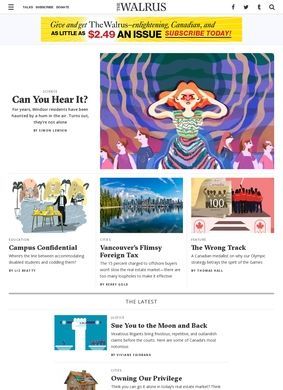
Eight print issues a year, plus a steady run of online editorial that never really pauses, is the working rhythm of The Walrus. Published out of Toronto by the nonprofit Walrus Foundation since 2003, the magazine has kept its scope deliberately wide: current affairs, politics, culture, science and technology, the environment, the arts. The throughline is Canada and how the country sits in relation to the rest of the world. That framing shows up in nearly every section, giving the publication a steadier identity than a general-interest title with no clear geographic anchor tends to hold.
Eight issues yearly plus continuous online coverage
The long pieces are where The Walrus does its most serious work. Investigative reporting and longform essays anchor the front of each issue, and the editorial mix leaves room for fiction, poetry, photography, and illustration alongside the journalism. A reader who arrives for a single political feature can leave having read a short story and looked through a photo essay. That breadth is intentional, not filler. The Foundation behind the magazine operates with a stated educational mandate to inform Canadians about national and international issues, and that purpose is visible in how coverage gets chosen week to week.
Investigative reporting and literary content
Beyond the printed page and the website, content spreads into podcasts and newsletters, so the same editorial voice reaches people who prefer to listen on a commute or read a curated digest in their inbox. The social numbers back this up: more than 80,000 followers on Facebook, over 45,000 on Twitter, and upward of 15,000 on Instagram. Those figures are substantial for a Canadian publication, and they point to a readership that has stayed engaged across platforms rather than congregating in one place.
Reaching readers across podcasts and social media
The Walrus has accumulated a significant run of National Magazine Awards over the years, with wins going back to its very first issues in 2003, and Utne Reader named it the best new publication in 2004. Awards in a debut year are worth noting because recognition at that stage has nothing to coast on. A magazine can trade on reputation later; this one had to earn the recognition when it still had everything to prove. That early momentum carried into the following decade, with the title continuing to take awards across multiple categories.
National Magazine Awards and early recognition
On factual reliability, the independent assessment from Media Bias/Fact Check places the publication as Left-leaning while giving it a High rating for factual reporting and a clean fact-check record. The political lean is relevant context for how opinion pieces are framed. The factual score and the absence of failed checks are a separate matter, and that distinction is the honest way to read a publication of this kind. Lean and accuracy are not the same thing, and the rating keeps them apart.
High factual accuracy with left-leaning perspective
Third-party reader reviews of The Walrus across the usual platforms are sparse. A search turns up little beyond a handful of aggregated scores, none with enough volume to draw a firm conclusion either way. What fills the gap is the awards history and the Media Bias rating, both of which are verifiable against primary sources. The combination gives a clearer picture than reader scores alone would, since awards and independent fact-check ratings come from different evaluative processes and tend to reinforce each other when both are positive.
How does The Walrus serve different readers?
The Walrus also functions as an open door for writers, accepting literary and journalism submissions across fiction, poetry, essays, and reportage. The masthead is not a closed shop. For an emerging Canadian writer that is a concrete opportunity, and it says something about how the title sees its role: a venue that brings new work in. Subscriptions run through the site directly and through third-party distributors such as Express Mag, so getting the print edition is not tied to a single seller. It would also turn up in any reputable Canadian media business directory if you were cataloguing national publications of record.
Open submission process for Canadian writers
What you get from The Walrus depends on what you came for. Someone tracking Canadian politics and policy will find the depth they were looking for. A reader who wants a short story or a photo essay between the heavier features will find those too, and a writer with a manuscript has a real submission route open to them. The print run is augmented by digital content year-round, so the coverage does not fall off between the eight annual issues. The mandate, the awards spread across two decades, and the factual rating all point in the same direction. That consistency across format, subject matter, and independence is unusual, and the published record bears it out.