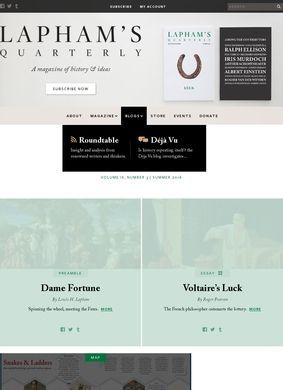
Every issue of Lapham's Quarterly is built around one word. Energy, Disaster, Comedy, Home, Swindle and Fraud: pick up a single volume and you get a few hundred pages on that theme alone, stitched together from voices spanning centuries. Published four times a year by the nonprofit American Agora Foundation, Lapham's Quarterly does something unusual for a periodical. Rather than commissioning fresh reporting on whatever is current, it pulls primary-source excerpts out of the historical record (no, scratch that framing: it does not pull, it arranges). Letters, court documents, novels, speeches, treatises: the editors set them beside each other so a reader can watch the same human problem recur across two thousand years.
How the magazine builds each issue around one theme
The format owes its shape to Lewis H. Lapham, who edited Harper's Magazine for decades before starting this venture. That lineage tells you what to expect from the tone: literate, opinionated, more interested in ideas than in news pegs. What surprised me when I went through the contents was how much of the heavy lifting is done by the dead. A typical issue of Lapham's Quarterly gives you historical passages from writers across the centuries, surrounds them with original essays, maps, charts and graphs, and includes a section called Voices in Time made up of curated historical quotations. The editorial hand shows in the selection and the juxtaposition, not in a torrent of new prose.
Historical excerpts paired across centuries
This is the part worth dwelling on because it is the whole point of the thing. A theme like Disaster or Swindle and Fraud becomes a lens, and Lapham's Quarterly assembles excerpts that approach it from wildly different angles and eras. You might find an ancient account beside a Victorian one beside something from the last century, all speaking to the same idea without any author knowing the others existed. The supporting essays from contemporary writers give context, and the visual material (maps, charts, data presented graphically) breaks up what could otherwise be a dense wall of quotation.
Reading style demands patience with primary sources
It is a demanding read, and that is not a knock. Lapham's Quarterly assumes you want to sit with material, follow a thread of human behavior across history, and draw your own conclusions about what stays constant. Readers who come to history through anecdote and pattern will find a lot here. Anyone wanting straight narrative history, told start to finish by a single author, may find the anthology approach scattered by design. That is a question of taste rather than quality.
Quarterly publication with daily online content
The quarterly cadence matters too. Four issues a year means each volume needs to hold up on its own, and most do, but there is no rhythm of regular delivery to keep a subscriber engaged between them. The free online content fills that gap, which is probably intentional.
Free online sections and podcast
The site carries more than scans of the print product. Several ongoing sections run online and update on their own rhythm. Roundtable collects analysis and commentary from contemporary writers and thinkers. Deja Vu is a blog whose entire premise is drawing historical parallels to current events, which fits the instincts of Lapham's Quarterly almost too neatly. Lapham's Daily is a daily online feature, and there is a free newsletter that arrives by email for anyone who signs up.
Then there is the podcast, The World in Time, which runs conversations with historians and public intellectuals. For people who would rather listen than read, it is a reasonable entry point into the same sensibility that drives the print issues. The Store sells back issues and related books, so a reader who discovers an old theme can still track down the volume. Beyond that, the site lists Events, an Internships page, and a donor program called the Janus Society, which makes the nonprofit funding model plain enough.
Taken together, the online presence means you can spend a fair amount of time with Lapham's Quarterly without paying anything. The Roundtable essays, the Daily features, the Deja Vu posts: they add up to a genuine sample of the editorial voice, not a stripped-down teaser. Someone who reads those and finds the historical-parallel habit compelling will probably want the print volumes. Someone who finds it precious will know that quickly.
Comparing the editorial reputation to business records
The external reputation picture is mixed in an honest way. Goodreads lists individual issues of Lapham's Quarterly separately, each with its own rating, and those land roughly between 3.5 and 4.5 stars, though the vote counts are small, anywhere from about four to forty-two ratings per volume. That is the footprint of a niche literary product, not a mass-market one, and the scores themselves are respectable for that niche. The Better Business Bureau's New York profile is the cautionary note: it exists, and it carries at least one critical customer review about fulfillment and subscription problems, with no aggregate star rating shown. The editorial quality and the back-office experience are separate things, and the BBB record is a reminder of that.
What does the factual reporting actually show?
On the question of slant, Media Bias/Fact Check rates Lapham's Quarterly as Left-Center in bias and high for factual reporting. For a magazine that leans heavily on primary documents, the high factual mark is the more telling of the two. The editorial framing carries a point of view, as any anthology built on selection must, but the underlying material is sourced from the record. That combination (positioned perspective, documented evidence) is worth understanding before you form an opinion about the publication's reliability.
Contact takes a little hunting. There is a contact page, but it sits in the footer under a heading called Connect, and no phone number or street address appears on the homepage. For a print operation that ships physical issues, that low-key approach to contact is a minor friction, and it pairs with the subscription complaints to suggest Lapham's Quarterly puts its energy into the pages first and the customer-service side second. That is an accurate priority for the editorial mission but a practical inconvenience if something goes wrong with a subscription.
The Energy issue, the Disaster issue, the Comedy issue: each is a self-contained argument about how one idea has moved through time, and Lapham's Quarterly stands or falls on how well that argument lands. The free newsletter and the podcast cost nothing to sample, and the online sections give enough of the editorial voice to make an informed decision. If the historical-parallel premise appeals, the print volumes deliver on it. If it does not, no amount of good production will change that, and the online sampling makes it easy enough to find out without spending on a subscription first.