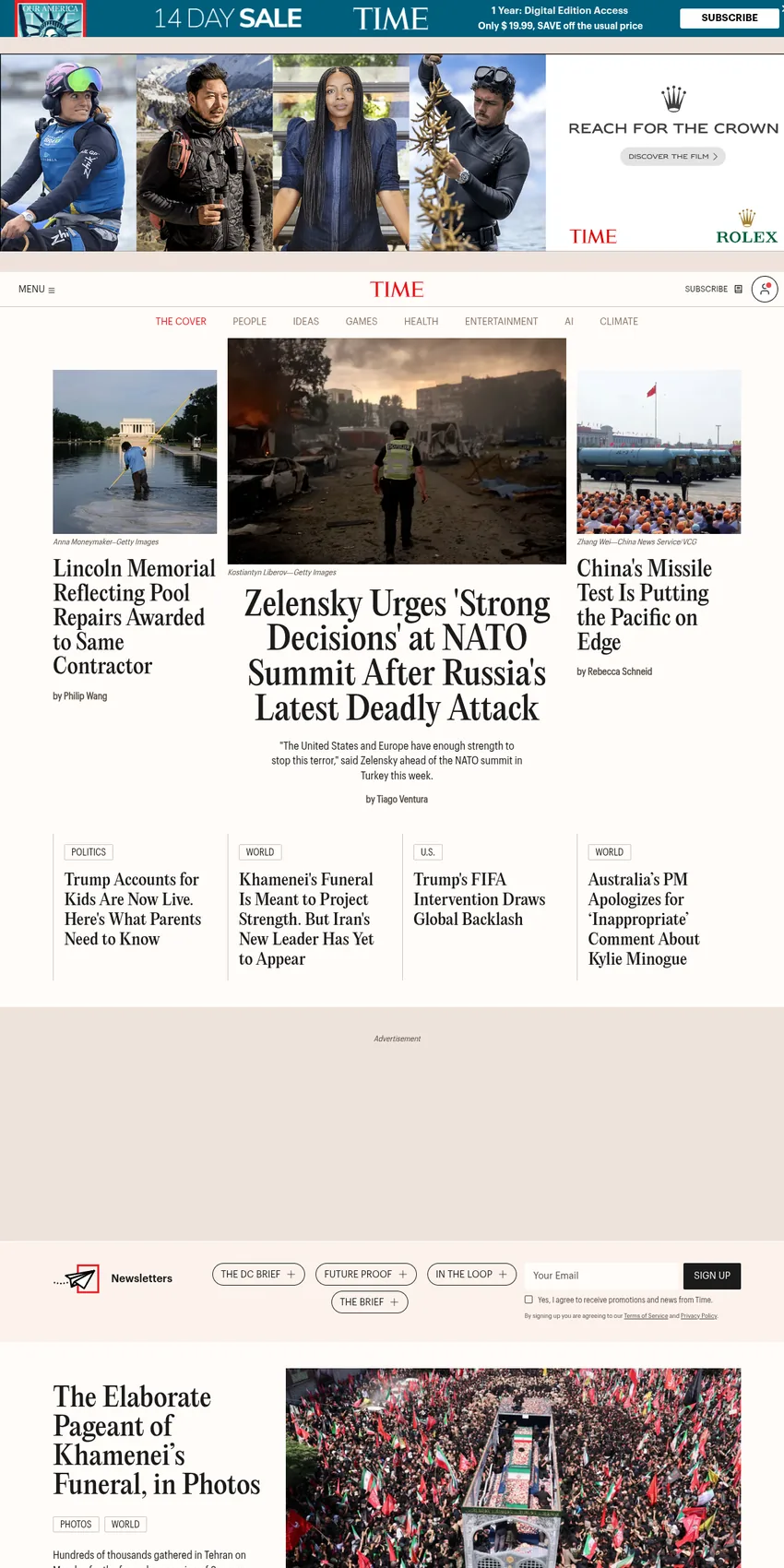
TIME's games page is the strangest corner of the site: a daily puzzle built around the magazine's own covers, a jigsaw, and a market-movers game, refreshed each day for readers who want a break from the headlines. That is an odd amenity coming from the first weekly news magazine published in the United States, and it is a fair signal of what the operation has become. The weekly print edition survives, but the thing living at the web address is a round-the-clock digital publication whose feed declares an hourly update cycle, and the gap between those two products is most of the story here.
Ten section fronts organize TIME's coverage: Politics, World, U.S., Business, Health, Climate, Science, Entertainment, Ideas, and Sports. Each front is an article grid led by photography, much of it wire imagery from AP and Getty run at generous size, with commissioned illustration carrying the lighter features. The feed underneath is clean RSS 2.0, twenty-five items deep, with lead images attached to most of them; anyone who follows the news through a reader app will notice the difference that makes. The Politics, World, Business, Health, Climate, and Science fronts all run deep enough to bookmark on their own.
Section fronts and signature franchises
The homepage mix runs wide. On one visit the lead grid held a China missile test story, an explainer on so-called Trump accounts, a report on Zelensky at a NATO summit, an essay on AI governance, and a feature about what the cost of living is doing to dating. Hard geopolitics, service journalism, and argued opinion share a single front without much friction, and none of it read like filler pushed out to feed an algorithm. The photography does much of the work: big single-image leads over each story keep the grid readable even when a missile test sits beside a dating feature. For a general news weekly working online, that spread is the whole job, and TIME covers it without obvious gaps.
Politics, World, and U.S. carry the hard news. Business and Health handle money and medicine, Climate has a front of its own instead of being folded into Science, and Entertainment and Sports fill out the general-interest side. Ideas is the essay section, single authors making an argument at length rather than reporting it out; the AI governance piece on the homepage grid is the sort of thing it runs.
Person of the Year and the influence lists
Person of the Year remains the franchise most people can name unprompted, and around it sits a family of annual lists: the TIME100 roster of influential people with its Next and Companies offshoots, plus Best Inventions and World's Greatest Places, which apply the same formula to products and to travel. The reveals get treated as news events far beyond TIME's own pages; the global press picks them apart every cycle, which is distribution most publishers can only envy.
Institutional list-making is easy to roll your eyes at, and TIME leans on it hard. The lists do real work, though. Each edition sets off a public fight about who made the cut and who got robbed, and a fight at that scale is a form of reach that page views cannot measure. A publication has to matter to a great many people before strangers will bother being angry about its rankings, and strangers reliably get angry about these. The franchises age well, too, since each new list can be read against all the earlier ones.
The Vault archive
The TIME Vault is the feature that most separates this site from other news homepages: a digital archive of magazine issues reaching back to the title's first year of publication. Very few outlets keep their full run within reach of a browser, and fewer make the archive a named destination with its own address on the site.
The archive pays off for two different audiences. Researchers and students get a century of primary-source coverage, the news as it read before anyone knew how events would turn out. Casual visitors get the covers, which double as a running history of graphic design and of what once counted as the story of the week. I went into the Vault to check a single issue and surfaced forty minutes later somewhere in the middle of the Cold War, which is the normal hazard of the place. As a companion to the daily news operation it gives the site unusual depth; few publications can put their own first drafts of history a click away from the current ones.
Ownership, policies, and the commercial arms
Marc and Lynne Benioff own the title through TIME USA, LLC, following a purchase from Meredith Corporation for $190 million that CNN, Forbes, and Nieman Lab all covered. Ownership by one wealthy couple is a fact worth weighing with any news organization. The arrangement here is at least public and thoroughly documented, so a reader can decide for themselves how much it matters.
TIME's About page claims an audience of more than 100 million people worldwide across its platforms, plus a social footprint past 51 million spread over Facebook, X, Instagram, LinkedIn, and YouTube. Those are the company's own figures, and self-reported reach numbers deserve the standard discount. Even after applying it, they describe a publication operating at a genuinely global scale. It is an unusual entry to find in a business directory built mostly around local shops and small service firms.
The accountability pages tie the whole thing together. TIME publishes a formal Ethics Policy, a corrections policy, and a full editorial masthead naming the people responsible for the coverage, top to bottom. Those documents give a reader something concrete to hold the journalism against: named editors and a paper trail for errors. Few readers will ever open the corrections policy, but its existence changes the incentives for the people writing under it. Their value grows as the company's commercial ventures multiply, which they have.
The Studios, CO2 and Stamped arms
TIME Studios produces film and television, and it is only one piece of a busy commercial side. Red Border is the in-house branded content studio, which means sponsored work built to sit alongside the journalism; keeping that output under a named studio makes it easier to identify than sponsored pieces scattered loose through a site. TIME CO2 is a climate action platform, a curious sibling for a newsroom that runs an editorial Climate desk, and the two should not be confused with each other.
Then there is TIME Stamped, a recommendations and e-commerce operation created in partnership with Taboola. None of this is unusual for a legacy publisher funding a large newsroom, and the About page lays it out in plain language. It does put a small burden on the reader to keep the categories straight. Stamped's product picks and Red Border's sponsored output are commerce, and the ethics and masthead pages are where the line between that and the reporting gets drawn.
TIME sells subscriptions for the print magazine and for digital access, and the weekly issue keeps going out on paper, a century after the first one. The cover puzzle resets every day.




Business address
TIME USA, LLC
3 Bryant Park, 6th Floor,
New York,
NY
10036
United States
Contact details
Phone: 1-800-843-8463
The conversation is now all about energy security, competitiveness, and affordability.
China’s Xi Jinping announced during his state visit to the U.S. that two new pandas would arrive soon at a zoo in Atlanta.
HBO's glossy billionaire divorce drama has all the elements of prestige TV but no perspective on the world it's depicting
As pressure mounts for Congress to address the risks of artificial intelligence, lawmakers are finding little agreement on what…