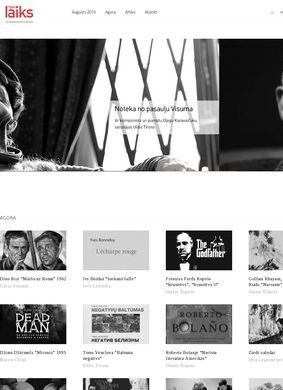
A piece filed under raksti, the articles section, carries the title "Heidelbergas Sokrats," a study of a philosopher written for a general Latvian readership. That single title tells you the register Rigas Laiks works in: long essays on culture, philosophy, politics and history, written for people who want the whole argument in front of them instead of a paragraph of summary.
Rigas Laiks is Latvian and independent, and it comes out monthly. It describes itself with the plain word neatkarigs, meaning independent, which for a cultural title in a small language market signals a genuine editorial stance and a willingness to answer to its readers instead of a larger media group. A separate Russian-language edition appears four times a year, widening the readership past Latvian speakers to the large Russian-reading public across the Baltic states and beyond them.
Publishing in both languages is a real editorial decision in a country where the two communities do not always share the same press, and it lets a single set of essays reach two audiences that rarely read the same magazine. The quarterly cadence on the Russian side, against a monthly one in Latvian, also says something honest about where the resources sit: the home-language edition is the flagship, and the Russian version is a considered supplement rather than a full mirror of it.
The editorial mix at Rigas Laiks holds steady from issue to issue. Investigative reporting sits beside long interviews and profiles of public figures in Latvia and abroad, and the effect is that of a serious journal of ideas, closer to a quarterly review than to a weekly news magazine. The interviews in particular are described as in depth, which in this context means genuine conversations given room to develop, the kind a reader finishes feeling they have followed a real line of thought.
For anyone who has no Latvian, there is still a way in. The magazine runs a companion English-language publication, Rigas Laiks Conversations, on its own separate site. That title is described as an independent magazine known for non-fiction writing and long interviews on philosophy and culture, and it operates on reader registration with paid digital subscriptions. An English speaker curious about the parent journal can read here without the language barrier, a sensible bridge for a publication whose standing carries further than Latvian does.
Inside a Latvian journal of ideas
The public face of Rigas Laiks divides into a handful of distinct parts, each aimed at a slightly different reader and each doing a different job. The two magazines are the heart of it; the app, the small-books section and the social feeds sit around them.
None of those smaller parts would matter much on their own. They exist because the two magazines built an audience worth serving through other channels, so it makes sense to start with the writing itself before getting to the app and the feeds.
The raksti and its essays
The raksti section is where the core of the writing lives. These are full-length essays, the sort of pieces that assume a patient reader and repay the patience with depth, and the philosophy study named earlier is a fair sample of the altitude the magazine works at. Because the Latvian edition comes out every month, those essays accumulate into a substantial back catalogue, so the archive is worth as much as any single current issue to a reader willing to dig.
Rigas Laiks has built its name on exactly this kind of writing, and it is the reason the title gets talked about in European cultural circles well outside Latvia. There is a cost to this format, and it is worth naming: long essays and extended interviews ask more of a reader than a news feed does, so the magazine is squarely aimed at people who already want that depth and will make time for it.
That is a narrow audience by the standards of mass media, but it is a loyal one, and a publication built for it tends to hold its readers for years.
The English-language Conversations
Rigas Laiks Conversations is the outward-facing half of the operation for the non-Latvian audience. The territory is the same, non-fiction and the extended interview, and access runs through free registration with paid tiers for full digital reading. That paywall is worth being clear about: the sampling is open, but the substance sits behind a subscription, which is the standard model for a serious magazine that pays its writers and cannot lean on advertising alone.
For a reader outside Latvia, this English site is the practical entry point, and it is the version most people abroad will actually meet. Registration costs nothing and lets a curious visitor gauge the tone before deciding whether the paid tier is worth it, which is a fair way to run a paywall and better than hiding everything behind a sign-up wall from the first click.
The app, the small books, and the social feeds
Beyond the two editions, Rigas Laiks keeps a few smaller channels running. There is a Rigas Laiks App, a Facebook page, and an X account posting under the handle RigasLaiks. A section called mazas gramatinas, or small books, also exists, though at the time of searching it was showing as under maintenance, so its current shape is hard to judge. None of these extensions changes the basic proposition. The writing is the product, and the app and the feeds are ways of getting it in front of people who might never pick up the print magazine.
The company behind all this is registered as SIA Rigas Laiks, and a professional-network profile files it under book and periodical publishing, privately held, with a headcount reported in the fifty to two hundred band. That is a sizeable staff for an independent cultural magazine, and it points to a proper organisation running the two editions, the subscriptions and the digital side, not a small circle of contributors doing it in their spare time. It also fits the scope of what is on offer, which is more than a single title could plausibly sustain on a skeleton crew.
Contact is where the record has the least to offer, and it is fair to say so plainly. A Riga postal address recurs across the Rigas Laiks site, turning up in the footer consistently enough to read as the registered base of the publisher. What does not surface is a phone number or an email address, and no standalone contact page appeared in the search results.
For a subscription publication that gap is minor, since registration and payment are handled online and most reader business runs through the account system, but an editor or contributor hoping to reach the office directly is left with a postal address and little else.
There is little outside opinion to weigh. No consumer review platform carries star ratings for Rigas Laiks, which is normal for a literary journal, and searches instead surface editorial descriptions from European journalism outlets and press directories alongside unrelated travel reviews of the city of Riga. Those press references do useful work: they place the magazine among recognised European cultural publications instead of leaving it an unknown quantity, even if none of them is a review a shopper could compare against a rating out of five.
A reader judges a magazine like this by reading it, and the external record is enough to confirm it is a real and respected title. It helps to be clear about what this means in practice: a would-be subscriber cannot line up dozens of customer verdicts the way they might for a consumer product, so the decision rests on sampling the writing and trusting the reputation the press notices point to.
For a cultural journal of this kind, that is the ordinary way of things, and the absence of star ratings says nothing bad about the work itself.
Strip away the app, the small books and the social feeds, and what is left is still two working magazines putting out long-form writing on a fixed schedule, one monthly and one quarterly. That is the part of Rigas Laiks worth judging the rest by.