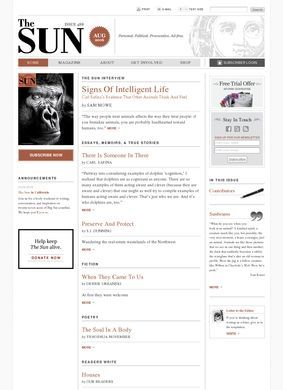
Surviving more than fifty years in print, funded entirely by subscribers and carrying no advertisements, is an unusual fact about any magazine. The Sun has managed it, and the model shapes everything from the editorial line to the way the website is built. No banner ads, no sponsored content, no commercial partners with a stake in what gets published. The money comes from people who pay to read it, which is about as direct an accountability structure as publishing gets.
Original fiction and essays
Each issue carries original short fiction, poetry, personal essays, and long interviews. The editorial direction runs toward intimate, socially conscious work, the kind of confessional writing that does not always fit comfortably in commercial glossy magazines. One recurring feature, Readers Write, invites subscribers to respond in writing to a given theme, so ordinary readers appear alongside professional contributors in every issue. Photography runs through the print product as well, typically black and white and quiet in its approach. The Sun has kept this format steady for decades, which is itself a statement about editorial discipline.
Inside the subscription platform
The website is a clean extension of the print operation. Print subscriptions, digital subscriptions, and combined options are all available, with Stripe handling payment processing, a standard and trustworthy route. Single issues can be purchased for anyone who wants to test before subscribing. The feature worth flagging most is the open archive: past articles are freely readable without any account or payment. For a publication with no advertising income that could easily justify paywalling its back catalogue, offering it freely is a genuine decision, and it lets a curious reader form a real opinion about the editorial sensibility before spending anything.
Writers get clear guidance as well. The Sun posts its submission guidelines openly, specifying what the editors want for fiction, essays, and poetry and how to send work. That fits the character of a magazine built on reader participation. A publication that treats subscribers as contributors has good reason to keep its submission process visible and accessible.
Who reads The Sun?
On the question of audience, The Sun is narrow by design and shows no sign of apologizing for it. People interested in literary nonfiction, creative writing, and independent journalism will recognize the territory at once. Anyone expecting lifestyle service pieces, celebrity coverage, or breaking news will be somewhere entirely wrong. The magazine has done one thing for a long time and the consistency is part of what its long-term readers value. Media Bias/Fact Check has described The Sun as carrying a clean fact-check record with high factual reporting standards, which counts for a publication that mixes personal essay with reportage and relies entirely on reader trust.
Third-party rating data is limited and the picture it gives is uneven. Trustpilot carries two reviews averaging 3.1 out of five, which is too small a number to mean anything. Two opinions are not a verdict on a fifty-year-old publication. Goodreads is more informative: reader comments there run consistently positive, with long-term subscribers returning again and again to praise the editorial quality and the ad-free model, even though no aggregate score is attached to The Sun as a distinct listing. No BBB, Yelp, or Google review tallies appeared in a search.
The honest read of this is that devoted long-term readers are vocal in their support on literary platforms, while the general rating aggregators have almost no data on The Sun at all. That gap is common for niche literary titles that never sought a mass audience, but it does mean anyone wanting independent verification has to look at the longevity record and the free archive rather than star ratings.
Finding contact information
On contact, the site has an About page with organizational background, a navigation route to a contact form, and a submission portal, so reaching The Sun is possible. A phone number and postal address are not prominently placed on the homepage, which means a first-time visitor has to navigate to find them. For a subscription operation that processes payments and solicits manuscripts, surfacing those details more plainly would reduce friction for new visitors. It is a small improvement waiting to happen.
The reader-supported model explains a great deal about the editorial tone. When no advertiser has a stake in the pages, choices answer only to editors and subscribers, and you can feel that independence in the kind of writing The Sun is willing to run. Slow, difficult, personal pieces survive because no media buyer needs to be kept comfortable. That is a concrete editorial advantage, the direct consequence of turning down advertising money for fifty-plus years.
Fifty years without advertising
Longevity is worth pausing on. Most literary magazines fold inside a decade. The Sun has kept publishing monthly across a period when most of the print industry contracted sharply, and it did so without the cushion that advertising usually provides. Running that long on subscription income alone points to a loyal readership and a disciplined operation. The open archive fits this picture: an organization confident that the work itself will draw new readers in does not need to lock the back catalogue away.
Any honest note of caution here applies to the format as much as the publication. The confessional, unhurried style of The Sun is specific, and a reader who tries several archived essays and feels nothing will probably not enjoy a full subscription. The Sun makes that sampling easy and free. That alone is a fair gesture from a publication that leads with an ad-free, reader-funded model: the evidence is there in the archive, and the price of being wrong about fit is an afternoon, not a year's subscription fees.
Taken together, The Sun presents as a serious, self-funded literary magazine with a clear identity and a long record of delivering on its promises. The offering is coherent, the archive is open, the payment handling is standard, and the editorial standards have held up to outside scrutiny. The limited third-party rating data and the slightly buried contact details are soft spots but not disqualifying ones. What remains most striking is the central fact The Sun leads with: more than fifty years of monthly publishing, no advertising, paid for entirely by readers who keep renewing.