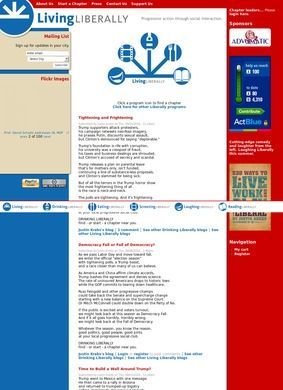
What is Living Liberally, and what does joining one of its chapters actually involve? The site answers the first part in its own navigation, under a tab that spells out the question word for word: it is a grassroots progressive community-building network, a set of local clubs where left-leaning people meet in person, socialize, and get pulled a little further into political activity. The second part is the more interesting one, and the homepage answers it by handing you a map.
How the chapters are organized
The whole model rests on the chapter, a local group that meets on a regular rhythm somewhere ordinary, a bar or a dining room or a screening. Living Liberally began in New York City as a single format called Drinking Liberally, then spread outward under a parent organization it carried before a later rename. The idea it kept is simple: give people an easy door into progressive involvement and use plain social contact to nudge that into action.
Two things make that structure legible from outside: the different formats a chapter can take, and the map that shows whether one already meets nearby. The next two sections take each in turn.
The formats, from Drinking Liberally to Screening Liberally
The chapter types are where the character shows. Drinking Liberally is the original, and around it sit Laughing Liberally, Dining Liberally, Eating Liberally, and Screening Liberally, a film series built around political documentaries and discussion. The names are a running pun, and they carry a real point, which is that each format meets a different appetite for how public a person wants their politics to be.
Someone who would never show up to a rally might turn up for a drink or a movie. That range is the cleverest thing Living Liberally does, because it gives a hesitant newcomer a low-stakes way in and lets a chapter grow its own character depending on which format its regulars favor. That is the whole wager of Living Liberally, and the chapter list makes the wager legible at a glance.
Finding a chapter on the map
The homepage centers an interactive map keyed to US state. Every one of the fifty is clickable, along with the District of Columbia, Puerto Rico, and an International option for chapters outside the country. Click a state and you get its local groups. Find nothing there, and the site does the sensible thing: a "Can't find a Chapter? Start One!" prompt sits ready to turn a dead end into an invitation to organize.
For a network that lives or dies by local density, putting the map first is the right call, though the map is only as good as the chapters currently behind it, and coverage on a volunteer network like this tends to be uneven from one state to the next. A big metro area might have an active Living Liberally group meeting every week, while a whole state shows a single dormant pin or none at all.
The map is honest about that, which is to its credit, but it also means a first visit can end in a shrug as easily as a meetup.
What holds the network together
Between meetups, the thing that gives Living Liberally a pulse on the web is its writing and its sign-in wall. Neither is huge. Both tell you something about how the operation runs day to day.
One half of that pulse is a recurring column from a named writer. The other is what sits behind the sign-in wall, and what little turns up when a person goes looking for outside reviews.
Justin Krebs and the homepage column
The front page runs a recurring column of short, poetic political commentary by Justin Krebs, tied to current events in US politics and updated often. It gives Living Liberally a voice, which many organizing hubs lack entirely, and the freshness of the posts is a quiet signal that someone is actually tending the thing.
The verse format will not be to everyone's taste. It does, though, keep the homepage from feeling impersonal, and it anchors Living Liberally to a named human instead of an anonymous committee.
Signing in, and what stays out of view
Past the About tab, the Chapter Types listing, and that map, the public surface doesn't offer much. A Sign In link gates the member and organizing tools, so a curious first-timer sees the pitch and the geography but not much of the machinery underneath. That is a defensible design for a members' network, yet it comes at a cost on the contact side.
No phone number, email, or mailing address surfaced on the pages that load openly, and the third-party nonprofit profiles that list Living Liberally do not fill that gap either. If a would-be organizer wants a human to answer a question first, the route to one is not obvious.
As for how Living Liberally reads to outsiders, there is little to report. No Google, Yelp, Trustpilot, Facebook, or Better Business Bureau ratings turned up in a search. What comes back instead is descriptive: a Wikipedia entry, listings on Idealist and Catchafire that catalog it as a nonprofit, and a profile on Influence Watch, a conservative-leaning organization tracker, that describes its structure and history. None of that is a consumer verdict. It confirms the group exists and does roughly what it says, and nothing more.
For a network built on face-to-face meetups, that near-silence online is not surprising, since the people who show up to a chapter night are unlikely to file a star rating afterward.
Living Liberally lands somewhere honestly lukewarm. The concept is sound and genuinely appealing, the format list is clever, and the map plus the start-a-chapter prompt lower the barrier to entry about as far as it can go. The catch is that everything depends on whether a live chapter exists near you, and the open web gives you no easy way to gauge that ahead of time, or to reach an organizer if it does not pan out.
As a front door to progressive socializing, Living Liberally is welcoming and clear about its intentions. As a reliable path to an actual meetup on a given night, it asks a newcomer to take a fair amount on faith.