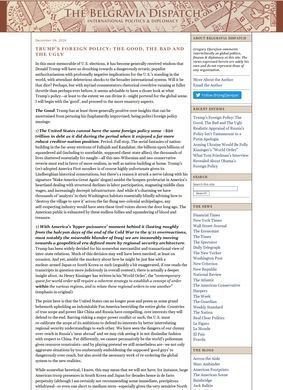
Gregory Djerejian wrote The Belgravia Dispatch from London, where he lived in the Belgravia district, and the blog's running subject was American foreign policy as seen by someone watching it from across the Atlantic. The posts dug into U.S. conduct on torture during the Iraq years, the wider Middle East, NATO, and the state of transatlantic relations. This was long-form argued commentary, not headline aggregation. Anyone coming to it today should know one thing up front: the site currently returns a 500 error and will not load, so what follows is a verdict on the body of work the address points to, not a live experience of clicking through it.
Origins in London and transatlantic perspective
The archives reach back to at least March 2003, placing The Belgravia Dispatch squarely in the period when independent political writing online still carried real weight in the wider conversation. Djerejian wrote in his own name, with a consistent point of view, and he stayed on the harder questions instead of chasing whatever was loudest that week. The Iraq War and the legal and moral arguments around interrogation and detention come up repeatedly, treated as matters to reason through rather than slogans to repeat. That is the texture of the thing: a single author, a defined set of preoccupations, and enough volume over the years to amount to a genuine record.
Long-form analysis of Iraq and foreign policy
What gives The Belgravia Dispatch its standing is citation, not self-description. Crooked Timber, Outside the Beltway, and Foreign Policy all pointed to The Belgravia Dispatch at various points as a serious international-affairs blog. The recurring note in those references is worth pausing on: Djerejian wrote from a right-leaning position, yet readers across the spectrum treated The Belgravia Dispatch as a source of real analysis instead of partisan talking points. Being taken seriously by people who did not share his politics is a harder thing to earn than a stack of agreeable comments, and it tells you more about the quality of the writing than any rating would.
Recognition from peer publications
The honesty here has to cut both ways. The Belgravia Dispatch was already winding down well before its server gave out. By 2011, outside observers were noting, with some affection, that new posts arrived roughly once every nine months, which is another way of saying the blog had effectively gone quiet. The most active stretch was the mid-2000s, and the trickle that followed through the early 2010s reads like the slow close of a project the author had moved on from. This is not a resource you visit for current commentary on anything happening now. It belongs to a finished chapter.
Decline and archive status
That changes what kind of value The Belgravia Dispatch holds without erasing it. A defunct blog with a deep archive of well-argued foreign-policy writing from the Iraq decade is a primary-ish document, useful to anyone studying how the war and the surrounding debates were processed in real time by thoughtful people outside the official channels. The catch is the 500 error. If the live site stays down, the writing is only reachable through web archives or the third-party references that quote it, and a reader will have to do that legwork themselves. The address as listed does not currently deliver the goods.
Access and technical problems
On the practical side, there is little to report and it is better to say that plainly. With the site returning an error, no contact route could be confirmed, and none surfaced in outside references either. For a personal commentary blog that is unremarkable; readers of this kind of writing generally reach an author through comments or social channels, not a switchboard. Anyone hoping to get in touch with Djerejian through The Belgravia Dispatch itself will not find an obvious way in at present.
Citation as the measure of reputation
As for formal reputation, there is nothing to weigh: no Google, Trustpilot, or Yelp entries, no star ratings, no review counts. What exists instead is the citation trail, and for a blog of this type that is arguably the more meaningful gauge. Being named as a notable international-affairs voice by Foreign Policy and by sharp group blogs on both sides of the aisle is recognition that came from peers who read the work. It does not translate into a number, but it is not nothing, and the absence of a rating profile is no surprise for a personal political blog from the 2000s.
Value as historical record
So where does that leave the verdict? The Belgravia Dispatch was, by the evidence, a substantive and well-regarded political blog whose best years are behind it and whose front page no longer loads. If the foreign-policy arguments of the 2000s interest you and you are willing to chase the archive through other means, the writing rewards the effort and Djerejian's reputation holds up under inspection. If you want something live, current, or easy to reach, this listing will disappoint, and there is no point pretending otherwise.
Conditions for using this archive
The Belgravia Dispatch is best understood now as an archive worth knowing about rather than a site worth bookmarking. The recommendation is conditional on your tolerance for digging up writing that the server itself has stopped serving, but treated that way, with eyes open, The Belgravia Dispatch remains a name in international-affairs blogging that earned the respect it got, even if the lights are off.