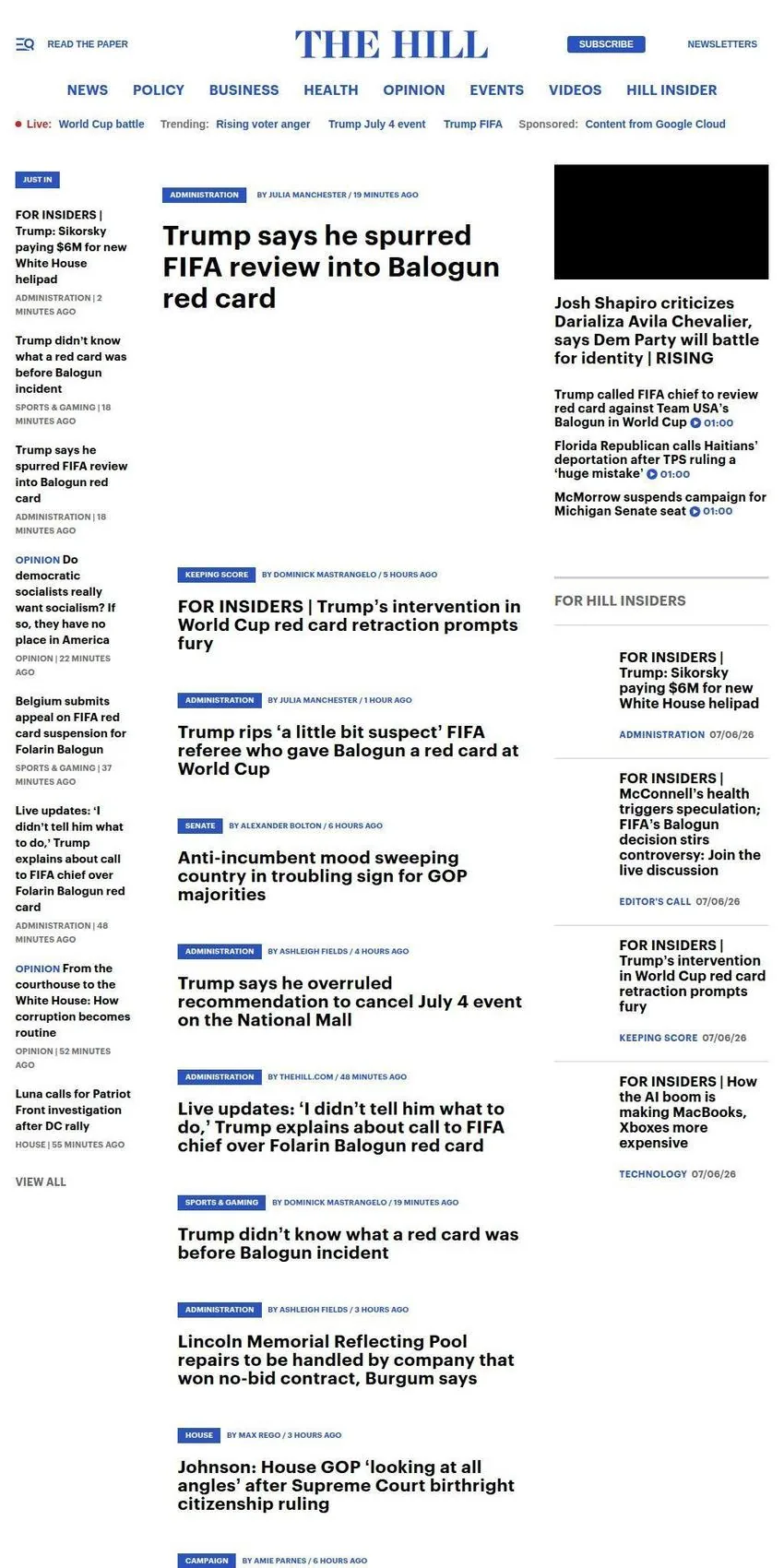
A Capitol Hill paper that Nexstar bought
Jerry Finkelstein and Martin Tolchin started The Hill in 1994 as a print newspaper aimed squarely at Congress, and Tolchin came to it after years as a New York Times correspondent. That pedigree showed in the paper's early habit of covering the mechanics of legislation instead of only the noise around it. Its first readers were the staffers, members and lobbyists who run the building, and it wrote to that inside audience. The company behind it then was Capitol Hill Publishing Corporation, and for most of its life the product arrived on paper, dropped in the corridors and offices where the people it wrote about worked.
That changed in 2021.
Nexstar Media Group paid 130 million dollars for the title and folded it into a digital operation. The number is less important than who is paying it: a broadcast group, not a newspaper chain, now sets the direction. Nexstar is the largest owner of television stations in the country and trades publicly, so The Hill now sits inside a media company far bigger than a single Washington newspaper. What that scale buys a reader is a large newsroom and a steady publishing rhythm backed by a parent with real distribution muscle. What it costs is harder to see from outside, though anyone weighing the site should know a national broadcast group signs the checks now.
The feed tagline reads "Unbiased Politics News," and the channel titles itself The Hill News. The news pages mostly write to that label: short, dated items on votes and hearings, with the editorializing kept out and pushed instead into the Opinion pages. Headlines stay close to what happened rather than reaching for an angle, more like wire copy than opinion writing.
How the coverage splits across sections
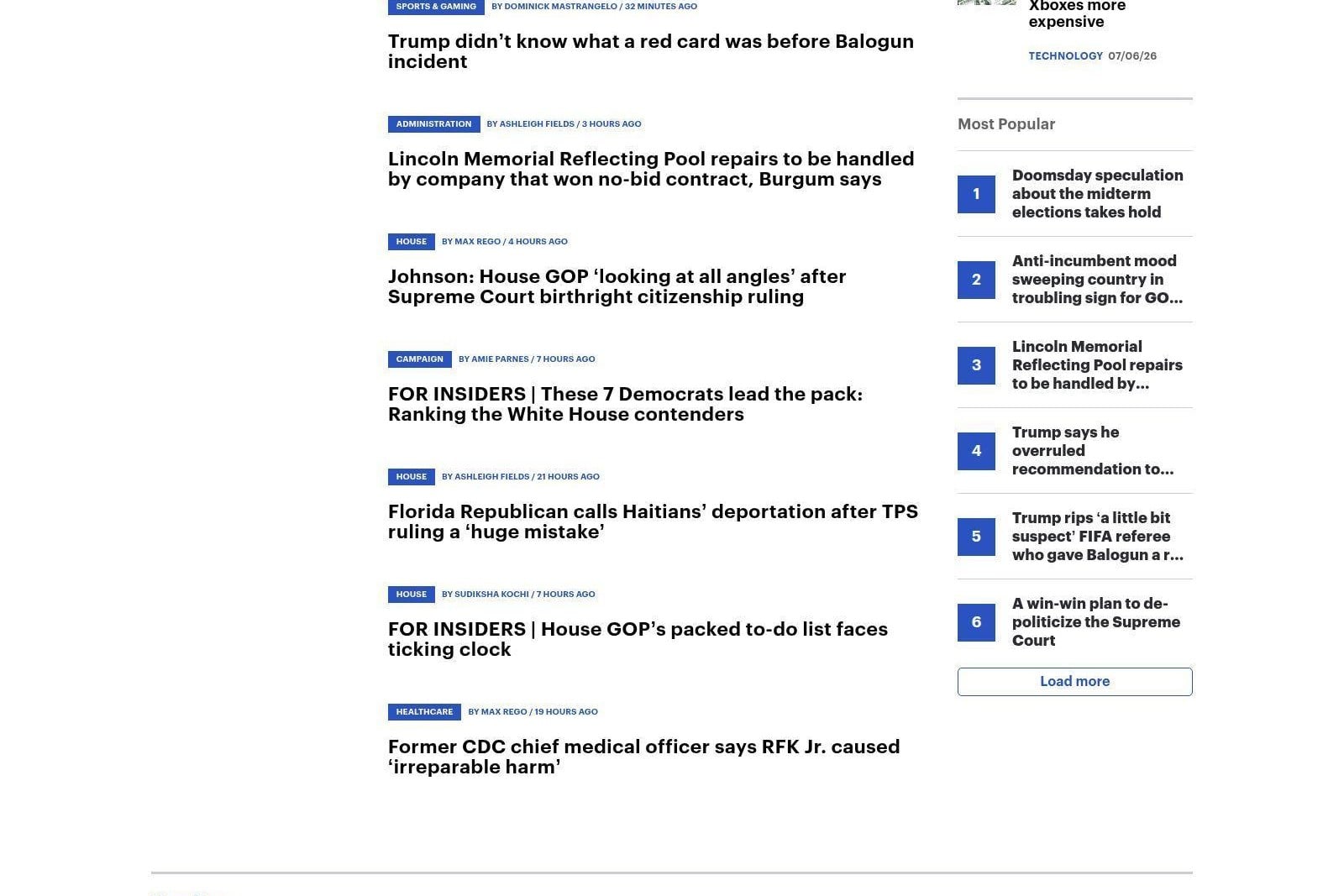
The home page is a dense grid of the day's political headlines, and from there the site fans out into a handful of named sections, and each one covers a distinct beat. The main news sits under Homenews, and its Just In feed stacks stories in the order they break, which is the closest thing the site has to a wire. None of the sections hide behind clever names; the labels say what they hold. This is where The Hill draws most of its daily traffic, and the layout makes sense once you learn where things sit.
Policy, business and opinion
Policy is the section closest to The Hill's founding purpose. It tracks bills, agencies and the fights over them, and breaks out international policy and Senate coverage on their own pages. The international policy and Senate pages are useful if you follow one thread and do not want the rest of the day's noise on top of it. Business runs alongside it for the money side of Washington, covering markets and the budget standoffs that never fully resolve. Opinion is the op-ed wing, where columnists and outside contributors argue rather than report, and I found the wall between the reported sections and that one cleaner than many political sites bother to build. A campaign and elections subsection sits under the news umbrella too, which is where The Hill tends to swell during a voting cycle.
The Changing America vertical
Changing America is the one section that steps off the Capitol beat. It gathers sustainability, equality, health and environment coverage under a single banner, aimed at readers who want those subjects without the horse-race framing of the main news pages. The pieces there run longer and read like explainers, a step back from the minute-by-minute front. It reads as The Hill's bid to hold an audience that cares about policy outcomes more than the daily scoreboard on Capitol Hill.
Rising and the app side
Beyond the written sections, The Hill produces "Rising," a weekday news-commentary show that airs at 9am Eastern and lives on YouTube. That gives The Hill a video presence next to the articles, and it pulls in viewers who might never open a section front. Posting it to YouTube keeps the show free to anyone, outside the article pages instead of behind them. There are dedicated apps as well, listed in the site navigation, for people who would rather follow along on a phone. The publisher also runs a separate advertiser-facing media kit on its own site, the commercial machinery you would expect behind a property this size and nothing a general reader needs to touch.
Under the hood the site runs on WordPress, in a multisite setup, and it pulls a syndicated partner feed in alongside its own reporting. Some of what scrolls past on the section fronts originates elsewhere. That single detail, more than the corporate owner, is worth keeping in mind while scrolling, especially for anyone trying to gauge how much of The Hill is staff-written.
The honest read on The Hill is that it remains a competent, established Washington news operation doing roughly what it has done since 1994, now with a broadcaster's resources behind it. The sections divide sensibly, the policy reporting stays close to the legislative detail, and the video and app extensions give it reach past the page. The wrinkle is that a syndicated partner feed and a parent built on television mean the product is broader and less handmade than the old print sheet was. It still covers Congress day to day about as well as it ever has, one arm of a large media company now instead of a standalone print paper, and the opinion pages are worth reading as opinion and nothing more.




Verified social profiles
Business address
The Hill (Nexstar Media Inc.)
1625 K Street NW, Suite 900,
Washington,
DC
20006
United States
Contact details
Phone: 202-628-8500
Jurors have been in the spotlight after the divisive case ended in a mistrial.
The bar had required masks for six years before the owner eased the rule.
The Imagination Library was inspired by Parton's father, who could not read or write.
Sen. Susan Collins (R-Maine), who chairs the Senate Appropriations Committee, called on the Trump administration to spend more…