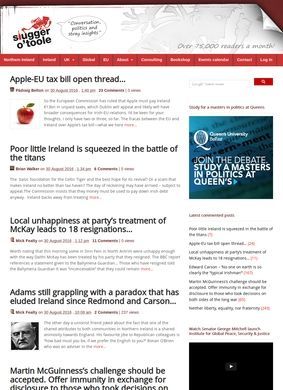
Slugger O'Toole is a Northern Ireland political commentary blog, founded and edited by Mick Fealty, that has spent years tracking the messier corners of Stormont, unionism, nationalism, and the long argument over Irish unity. It is not a wire service and does not pretend to be one. The writing leans toward analysis: where a budget line in the Stormont executive matters, where a constitutional debate is heading, what Brexit did and continues to do to the region. David McCann sits as Deputy Editor, and the Slugger O'Toole masthead reads as a small editorial operation with a clear sense of who it serves and why. The category fit, political news, is accurate enough, though the emphasis falls more on interpretation than on reporting the day's events.
Formats beyond a typical opinion blog
What Slugger O'Toole actually publishes is worth itemising, because the range is broader than a typical opinion blog. There are long-form analytical pieces on devolution and economic policy. There are community discussion threads, the best known being Open Sunday, where readers set the agenda and the comment section becomes the content. On top of the written word, the site runs video under the Slugger TV banner and puts out podcasts, which means the same political questions get worked over in more than one format. Cultural commentary turns up alongside the hard political coverage, so the tone is not relentlessly procedural, and a reader can dip into Slugger O'Toole for a sharp essay on the constitution or stay for a looser thread about life in the North. Few regional outlets attempt that spread of formats and keep them all running.
Subscriber numbers and funding model
The audience numbers give some sense of reach. Slugger O'Toole reports more than 17,600 email subscribers, which for a regional political blog is a substantial standing readership, not a passing one. That subscriber base also hints at how the operation stays alive: it takes reader donations and sells its own advertising, with a separate page set aside for advertising inquiries. RedCircle, which hosts podcast content, describes it as an award winning news and opinion portal. Read that descriptor with the usual caution one applies to a hosting platform's own framing, but it lines up with a site that has been around long enough to build a genuine habit among the people who read it. The mix of donations and advertising is a familiar funding shape for independent media, and Slugger O'Toole appears to make it work without obvious paywalls.
Claim of political independence
Independence is the claim that does most of the work here. Slugger O'Toole presents itself as unaffiliated with any political party or institution, which in Northern Irish media is a meaningful position to stake out, given how much of the surrounding commentary tilts one way or the other along the unionist or nationalist line. Whether the writing lives up to that is something a regular reader judges over time, but the editorial posture is stated plainly.
Comment culture and open debate
The comment culture, where opposing camps argue in the same thread, is at least consistent with an outlet that does not want to be anyone's house organ. That openness to disagreement, kept civil enough to remain readable, is part of what has held the place together. Plenty of comment sections collapse into noise; the one at Slugger O'Toole has a reputation for being argued through, not merely shouted.
Reputation and bias ratings
On reputation, the picture is mixed and worth being honest about. Biasly, which combines AI scoring with analyst review, rates Slugger O'Toole as Center, with a low bias score around ten percent and a reliability grade of Average. Center placement is a point in its favour for anyone wary of partisan framing. An Average reliability mark is more of a caution than a recommendation, and a reader should treat individual posts on their merits before trusting any single one as settled fact. Beyond Biasly there is little to go on.
Checking consumer review platforms
No consumer ratings surface on Google, Trustpilot, Yelp, or the usual review platforms for the blog itself. A five star result that shows up under the same name belongs to a Celtic band, not this site, so it should be set aside completely. For a political blog this absence of star ratings is unremarkable: people do not leave Trustpilot reviews for op-ed sites the way they do for shops, and the real measure of trust here is the subscriber count and the longevity, both of which point in the right direction.
Contact options and transparency
Contact arrangements at Slugger O'Toole are straightforward without being expansive. There is a page for getting in touch, and Mick Fealty can be reached through a site form; a parallel page handles advertising questions. What is missing is any phone number or physical address, which is typical for a one-editor digital outlet but does mean a reader cannot place the operation geographically beyond its Northern Ireland focus, or pick up a phone to ask something quickly. For an editorial site that runs on email and comment threads, a working contact form is the realistic channel, and Slugger O'Toole provides it. The transparency gap exists but stays minor, and it does not undercut the basic ability to reach the people behind the writing.
Who should read Slugger O'Toole?
So who is Slugger O'Toole for? Someone following Northern Irish politics closely, who wants argument and analysis rather than headlines, and who is comfortable with a comment section that can be as informative as the article above it, will find it a useful daily stop. The format mix of essays, video, and audio means the same reader can engage at different depths depending on the day and the topic. A casual visitor looking for neutral breaking news will be in the wrong place; this is opinion and interpretation, declared as such, and stronger for not hiding the fact. Knowing what you are reading before you read it is half the value.
Weighing strengths against weaknesses
The weaknesses are the ones that come with the territory. The reliability rating is middling rather than glowing, the offering rests heavily on one editor's judgement, and there is no third-party consumer feedback to corroborate the experience one way or the other. Set against that, Slugger O'Toole brings a long track record, a sizeable and loyal subscriber list, a credibly independent stance, and a Center bias reading that few partisan outlets could claim. The donation-and-advertising model keeps it free to read while leaving its independence intact, which is harder to pull off than it looks, and the willingness to host video and audio alongside text suggests an operation still putting effort in, not coasting on old archives. That alone separates it from a good many sites that went quiet years ago and never said so.
Taken as a whole, Slugger O'Toole reads like what it says it is: a long-running, independent platform for working through the questions that dominate politics in Northern Ireland, with enough formats and enough readers behind it to matter to the conversation. This entry will mostly interest people already invested in that subject, and they are the ones who will get the most out of what Slugger O'Toole offers. The harder call sits with the visitor who weighs that low bias score against the Average reliability mark beside it. On the published evidence the verdict leans favourable: an even-handed outlet with a long record and a sizeable readership rewards regular reading, so long as each individual post is taken on its own evidence and not as settled fact.