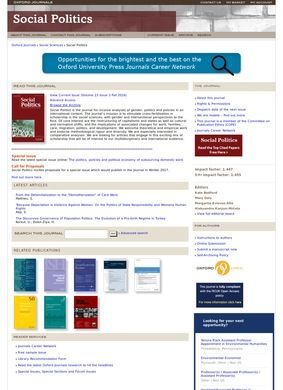
Publishing under Oxford University Press since 1994, Social Politics: International Studies in Gender, State and Society occupies a specific corner of the social sciences that most political journals leave underserved. The full title is the clearest description of the scope: gender as it intersects with state structures and the organisation of society, examined through political science, sociology, and gender studies working in combination. Volume 33, Issue 1 (Spring 2026) is the current issue listed on the platform, which puts the journal's run at over three decades of continuous publication on a focused remit.
Scope and comparative focus
The coherence of Social Politics comes from that narrowness. This is not a general political science outlet that carries a gender paper once a year. The entire catalogue is built around how states, institutions, and markets organise themselves along gendered lines, with a strong comparative habit running through the work. A reader will find articles that set one country's care policy against another's, studies of how welfare regimes encode assumptions about unpaid labour, and analyses of political representation that try to explain why some legislatures look the way they do. The comparative emphasis is the throughline, and it makes the archive more useful than a single-country specialist publication would be, because the arguments travel across national contexts rather than staying locked to one.
How the journal organizes its archive
The site is organised in ways that reflect how researchers move through a journal in practice. Beyond the regular issues there are advance articles posted ahead of formal issue assignment, which is useful in a field where a year's publication delay can leave a policy argument stale by the time it appears. Editor's Choice picks draw attention to work the editors want highlighted. Most-read and most-cited rankings do something quieter: they show a newcomer to the field where the centre of gravity sits, which is the kind of orientation a literature review needs and rarely gets handed to it. Those ranked lists are genuinely more useful than an editorial flag, because citation patterns over time reflect sustained use across the field, not an internal selection.
Special Collections by theme
Beyond regular issues, Social Politics organises its archive into curated Special Collections that pull scattered articles into coherent themes. The examples on the platform give a fair sense of scope: Women's Leadership Across the Globe, Gender Regimes, Postconflict Care Economies. These collections save readers the work of reconstructing a sub-literature from scratch using a database search. Someone writing on the care economy in a postconflict context can find a ready-made cluster of relevant material instead of building a bibliography from nothing. That curation is editorial labour that does not always get credited, and it is one of the clearer arguments for Social Politics over a raw database search of an aggregator.
Citation metrics in social sciences
On standing, the numbers are respectable without being commanding. Social Politics carries a 2.4 Impact Factor and a 4.9 CiteScore in the figures published on the platform. For a specialised journal in the social sciences, where citation volumes run structurally lower than in the sciences and a tightly defined field limits the citing pool, those are solid results. Within gender and politics scholarship, Social Politics is a known quantity: the metrics are consistent with a publication read and cited by the people who work in the area, not one coasting on its publisher's reputation.
Submission and access infrastructure
The practical apparatus around publishing is present and where you would expect it. Submission guidelines and manuscript preparation instructions are laid out for prospective contributors, with manuscripts handled through ManuscriptCentral, the system many will already know from other titles. Open access publication options are available for authors working under funder mandates, which has become close to non-negotiable in many institutional contexts. For readers and librarians there are institutional sign-in options, a library recommendation tool, and email alerts pushing the table of contents for each new issue. None of this is unusual, and that is the point: Social Politics sits inside Oxford Academic's standard infrastructure, so anyone who has used another OUP title will find the interface familiar.
Institutional paywall limits readership
The honest answer about audience narrows it considerably. Social Politics serves academic researchers, faculty, graduate students, and subscribing institutions. The paywall built into that model means a casual reader following a news story about gender policy is likely to hit a sign-in wall before reaching any substance. Open access articles are the exception within each issue, scattered through the issues with no obvious free tier grouping. Access to most of the content depends on an institution that pays for it, and that shapes who will get real use from the listing.
Research foundation, not news source
Filed under political news in this directory, Social Politics is not a news source in any ordinary sense. It does not report events, carries no commentary on the week's headlines, and publishes nothing that updates at the pace of a news cycle. What it offers is the slower layer underneath those headlines: peer-reviewed research that, years later, a journalist or policymaker might cite when arguing about parental leave, electoral quotas, or the gendered effects of austerity. A reader arriving expecting current political coverage will be in the wrong place. A reader wanting the evidence base behind those debates will find a serious one in Social Politics.
Slow publication cycle by design
That distinction sets a fair expectation about cadence. Quarterly publication and the long lead times of peer review mean content in Social Politics moves slowly by design. The advance articles feature softens that somewhat, but anyone hoping for a steady stream of fresh material every week should look elsewhere. The value of Social Politics is cumulative and archival, built issue by issue over many years, and it rewards the reader who treats it as a library to mine rather than a feed to follow.
The verdict on Social Politics lands somewhere short of unqualified enthusiasm, and the reasons are structural. The scholarship is sound, the editorial curation is a real asset, and the comparative focus gives Social Politics a clear identity that broader outlets lack. Against that, the impact metrics are good without being commanding, the paywall puts most of the work out of reach for anyone outside a subscribing institution, and placement under political news will mislead a reader who has not looked closely at what Social Politics covers. With institutional access and a research interest in gender, the state, or comparative social policy, this is a well-organised resource worth the time. Without that access, most of the catalogue is locked, and that limits how useful the listing is in practice.