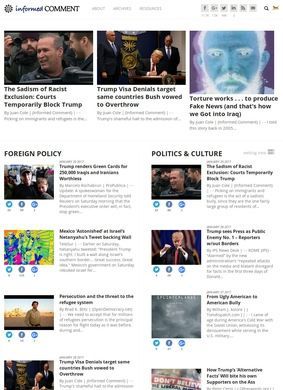
Juan Cole: Informed Comment is a daily political commentary and news analysis blog run by Juan Cole, the Richard P. Mitchell Distinguished University Professor of History at the University of Michigan. The site reads the day's events through a historian's lens, with a heavy concentration on Middle Eastern affairs, U.S. foreign policy, and the wider geopolitics that connect the two. Cole has been writing in this vein for a long time, and the archive shows it: over 3,100 pages of posts, which is a serious record by any blog's standard.
Middle East focus with energy policy
The subject matter is wider than the Middle East tag suggests. Alongside coverage of regional conflicts and American intervention, Juan Cole: Informed Comment regularly takes on climate and energy policy, which is not a pairing you see often on a foreign-affairs blog. That combination gives the writing a particular shape. A reader who comes for analysis of a Gaza ceasefire or a sanctions package may also find a piece on solar capacity or fossil-fuel politics in the same week, and the two threads are treated with comparable seriousness instead of one being filler for the other.
Guest contributors and syndicated content
Not everything on Juan Cole: Informed Comment comes from Cole himself. The site runs guest contributors and carries syndicated pieces from outlets including The Conversation and Global Voices, and it openly accepts freelance contributor submissions. It is a single-author blog in origin, built on one professor's voice and judgement, but it has grown into something closer to a small platform that lets in other writers. The syndication relationships also tell you who its peers are. Juan Cole: Informed Comment is carried on Common Dreams, so the traffic flows in both directions.
Left-leaning commentary with factual grounding
This is the question that decides whether the site is right for you, and it is worth being clear-eyed about. Juan Cole: Informed Comment is commentary first. The pieces analyze and argue; they do not pretend to be neutral wire copy. Media Bias/Fact Check rates Juan Cole: Informed Comment as Left Biased and judges its reporting as Mostly Factual, which is about what an honest reader would expect after spending an hour in the archive. The point of view is consistent and the author does not hide it.
Comparing commentary blogs to wire services
I find that openness easier to work with than the false balance some outlets perform, because you always know the angle going in and can weigh the argument accordingly. The Mostly Factual mark is the part that earns the site its credibility. A strong perspective paired with a decent factual track record is a usable combination; a strong perspective paired with sloppy facts is not, and Juan Cole: Informed Comment lands on the right side of that line. Cole is also verified on Muck Rack as a journalist tied to the site, which is a real marker that the byline is who it claims to be.
Daily analysis from a historian
What you will not get here is the pretense of a detached news desk. If you want straight reporting with the analysis stripped out, Juan Cole: Informed Comment is not that, and the site does not market itself as that. The value is in the reading of events by someone who has spent a career studying the region and can put a single day's headline against decades of context.
Academic recognition and professional verification
The author's standing is the engine of the whole thing. A sitting university professor of history writing daily, under his own name, with an academic specialty that maps directly onto the subject matter, is a different proposition from an anonymous aggregator. The University of Pittsburgh's CERIS network lists Juan Cole: Informed Comment as a reference resource on the Middle East and Islamic world, and academic institutions cite it. That kind of recognition is harder to come by than traffic, and it points to the site being treated as a source by people who study the region professionally rather than only as a place to read opinions.
Newsletter, social media, limited direct contact
On staying connected to Juan Cole: Informed Comment, the options are narrow. There is a newsletter and email subscription form, and the site keeps active presences on Facebook, Twitter/X, and Bluesky, so following along is straightforward enough. Reaching the people behind it is a different matter. No phone number or postal address appears on the homepage, and there is no prominently displayed direct email. For a personal commentary blog this is a common shape and not a scandal, but it does mean a reader with a correction, a tip, or a submission idea has to work through the subscription form or social channels. The freelance submission door is open, yet the path to it could be more visible.
How does reputation measurement work here?
The reputation evidence for Juan Cole: Informed Comment is worth sorting out. The measures that count for a site like this are the Media Bias/Fact Check assessment, the Muck Rack verification, the academic citations, and the syndication on Common Dreams. There are no Google, Trustpilot, Yelp, or BBB ratings to point to, which is unsurprising. Those platforms measure businesses and services; a one-author analysis blog is judged instead by who republishes it and who cites it, and on that measure Juan Cole: Informed Comment does well. No outside ratings exist, but no outside ratings were expected.
Sustained geopolitical coverage for serious readers
The daily rhythm, the depth of the archive, and the dual focus on geopolitics and energy make Juan Cole: Informed Comment a strong fit for readers who want sustained, informed analysis and who are comfortable reading from a declared left-of-center viewpoint. Students of Middle Eastern history, policy watchers, and anyone trying to follow regional conflicts beyond the headline cycle will find more here than on most general-news sites. Someone hunting for neutral summaries or breaking bulletins will be less at home.
Single-author model with inherent limits
The honest weak spots are the limited contact transparency and the inherent limits of a single-author model, where the breadth of any given week depends on what Cole and a handful of contributors choose to write. Neither undercuts the core value. Juan Cole: Informed Comment offers years of consistent, sourced analysis from a credentialed historian, recognized by academic networks and carried by allied outlets across thousands of posts. Long-running commentary blogs that hold both a clear voice and a solid factual record are not as common as the open web makes them seem, and Juan Cole: Informed Comment belongs in that smaller group.