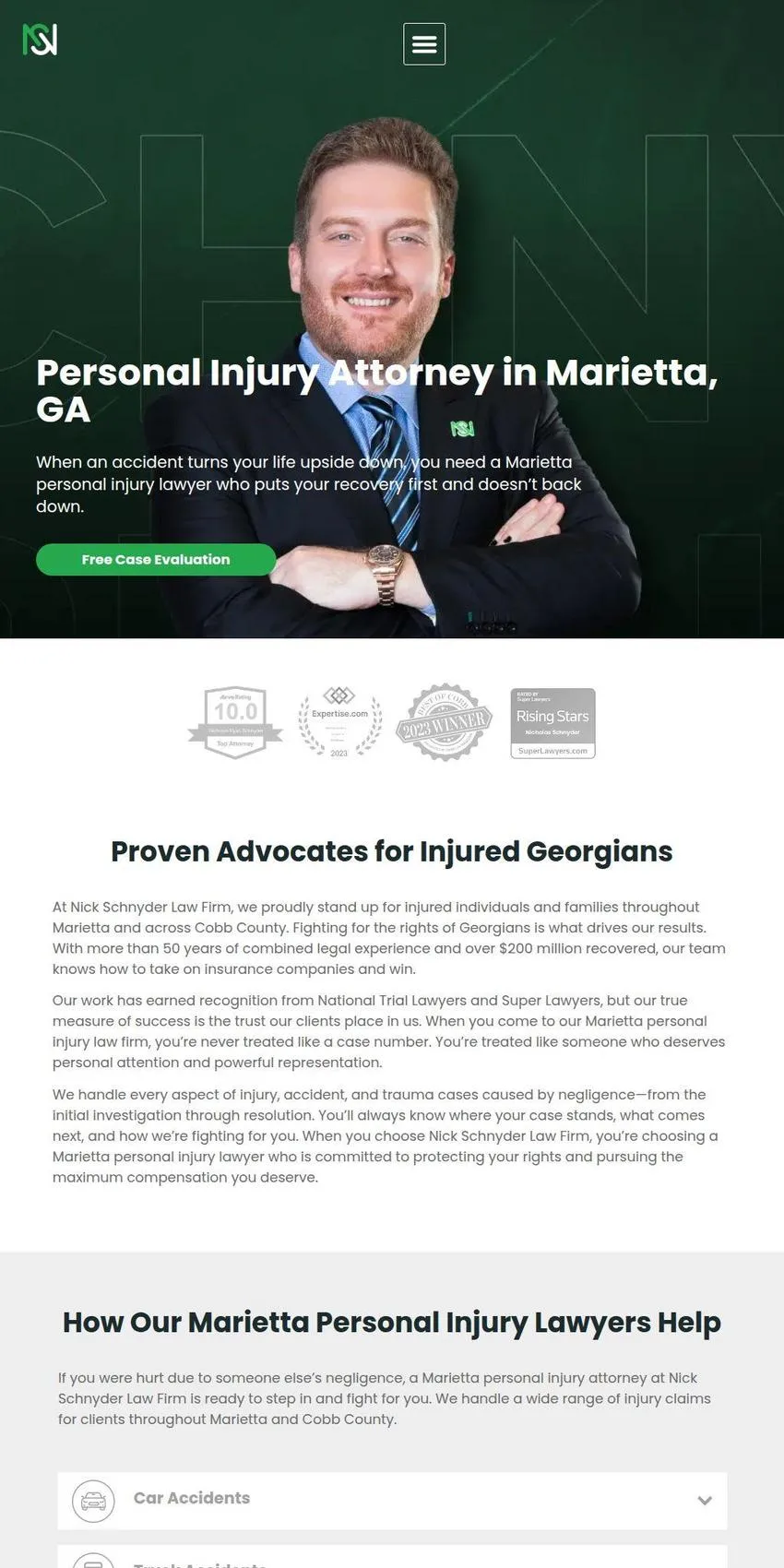
In the field of plaintiff-side personal injury practice in the state of Georgia—an area in which the injured party seeks, through the mechanism of tort liability, compensation for losses caused by another's negligence— the Nick Schnyder Law Firm operates as a specialized litigation practice centered in Marietta and Cobb County, with a scope of practice that the firm describes as extending statewide. Its niche is precise: not general legal counsel, not transactional work, but the representation of individuals injured in traffic accidents, on unsafe properties, in the workplace, or due to medical malpractice, against insurers and corporate defendants who stand between them and compensation. This review examines what the website reveals about the firm's origins, the structure of its practice, its working methods, and its internal organization.
Based on the firm's own account of its origins, the practice was founded in 2016 and has grown, according to its About Us page, from a small operation into a team spread across multiple offices in Georgia. The founding attorney presents himself as a first-generation lawyer who lost a brother to medical malpractice—a biographical detail the website provides not as a mere embellishment, but as the root cause of the firm's combative stance toward insurers. This stance is encapsulated in a registered motto, "WE DON'T ASK, WE TELL," which can be read as assertive rhetoric: the claim is not requested but stated, and the burden of response falls on the opposing party.
What, then, sets a practice of this kind apart in a crowded field of firms making comparable promises? The answer proposed by the website is specialization in depth, rather than breadth: a single field—personal injury—subdivided into seven areas of practice, each addressed on its own page, with its own explanation of causation, types of injuries, and remedies. The organizing principle thus proves to be taxonomic; the reader is guided, based on the nature of the injury sustained, to the relevant category.
The categories can be listed as follows: car accidents, truck accidents, and motorcycle accidents, which together form the "traffic" group; premises liability, covering damages caused by hazardous conditions on property; medical malpractice, addressing negligent care by clinicians and institutions; wrongful death, pursued on behalf of the surviving family; and workers' compensation, which stands somewhat apart. The page dedicated to recommendations from attorneys also includes hit-and-run accidents, ridesharing accidents, and slip-and-fall accidents, although these are, in essence, subsets of the motor vehicle and premises liability categories already mentioned.
Regarding how these services differ from one another, the fundamental distinction lies between tort claims and workers' compensation claims. The former require proof of negligence—that is, a duty of care, a breach of that duty, and a causal link to the injury and its financial consequences; the latter operates within a no-fault legal framework, in which the injured worker seeks medical treatment and wage compensation without having to establish the employer's fault. The firm reflects this difference in its language, referring to "compensation" and "damages" in the tort sections and to "benefits" and "coverage" in the workers' compensation section—a lexical shift that corresponds to a real difference in legal architecture.
The page dedicated to truck accidents serves as an example of the method the firm applies across its entire transportation practice. Liability, it explains, is determined by examining medical records, police reports, and the driver's logbooks; by verifying the driver's training and qualifications; by analyzing the vehicle's Event Data Recorder; and by comparing the carrier's conduct with the regulations of the Federal Motor Carrier Safety Administration, a violation of which constitutes evidence of negligence. Experts in transportation, medicine, and economics are consulted—respectively on causation, the severity and prognosis of injuries, and the quantification of losses—so that the case is assembled as a dossier, rather than merely as a narrative.
The same page outlines, with an educational intent that runs throughout the site, the three-part classification of damages available under Georgia law: economic damages, which include medical expenses, lost income, and property damage; non-economic damages, which include physical suffering, emotional trauma, and diminished quality of life; and punitive damages, reserved for conduct of aggravated severity and typically awarded by a jury in court. Of note is the reference to the two-year statute of limitations provided for in Section 9-3-33 of the Georgia Code; the inclusion of this information suggests that the pages are intended as a preliminary guide for injured readers, rather than merely as a means of soliciting clients.
Regarding the procedure, the homepage outlines a six-step process: consultation, case evaluation, investigation, formal notice of damages, negotiation, and, finally, settlement or trial. The vocabulary used to describe this sequence is martial in nature, featuring battle plans, front lines, and offensives, although the underlying structure is that of any well-managed claim; as a reviewer, I observe that the rhetoric and the procedure can be read separately. The rhetoric addresses the potential client's need for reassurance; the procedure addresses the insurer's need to receive a documented and evaluated claim that it cannot ignore.
In terms of organization, the website reveals a broader structure than the founder's name might suggest. In addition to him, the legal team includes several senior trial attorneys, a trial attorney, and a group of associates, while a distinct management level comprises a litigation director, a director and a supervisor for the pre-litigation phase, a transactions supervisor, and a training and development manager. This division reflects the two phases through which a claim progresses—the pre-litigation phase, involving documentation and service of process, and the litigation phase, involving the filing of a complaint, the presentation of evidence, and the trial—and implies that each phase is managed as a process with its own oversight.
The client testimonials featured on the website consistently converge on a single theme: the frequency of contact and the availability of updates, with several clients noting that the entire case was handled over the phone and online, without any visits to the office. When read in conjunction with the organizational chart, these accounts suggest that, within the firm, communication is treated as a matter of procedure rather than individual temperament, which, in my opinion, is the more sustainable of the two approaches.
Continuing with the educational aspect, a blog and a resources section accompany the practice pages, addressing issues such as the distinction between property damage and emotional distress, the consequences of partial fault, and how to negotiate with insurers. A Spanish-language version is also available, a feature consistent with the demographics of the Atlanta metropolitan area. Taken together, these materials extend the website's function beyond client acquisition to education, so that readers arrive at a consultation already equipped with the vocabulary to articulate their claims.
Tort liability can ultimately be understood as a mechanism for restoring a balance that negligence has disrupted: the injured party is restored, as far as money can make it possible, to the condition that existed before the injury, and the liable party is made to bear the cost of its own negligence. A practice such as the Nick Schnyder Law Firm operates as an instrument of this restoration, translating the specific facts of a collision, a fall, or a misdiagnosis into the general categories recognized by the law and applying these categories to institutions that would prefer the disruption to remain unremedied. One might conclude that the website presents, with unusual candor regarding its own rhetoric and methodology, a firm whose specialty is the ordinary misfortune of everyday life and whose work is the patient conversion of this misfortune into a claim.

Business address
Nick Schnyder Law Firm, LLC
351 Atlanta St SE,
Marietta,
GA
30060
United States
Contact details
Phone: 404-999-1111