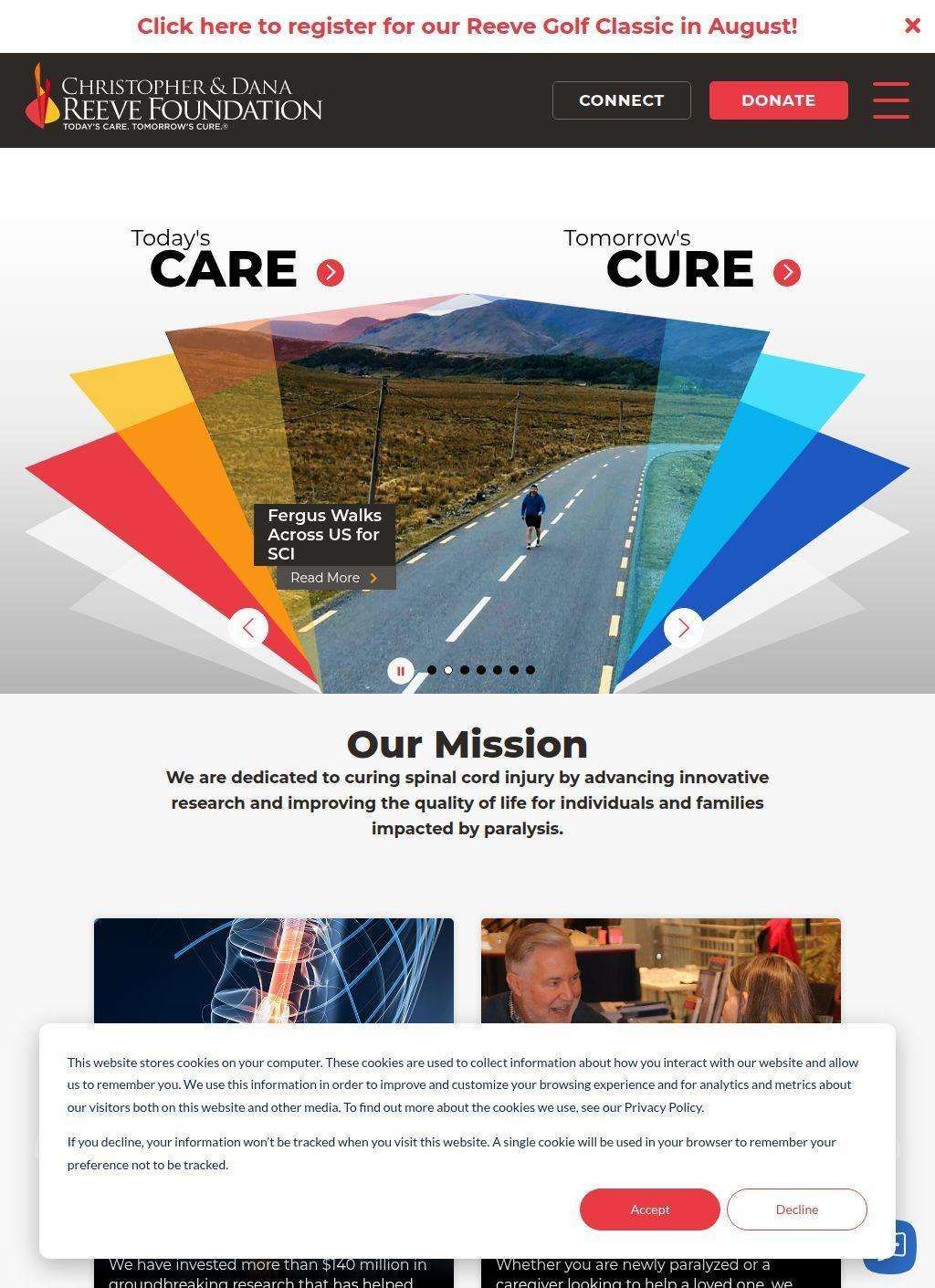
This entry's category label is wrong, and it is worth saying so up front: the Christopher & Dana Reeve Foundation is not a law firm. It files no cases, represents no clients, and gives no legal advice. It is a national nonprofit built to fund a cure for spinal cord injury and, in the meantime, to make daily life more livable for people who are paralyzed and for the families around them. Anyone arriving here expecting a personal-injury practice will be in the wrong place, though the mismatch does not diminish what the site itself contains.
What it contains is a lot, and the work splits cleanly along two lines the organization names itself. One side is present-tense help for people living with paralysis right now. The other is money and structure aimed at the research that might one day make paralysis reversible. Holding both under one roof is unusual, and the Christopher & Dana Reeve Foundation does not treat either as an afterthought. That dual mandate is the thread to keep in mind through the rest of what the Christopher & Dana Reeve Foundation puts on the page.
Care services through the National Paralysis Resource Center
The care side of the Christopher & Dana Reeve Foundation runs through the National Paralysis Resource Center, and this is the site's strongest section. There are educational materials, one-on-one consultations with information specialists, and peer mentoring that pairs people who have been through spinal cord injury with those newer to it. Virtual support groups extend that further for anyone whose mobility or geography makes an in-person group impractical. A caregiver support strand runs alongside, an acknowledgment that paralysis reshapes a whole household and reaches well beyond the injured person.
Multilingual guides and peer support
The Paralysis Resource Guide anchors much of this, and one detail caught my attention: it is offered in more than fifteen languages. That is a deliberate reach past the English-speaking, well-connected user toward families who might otherwise be shut out of the same information. It reads as a real editorial commitment, not a checkbox. The Christopher & Dana Reeve Foundation also runs a Military & Veterans Program for service members living with paralysis, a group with distinct benefits, systems, and needs that generic disability resources tend to gloss over.
Grants, employment support, recreation
Beyond information, the center funds and runs programs with tangible outcomes. Quality of Life Grants go to other nonprofits doing on-the-ground work, so here the Christopher & Dana Reeve Foundation acts as both a direct-service provider and a funder that multiplies its reach through smaller organizations. There is employment support for people with disabilities looking for work, and outdoor recreation programming, which speaks to a view of quality of life that goes past medical management into something closer to a full week.
Research funding and scientific partnerships
The forward-looking half of the mission is spinal cord injury research, and the numbers here are not modest. The Christopher & Dana Reeve Foundation reports more than $140 million invested in research to date, a figure that puts it among the serious private backers in this field, well past the level of a token grant-maker. A Scientific Advisory Board sits behind the funding decisions, which is the sort of governance you want to see when a charity is directing large sums toward laboratory work whose payoff is uncertain and slow.
The research is organized through partnerships and initiatives instead of a single in-house lab, a sensible structure for a foundation whose strength is convening and financing rather than bench science. The site is candid, at least in framing, about the two-track reality: cures are the long game, and care is the obligation in between. That honesty is part of why the Christopher & Dana Reeve Foundation comes across as grounded. It does not promise a breakthrough is around the corner. It funds the work and reports the total.
Team Reeve fundraising events
Community engagement wraps around both pillars. For the Christopher & Dana Reeve Foundation, Team Reeve is the fundraising arm where supporters run, ride, or otherwise raise money; A Walk to Believe events and Golf Classic outings give that a public, in-person shape. There is advocacy and policy work aimed at legislation and funding that affect the paralysis community, plus a community blog and a schedule of webinars. None of this is filler. Each piece feeds either the care operation or the research budget, and the throughline back to the founders is unmistakable given the organization's origins with Christopher and Dana Reeve.
Who this serves
Who is the Christopher & Dana Reeve Foundation actually for? A fairly wide circle, and the site is honest about the range. People with recent or long-standing spinal cord injuries, their families, and their caregivers are the core. Healthcare professionals looking for reliable patient-facing material are served too, as are veterans with paralysis and people with disabilities pursuing employment. That breadth could easily turn into a shapeless catch-all, but the navigation keeps the audiences distinct enough that a first-time visitor can find their lane without wading through everything else.
Scope and limitations
If there is a limit to what the site does, it is the flip side of its ambition. An organization spanning peer mentoring, multilingual guides, veterans' services, employment help, outdoor recreation, grantmaking, and a nine-figure research portfolio is carrying a very large brief, and depth on any single strand will vary. Someone who wants an exhaustive clinical library on one specific injury level, for instance, may find the resources here are a strong starting point that then points elsewhere. That is a reasonable role for a foundation to play. It is not a reason to expect it to be the last stop for every question.
The advocacy component deserves a note of caution too, though not a critical one. Policy work is by nature partial and ongoing; wins and losses come slowly and depend on forces outside any one nonprofit's control. The Christopher & Dana Reeve Foundation presents this as one lever among several, which is the correct posture. Readers should take it as sustained effort in a long fight, not as a settled set of accomplishments.
What lifts this above a typical charity homepage is how concrete the offerings are. It would be easy for a cause this emotionally charged to lean on inspirational language and photos and never pin down what it does. That is not what happens on the Christopher & Dana Reeve Foundation site. The Christopher & Dana Reeve Foundation lists specific programs, names its funding total, identifies the populations it serves, and gives its resource guide a real distribution footprint across many languages. The emotional weight is present, as it should be, but it sits on top of a service catalog you can point at and use.
My verdict is largely positive with one firm asterisk, and the asterisk is the placement, not the organization. As a resource for anyone touched by spinal cord injury or paralysis, whether newly injured, a caregiver, a veteran, a clinician, or a supporter looking to help, the Christopher & Dana Reeve Foundation is a substantial and credible destination, and the two-pillar structure of immediate care plus long-horizon research funding is coherent and well explained. The multilingual guide and the peer mentoring in particular signal an organization that thinks about the people it serves rather than only the cause it champions.
The one caveat is unavoidable given where this sits: nobody searching a directory of spinal cord injury law firms will find the legal representation they came for, because none is offered. A person weighing a lawsuit after a spinal cord injury needs an attorney, and the Christopher & Dana Reeve Foundation is not that. What it is, instead, is arguably more useful over the long run for the same person once the legal question is settled: a place for information, support, community, and a stake in the research that might change the diagnosis itself. Judged on its own terms, the Christopher & Dana Reeve Foundation is worth bookmarking. Judged against the category it landed in, it is simply filed under the wrong heading, and visitors should read it as the paralysis resource and research nonprofit it plainly is.
Business address
Christopher & Dana Reeve Foundation
636 Morris Turnpike, Suite 3A,
Short Hills,
NJ
07078
United States
Contact details
Phone: 1-800-225-0292