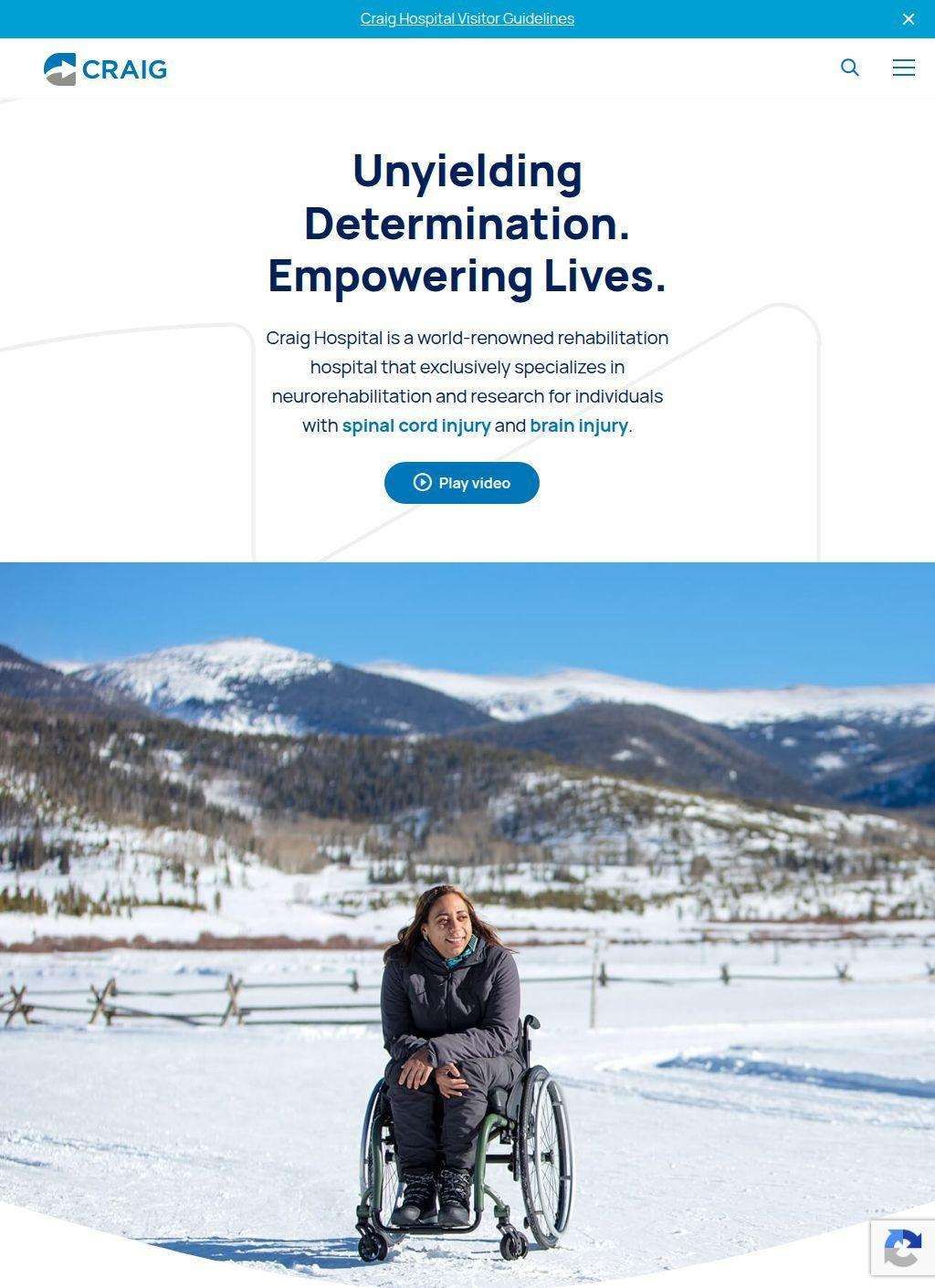
Craig Hospital in Englewood, Colorado, just south of Denver, is one of a small number of American hospitals that does only two things: it rehabilitates people with spinal cord injuries and people with traumatic brain injuries. It treats nothing else. That narrowness is the whole point. By concentrating exclusively on these two conditions, the hospital has accumulated a depth of experience that general medical centers, which see spinal cord injury occasionally amid everything else, cannot easily match. People in the field have referred patients to Craig for decades, and its reputation is one of the reasons it draws cases from far beyond Colorado.
Specialized focus on neurological injury
The hospital is a private, not-for-profit, freestanding facility rather than a unit inside a larger general hospital. It runs roughly 90 inpatient beds and provides a continuum that begins with intensive inpatient rehabilitation and extends through outpatient therapy and long-term follow-up. The freestanding, single-purpose structure means the entire building, the staff, the equipment, and the daily routine are organized around the specific problems of catastrophic neurological injury, from the layout of the therapy gyms to the way nursing handles the medical complications that come with high spinal cord injuries.
Model System designation and research
Craig is one of the federally designated Spinal Cord Injury Model Systems, a status granted by the National Institute on Disability, Independent Living, and Rehabilitation Research, the same federal program that funds the national statistics center. Model System designation is competitive and is reserved for centers that combine high-volume specialized clinical care with active research and standardized data contribution. Being part of that network means Craig is not only treating patients but also adding to the national evidence base on spinal cord injury outcomes, which is a meaningful marker of quality for anyone evaluating it through a business directory.
Interdisciplinary team approach
The clinical model at Craig is built around an interdisciplinary team assigned to each patient. Rather than seeing a physician one day and a therapist on another with little coordination, a patient and family work with a consistent team that includes a physician, nurses, physical and occupational therapists, a psychologist or counselor, and other specialists who meet regularly to set goals and adjust the plan. For spinal cord injury, that team approach matters because recovery is not one problem but many at once: mobility, self-care, bladder and bowel management, skin integrity, mental health, and the practical question of how the person will actually live after discharge.
Preparing patients for life after discharge
That last question, how someone will function back in the real world, is where specialized rehabilitation hospitals tend to distinguish themselves, and Craig is known for taking it seriously. The hospital works on the concrete skills of daily life, transfers, wheelchair use, driving where possible, and managing a household, rather than treating discharge as the finish line. It has long emphasized family training, so that the people who will be living with and sometimes caring for the patient learn what they need to know before the patient goes home. This focus on durable independence is a recurring theme in how former patients describe the place.
Services under one roof
The range of therapy under one roof is part of what makes that possible. Beyond the core physical and occupational therapy, the hospital offers services that a person with a serious spinal cord injury actually needs over a long stay: respiratory care for those with high injuries who depend on ventilator support, assistive technology evaluation, recreational therapy, psychology, and vocational and driving programs aimed at getting people back to work and behind the wheel where their injury allows. It also handles both traumatic and certain non-traumatic causes of spinal cord dysfunction, and it treats brain injury patients in parallel, which keeps the staff fluent in the overlapping complications that the two conditions can produce. That breadth means a patient rarely has to leave the building to assemble a complete rehabilitation program.
Craig also maintains a strong peer support tradition, connecting current patients with people who have already been through spinal cord injury rehabilitation and rebuilt their lives. Seeing someone with a similar injury level living independently, working, or raising a family does something that no amount of instruction can, especially in the early weeks when the future looks bleakest. The hospital pairs this with research participation opportunities, since its Model System status gives patients access to studies they might not encounter elsewhere. None of this is unique to Craig, but few places do all of it under one roof with this much accumulated practice.
The hospital's reach is genuinely national. Roughly half of its patients each year come from outside Colorado, and over time it has treated people from every state and from other countries. That draw says something about reputation, but it also points to a real consideration for families: getting to Craig and staying near it during a long rehabilitation stay is itself a logistical and financial undertaking. The hospital and its associated foundation provide some support for families traveling from a distance, but anyone considering it from out of state should plan for the practical side of an extended stay far from home.
On follow-up, Craig has historically invested in long-term care relationships rather than discharging patients into a void. Spinal cord injury is a lifelong condition with predictable later complications, and the hospital's follow-up services and clinics are designed to catch problems over the years that follow.
This long view is consistent with its research role, since tracking patients over time is exactly what the Model Systems network exists to do. For a reader building a picture of the field through a business directory, Craig is a useful example of how clinical care, research, and lifelong follow-up can be integrated in one institution. Patients who were treated there years earlier can return for reassessment as their needs change with age, which is the kind of continuity that is hard to find when rehabilitation is delivered as a one-time episode and then handed off.
A few honest caveats belong in any fair description. Craig is a rehabilitation hospital, not an acute trauma center, so the very first phase of care after a spinal cord injury, the emergency surgery and stabilization, happens elsewhere before a patient transfers in. Admission depends on medical appropriateness and on insurance and bed availability, and as a single specialized facility it cannot serve everyone who might benefit. Cost and insurance coverage for an extended inpatient rehabilitation stay are significant, and prospective patients should work through those questions with the hospital and their insurer early rather than assuming a place is available.
For the audience of this particular business directory category, the connection between a hospital like Craig and spinal cord injury law is direct. The quality, duration, and documentation of rehabilitation are central to both a patient's recovery and to any legal claim that follows a catastrophic injury, and the records and projections generated at a specialized center frequently inform life-care plans and damages analyses. Craig is not a law firm and offers no legal services; its role is the clinical one, and that role often runs in parallel with the legal process rather than touching it directly.
As a clinical resource, Craig Hospital is about as strong a reference point as exists for spinal cord injury rehabilitation in the United States, backed by its single-purpose focus, its federal Model System designation, and a national patient base built over many years. The realistic limitations are those of any specialized destination hospital: it is one facility, admission is not automatic, and an out-of-state stay carries real cost and logistical weight. Weighed honestly, it remains one of the most authoritative names in the field and a sound inclusion in any serious spinal cord injury resource list.
Business address
Craig Hospital
3425 South Clarkson Street,
Englewood,
CO
80113
United States
Contact details
Phone: 1-303-789-8000