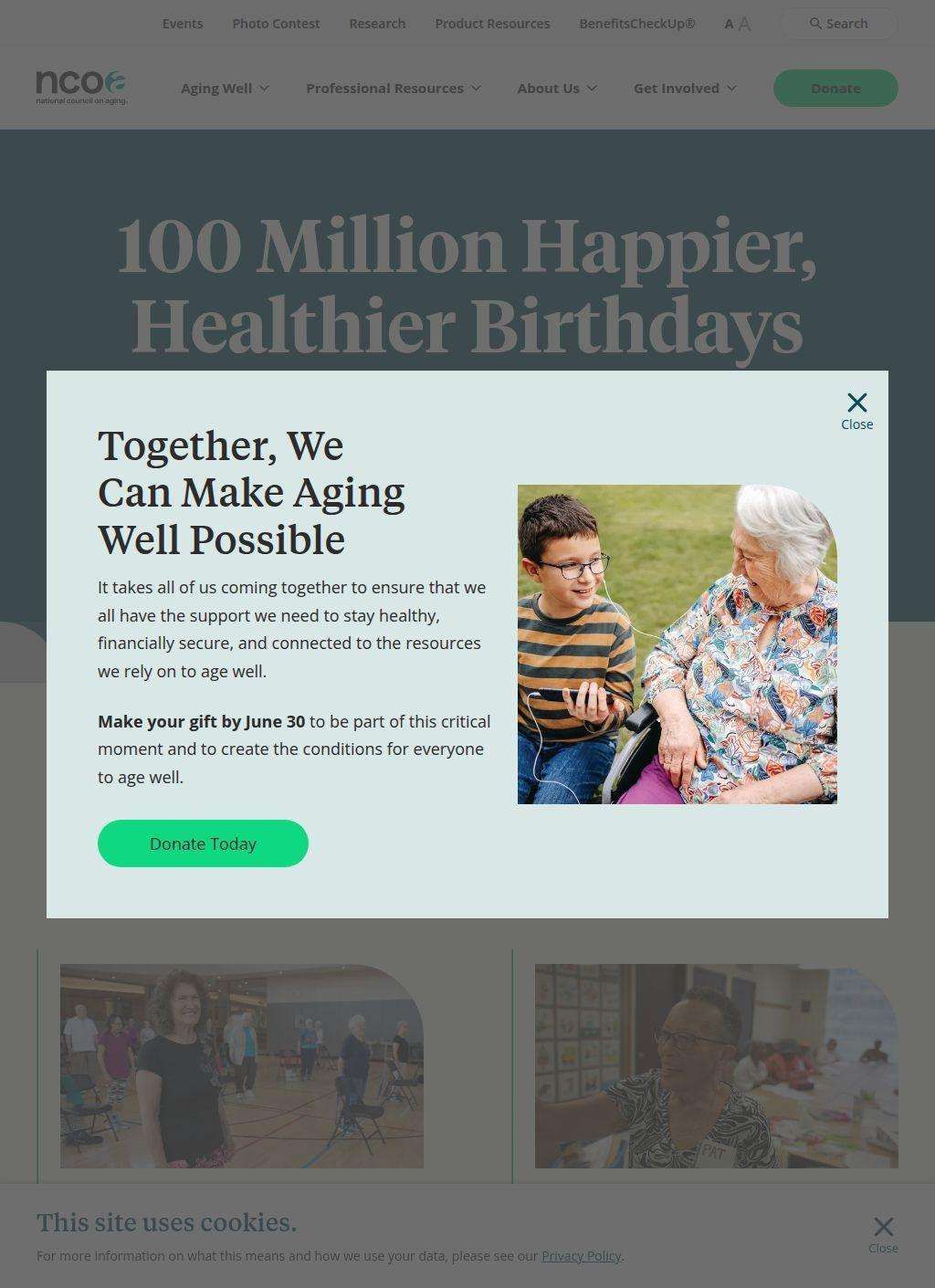
Falls prevention sits at the centre of this listing, and National Council on Aging, Falls Prevention treats it as a public-health problem with known, testable interventions rather than a general lifestyle topic. What that means in practice is evidence-based community workshops, named programs like A Matter of Balance and Stepping On, online screeners that help a person gauge their own risk, plain-language fact sheets, and a substantial section written specifically for the clinicians and senior-centre staff who run these programs on the ground. That last group gets its own material, which is unusual; most sites in this space write only for the older adult and leave the practitioner to figure out the rest.
Screeners and fact sheets for self-assessment
The screeners and fact sheets are the parts most likely to be useful to a general reader who arrived here worried about a parent or about themselves. They are short, specific, and tied to the workshop programs, so a person can move from a quick self-check to a structured course held in their own community. The training and resource pages for providers go deeper, covering how to set up and sustain a falls-prevention program at a senior centre or clinic, including the steps for recruiting participants, training facilitators, and tracking outcomes once a course is running. National Council on Aging, Falls Prevention keeps the consumer-facing and practitioner-facing material reasonably separate, which is more discipline than aging sites typically manage; the two audiences usually end up reading the same pile of text.
Training resources for senior-centre staff
Falls prevention is the headline for this entry, but National Council on Aging, Falls Prevention runs much further than that. The clearest standout is BenefitsCheckUp, a free tool that screens an older adult against public assistance programs across Medicare, Medicaid, SNAP, utility aid, and more, then points them toward what they may qualify for. For someone trying to stretch a fixed income, that single tool may be more immediately valuable than anything else on the domain. A user answers questions about location, income, and household, and the screener returns a list of programs to apply for along with links to the next step. Nonprofits frequently describe tools like this and stop there; this one works.
BenefitsCheckUp tool for public assistance
Around it sits a wide range of related material: chronic-disease self-management education, caregiver support, Medicare and insurance guidance, retirement and financial-security planning, nutrition and exercise programming, and aging-in-place resources. The breadth is genuine, and the topics connect logically, since the older adult worried about falls is frequently the same person navigating Medicare paperwork and thinking about whether the house is still safe. National Council on Aging, Falls Prevention also publishes research reports and policy briefs on aging in America, which gives the consumer pages a backbone of actual data instead of generic advice.
Chronic disease, caregiving, Medicare guidance
On the professional side, the organization runs development courses and e-learning for aging-services practitioners and reports reaching 47,150 of them. That figure, alongside the stated 40 million older adults served and a target of 100 million by 2040, puts National Council on Aging, Falls Prevention in a different category from local nonprofits or single-topic advocacy groups. It is an organization operating at national scale across a long stretch of time, and the site reflects that ambition without becoming unnavigable. The numbers are stated plainly on the page, so a visitor can weigh them against the depth of the material instead of taking the claimed reach on faith.
National scale training for aging-services practitioners
One thing worth naming for anyone who reached National Council on Aging, Falls Prevention under a Slip and Fall Lawyers heading: this is a health and aging nonprofit, not a legal practice. There is no personal-injury representation here, no claims work, no attorney consultation. What it offers is the prevention and education side, the resources that help an older adult avoid the fall in the first place and understand the programs built around it. A reader looking for legal recourse after an injury will need to go elsewhere.
Evidence-based programs and research backing
The substance backs the scale claims. The falls programs named on the site are recognized evidence-based curricula used widely in community settings, so National Council on Aging, Falls Prevention is not inventing untested methods and putting a federal-sounding name on them. The research and policy output gives the practitioner material a credible source, and BenefitsCheckUp is a working tool rather than a description of one. Where the site asks more patience of a visitor is navigation: the falls content is one initiative among many, and reaching it means moving past the broader aging-services material first. That effort is worth it. National Council on Aging, Falls Prevention delivers concrete workshops, real screeners, and provider resources that can be put to use the same week a person finds them.
Business address
National Council on Aging
251 18th Street South, Suite 500,
Arlington,
VA
22202
United States
Contact details
Phone: 571-527-3900