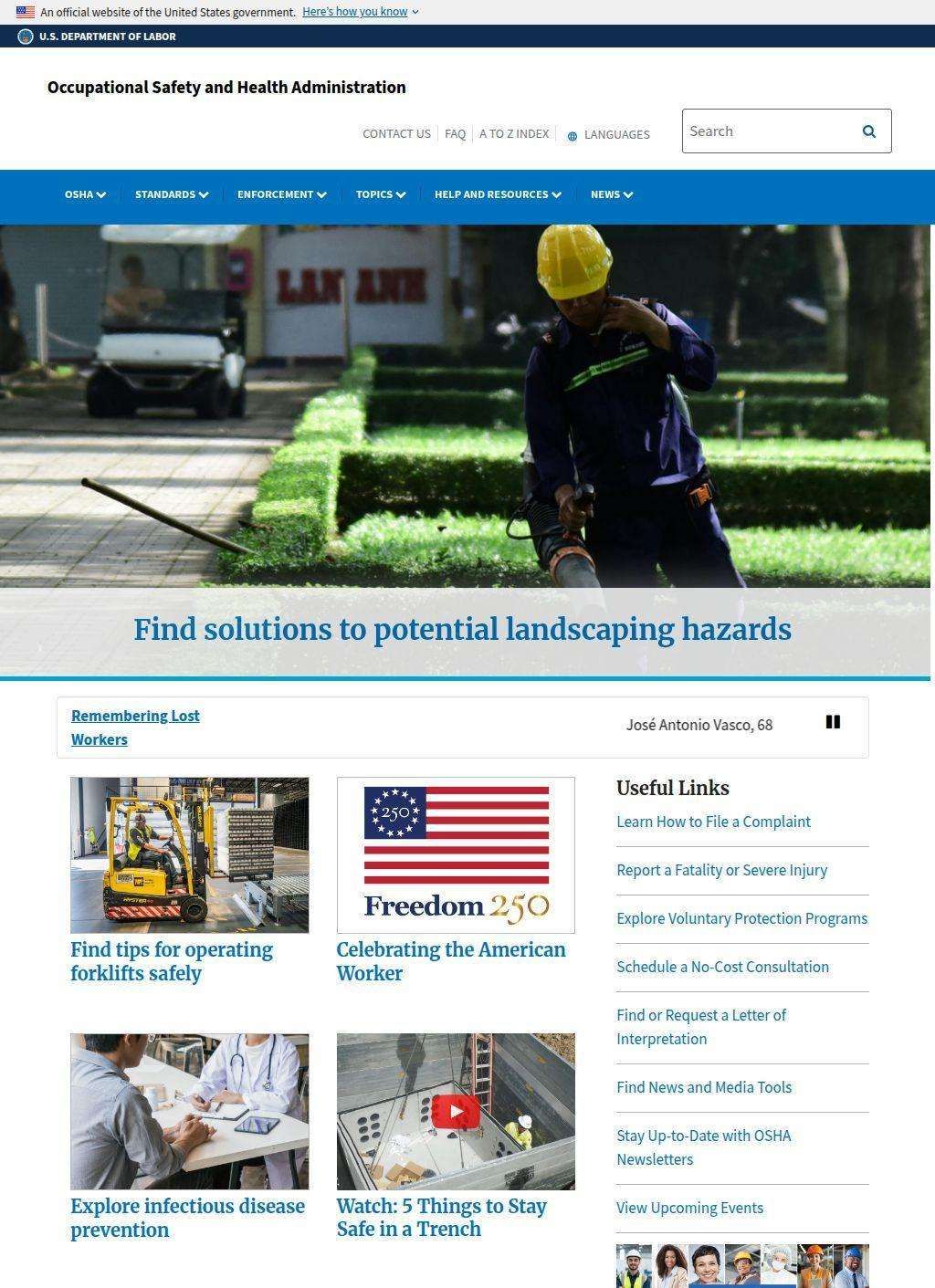
OSHA Walking-Working Surfaces (U.S. Department of Labor) is the topic page maintained by the Occupational Safety and Health Administration that collects the federal rules on floors, ladders, stairways, scaffolds, dockboards, and the fall protection that goes with them. It sits on osha.gov and points back to the final rule published on November 18, 2016, which rewrote 29 CFR Part 1910 Subpart D for general industry and touched related construction provisions in Part 1926. For anyone trying to understand the legal duty behind a slip, trip, or fall claim, this is the primary text the rest of the conversation refers back to.
Regulatory structure for general industry and construction
The page goes beyond summary and links the actual regulatory language section by section: 1910.22 on general requirements such as keeping surfaces clean, in good repair, and reachable by safe means of access and egress; 1910.23 on ladders; 1910.24 on step bolts and manhole steps; 1910.25 on stairways; 1910.26 on dockboards; 1910.27 on scaffolds; 1910.28 setting out the duty to have fall protection; 1910.29 spelling out the criteria for the systems themselves; and 1910.30 on training. Construction work routes off separately to 29 CFR 1926 Subpart M, including 1926.502. That separation is important, because the obligations on a job site are not identical to those in a warehouse or plant, and OSHA Walking-Working Surfaces (U.S. Department of Labor) is careful not to blur the two.
Fall protection systems and employer duties
On the fall protection side, the coverage runs through guardrails, safety nets, personal fall arrest systems, covers, and travel restraint systems, with the conditions under which each is acceptable. There is detail on platforms, on dockboards, and on stairways that open directly onto a door or gate, which is one of those specific hazard patterns that produces real injuries and real litigation. Employer obligations to inspect and maintain every working surface are stated plainly, and that thread of who is responsible runs through the whole page.
Supporting materials for compliance
Beyond the rule text, OSHA Walking-Working Surfaces (U.S. Department of Labor) gathers the supporting material that turns a citation into something a non-lawyer can work with. There is a FAQ that takes on the harder question of employer burden of proof when claiming an infeasibility exception, which is exactly the kind of gray area where employers and inspectors disagree. A training resource, Module 9 on Walking-Working Surfaces and Fall Protection, is available as a slide deck, alongside compliance checklists and fact sheets aimed at putting the requirements into a usable form.
The intended audience is broad in a useful way: employers and safety officers who have to comply, workers who want to know what protection they are owed, and compliance and enforcement personnel applying the rule. When reading a regulation page, the goal is to land on the exact subsection fast, and the organization by CFR number makes that quick. A guardrail height, a training requirement, an inspection duty: each is traceable to a numbered provision rather than to a paraphrase, which is what an argument about negligence eventually needs.
Scope limited to workplace surfaces
The limit worth naming is scope. OSHA Walking-Working Surfaces (U.S. Department of Labor) is about the workplace. It governs the duty an employer owes to its own people on surfaces under its control, and the enforcement that follows. A fall in a grocery aisle, a hotel lobby, or a neighbor's driveway falls outside it, governed instead by premises liability and state common law. Read the page expecting workplace fall prevention and it delivers; read it hoping for a general guide to every fall and the framework will not fit.
From regulation to enforcement and damages
The other thing to keep in mind is that this is the regulation, not the case law built on top of it. The standards tell you what was required; they do not tell you how a court weighed a particular failure, what a violation was worth, or how a citation translated into damages for an injured worker. OSHA Walking-Working Surfaces (U.S. Department of Labor) is the foundation, and an honest reader treats it as the starting reference point in fall protection, the place where the obligations are defined before anyone argues about whether they were met.
Set OSHA Walking-Working Surfaces (U.S. Department of Labor) against something like the National Safety Council's injury statistics and prevention guidance, and the difference in purpose becomes clear. The NSC is strong on the numbers, the trends, and broad safety messaging across home, road, and work. OSHA Walking-Working Surfaces (U.S. Department of Labor) gives the enforceable text instead, the precise wording an employer was bound by. That precision is the reason to start here when tracing the chain from a workplace fall to a legal obligation, and to bring the statistics in afterward.
Business address
Occupational Safety and Health Administration
200 Constitution Avenue NW,
Washington,
DC
20210
United States
Contact details
Phone: 1-800-321-6742