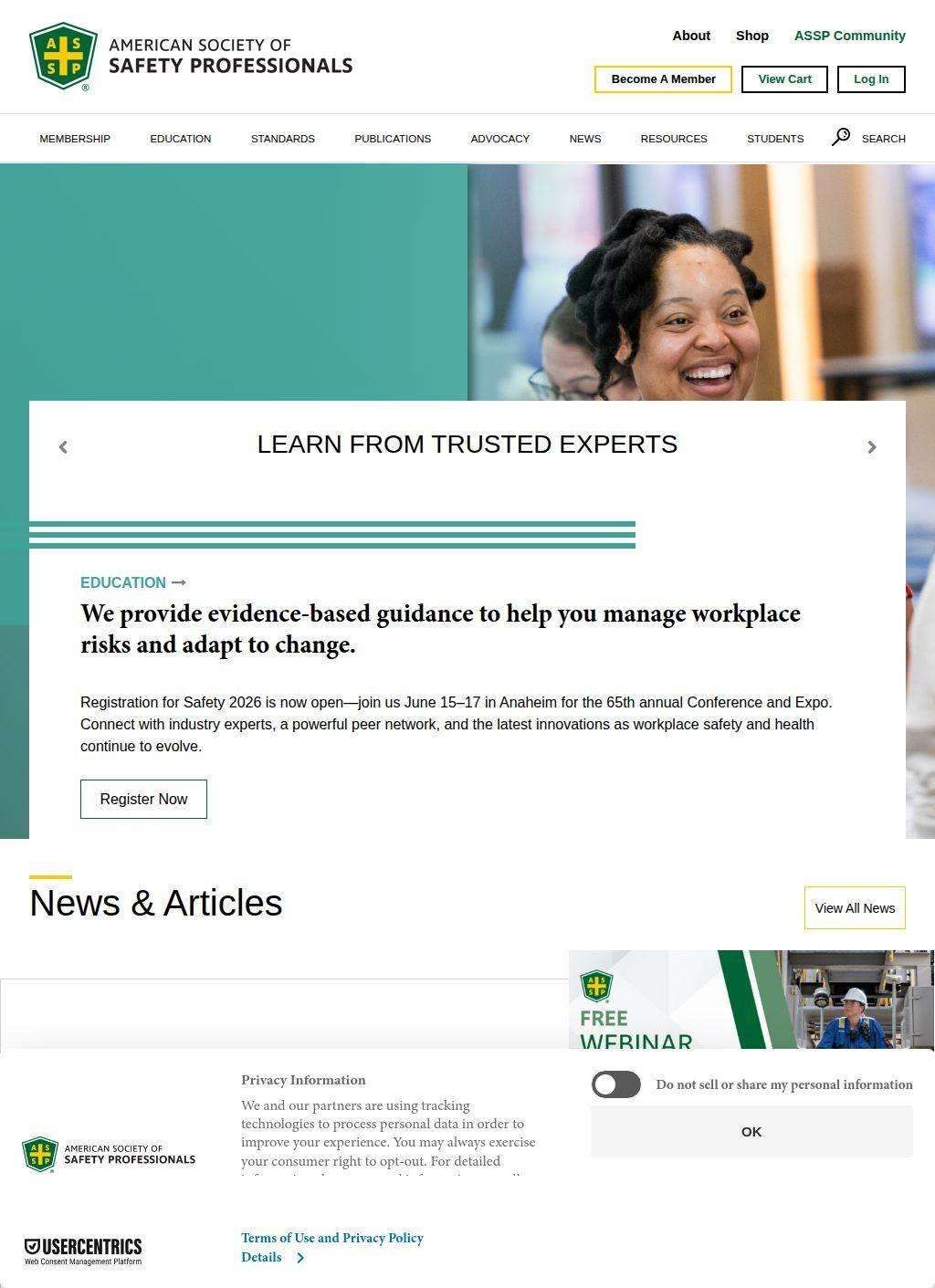
Who writes the rules that decide whether a walking surface is safe to stand on? A lot of the time the answer traces back to the American Society of Safety Professionals (ASSP), a membership association that has been working on occupational safety since 1911 and now speaks for more than 35,000 safety and health professionals around the world. That long run matters here, because the practical work of preventing slips, trips and falls leans on agreed technical standards, and this is one of the organisations that drafts them.
Developing consensus safety standards
The standards work is the part most directly tied to fall prevention. The American Society of Safety Professionals (ASSP) develops and publishes consensus safety standards across more than twenty topic areas, and those documents are available to buy through the site. For anyone whose work touches premises safety, the relevant material includes the A1264 standard on workplace floor and wall openings and on stairs and railings, alongside broader walking and working surfaces guidance. These are not opinion pieces. They are the negotiated technical baselines that engineers, employers and, often enough, courts and expert witnesses end up referencing when a fall becomes a dispute.
Standards for stairs, railings, floor openings
That overlap is worth naming plainly for a business directory entry that sits in a slip-and-fall legal category. A standards body is not a law firm, and the American Society of Safety Professionals (ASSP) does not handle injury claims or represent anyone in a slip-and-fall case. What it does is supply the underlying engineering consensus that such cases tend to argue over: what a compliant stair tread, handrail height or floor opening should look like. Someone trying to understand whether a property met the recognised standard at the time of a fall is closer to the source by reading the actual A1264 text than by reading a summary of it elsewhere.
How standards function in slip-and-fall disputes
Beyond the standards, the American Society of Safety Professionals (ASSP) puts a lot of weight on professional credentialing, and the site reflects that. It offers preparation resources for the main industry designations, the ASP, CSP, CHST and SMP certifications, the alphabet soup that marks a safety professional as having been tested against a recognised body of knowledge. The prep material sits alongside the certifications themselves, so a member moving toward one of these letters can find study support without leaving the ecosystem.
Professional credentials in safety
This is the kind of thing that gives the certification track real value: it ties directly into careers. The American Society of Safety Professionals (ASSP) runs a job board, mentoring programs, and offers scholarships and grants, which together make it a practical hub for people building a career in the field and more than a place to download a document. A student member and a twenty-year veteran are served by different parts of the same site, and the membership structure acknowledges that with standard, student and specialty tracks.
Career resources for safety professionals
Education is the connective tissue across all of it. The American Society of Safety Professionals (ASSP) delivers conferences, online courses and certificate programs through its own learning platform, and it publishes the Professional Safety Journal along with research publications and technical books. For a working professional, this is the continuing-education engine that keeps a credential current and keeps someone up to date as standards get revised. The publishing arm also means the organisation is producing original technical material, not reselling someone else's work.
Education, publishing, continuing learning
The community side is more developed than a casual visitor might expect. Membership is organised into communities by industry, so a construction safety specialist, a healthcare safety officer and a manufacturing professional each have a place tuned to their hazards. There are also affinity groups, including Women in Safety Excellence and dedicated networks for Black and Hispanic safety professionals. These are the parts of a long-established association that turn a subscription into something closer to a profession with a structure behind it.
Industry-specific communities and affinity groups
Advocacy rounds out the picture, and it connects back to the standards in a logical way. The American Society of Safety Professionals (ASSP) does government affairs and public policy work at both state and federal levels, which means the same organisation that writes a technical standard is also arguing for how safety should be regulated. For a reader who cares about why certain workplace rules exist, that is a useful thing to know about the source. It is not a neutral encyclopedia entry; it is a profession advocating for its own subject matter, openly.
Advocacy at state and federal levels
How does the whole thing read for someone who landed here from a slip-and-fall context specifically? Honestly mixed, and the category placement is part of why. The American Society of Safety Professionals (ASSP) goes deep on falls, but that depth is engineering depth, not legal depth. A person who needs to understand the recognised standard for a stairway, a ramp or a floor opening will find the authoritative document and the professionals trained to interpret it. The American Society of Safety Professionals (ASSP) is strong on the technical question of what safe should have looked like. It is a genuine primary source on workplace fall prevention, and the breadth of its work, standards, certification, education, publishing, advocacy, reflects an organisation that has had more than a century to build it out.
Technical expertise versus legal representation
Where it does not reach is the courtroom. The American Society of Safety Professionals (ASSP) will not tell a reader whether they have a claim, what a case is worth, or how to pursue it, and nothing on the site pretends otherwise. Its standards may end up cited in that process, but the organisation sits upstream of the legal fight, supplying the technical yardstick that others measure against. The site is dense and clearly built for practitioners, so a non-specialist should expect to do some reading before the relevance to their own situation becomes clear. That density is a fair trade for substance, though it does mean this is not light reading.
Recognizing what ASSP does not provide
So the useful distinction, in the end, is between the technical question and the legal one. If the goal is to grasp the engineering of why a fall happened and what the recognised standard required, the American Society of Safety Professionals (ASSP) is close to the source and the time spent here pays off. If the goal is legal representation after an injury, this is the wrong door, however authoritative the material behind it. The published evidence points to an organisation doing its own thing well; the gap is not in what it covers but in what it was never built to do. It sits in a different professional world from law firms and injury lawyers entirely, and anyone approaching it from the legal side needs to arrive with that expectation already set.
Business address
American Society of Safety Professionals
520 N. Northwest Highway,
Park Ridge,
IL
60068
United States
Contact details
Phone: 847-699-2929