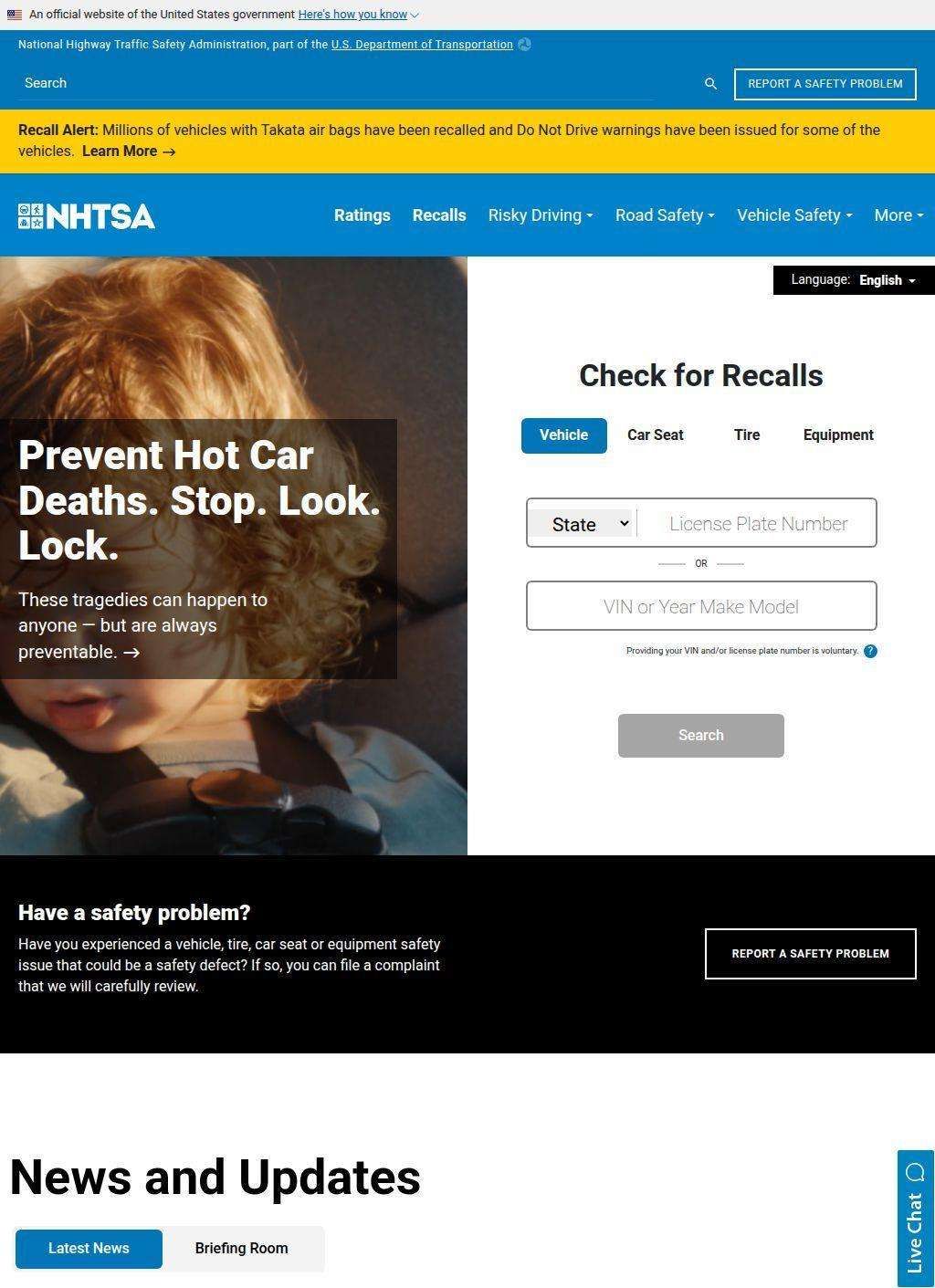
Type a vehicle VIN into the recall lookup tool and the site tells you, in seconds, whether the car you are sitting in is under an open safety recall, including the Takata air bag campaign that still carries Do Not Drive warnings for certain models. That single function is the most useful thing the National Highway Traffic Safety Administration (NHTSA) does for an ordinary person, and it sits a click or two from the front page. You can also search by license plate and state, by car seat brand and model, by tire brand, or by equipment type. Many drivers have no idea what a VIN even is until they go looking, so the multiple search paths are a practical choice rather than window dressing.
Recall lookup tool
The recall checker is only the entry point. The site lets people file safety complaints about a vehicle, a tire, a car seat, or a piece of equipment when something seems like a genuine defect, and those filings feed the investigations that can eventually force a manufacturer to act. Crash test results live here too, published as vehicle safety ratings, so someone comparing two cars before a purchase can pull the agency's own numbers instead of trusting a dealership pamphlet. For a motorcycle rider, the safety section gathers federal material on helmet use, rider behaviour, and the crash data that frames how dangerous a given choice really is. A personal injury claim or a careful buyer would want to cite the National Highway Traffic Safety Administration (NHTSA) directly, and this is where that original material sits.
Safety complaints and crash test results
The risky-driving coverage runs surprisingly wide. The National Highway Traffic Safety Administration (NHTSA) treats drug-impaired driving, distracted driving, speeding, and drowsy driving as separate subjects, each with its own material. That separation is honest about the fact that these are different problems with different fixes, and it means the site does not lump them together under a vague "road safety" umbrella. Road safety is also split by who is at risk: children, teen drivers, older drivers, pedestrians, cyclists, motorcyclists, and school buses. A parent worried about a newly licensed sixteen-year-old lands somewhere different from a city planner thinking about pedestrian crossings, and both find something built specifically for them.
Risk categories by driver type
On the equipment side, the catalogue is long and specific. Car seats and boosters, seat belts, tires, air bags, driver assistance technologies, electric and hybrid vehicles, automated vehicles, vehicle theft prevention, odometer fraud, adapted vehicles for drivers with disabilities, and even the notoriously tricky 15-passenger vans each get their own treatment. That last one tells you something about the agency's instincts. Fifteen-passenger vans roll over more readily than people expect, and the National Highway Traffic Safety Administration (NHTSA) carving out a dedicated topic for them is a sign that content follows real crash patterns rather than whatever happens to be in the news.
Equipment topics and manufacturer resources
There is a second audience here that an ordinary reader might miss. The National Highway Traffic Safety Administration (NHTSA) carries resources aimed at vehicle manufacturers and at state governments, alongside the published data, the research, the laws and regulations, and the enforcement and justice material. A lawyer working a motorcycle wreck case, the category this listing falls under in the business directory, would care about that regulatory and enforcement layer as much as the safety tips, because the standards a manufacturer was supposed to meet are spelled out in the same place the crash data lives. A briefing room handles agency news, announcements, and event updates for anyone tracking policy as it moves.
English and Spanish availability
The English and Spanish availability is worth noting plainly, since a large share of the people most exposed to road risk are not served by English-only safety guidance. It is an easy thing to skip past in a site description, but it changes who can use the material in any practical way.
The National Highway Traffic Safety Administration (NHTSA) is built to be authoritative on the data it generates, the recalls it tracks, and the rules it enforces, and on those it is the original source. The breadth across so many topics raises a fair question about how current and how detailed each individual corner stays. A site that tries to speak to manufacturers, state officials, parents, riders, and litigators at once is carrying a heavy load, and breadth and freshness pull against each other on a project this size. That tension does not fully resolve itself.
Depth versus breadth on motorcycle safety
For the motorcycle-focused reader who arrived through this listing, the picture is mixed. The rider-safety and crash-data material genuinely comes from the body that collects it, and the National Highway Traffic Safety Administration (NHTSA) is hard to beat as a source for a court filing or a serious safety argument. The agency gives a lawyer or an injured rider the federal numbers and the regulatory backbone they would otherwise have to assemble from scattered places.
Whether the helmet-effectiveness and rider-fatality material is detailed enough to carry an argument on its own, or whether it mostly points toward the raw datasets and research reports to do the real work, is something the description does not settle. The recall tool will tell you in seconds whether a bike is under open recall. The harder question, what the National Highway Traffic Safety Administration (NHTSA)'s own analysis concludes about a specific class of crash, is one the topic map alone cannot answer. That gap is exactly where a serious case still has to dig deeper into the National Highway Traffic Safety Administration (NHTSA)'s published research.
Business address
National Highway Traffic Safety Administration
1200 New Jersey Avenue SE, West Building,
Washington,
DC
20590
United States
Contact details
Phone: 1-888-327-4236