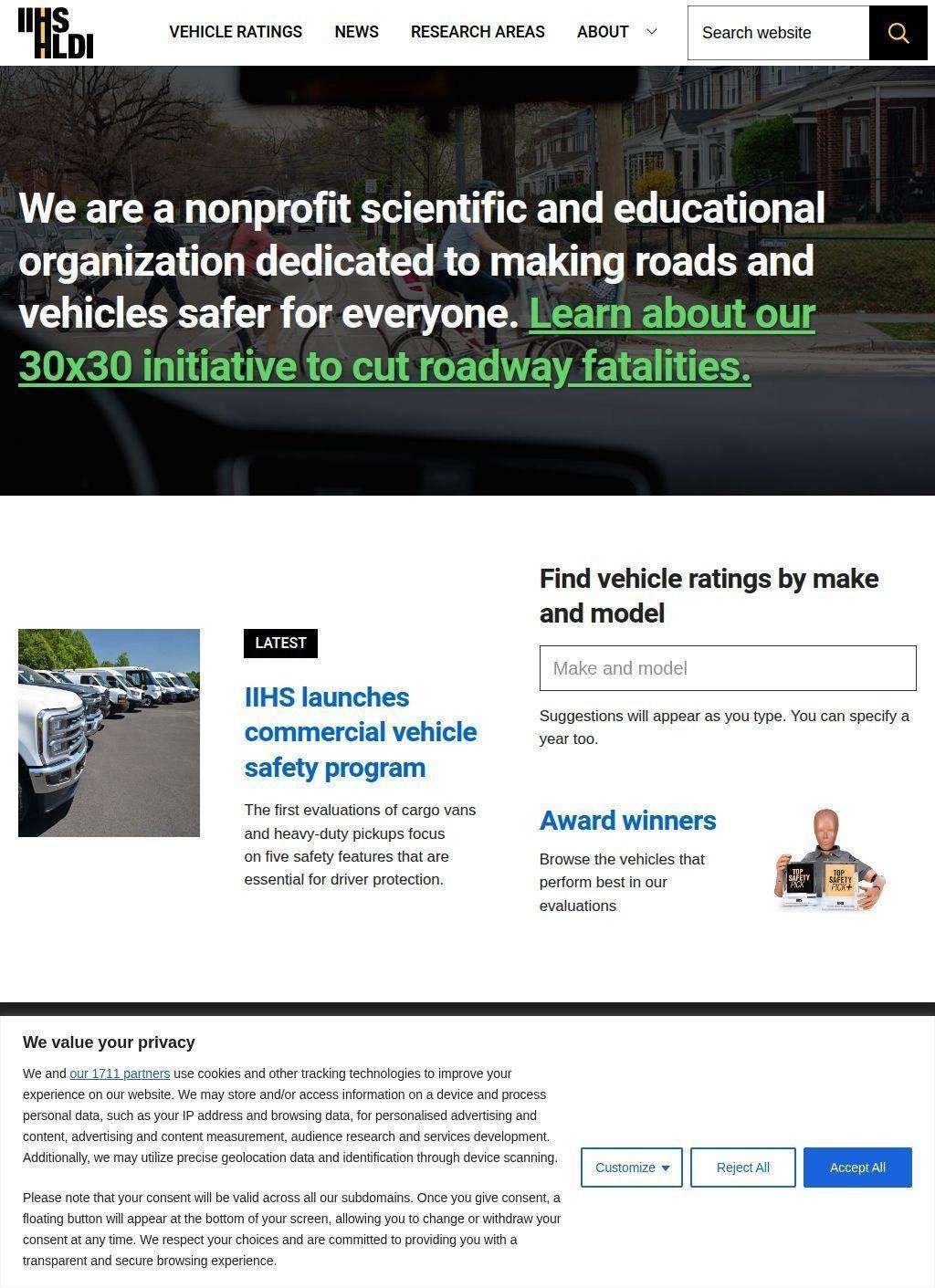
Funded by auto insurers and organized as an independent nonprofit, the Insurance Institute for Highway Safety (IIHS) studies how vehicles and road users come through crashes. Its appearance under a motorcycle-injury heading is a little sideways, since this is not a law firm and offers no legal service, but the body of work behind it touches motorcycle safety squarely enough that anyone researching a wreck will find something useful here. The center of the site is the crash-test program and the ratings that come out of it, with the TOP SAFETY PICK and TOP SAFETY PICK+ awards marking the vehicles that perform best. Those ratings are searchable by make, model, and year, which makes the site a working tool rather than a reading library.
Nine research areas covering road safety
What gives the Insurance Institute for Highway Safety (IIHS) its weight is the breadth of subjects it tracks. Nine research topic areas run across the site: advanced driver assistance systems, distracted driving, large trucks, motorcycles, pedestrians and bicyclists, red-light running, seat belts, speed, and alcohol or drugs. Each of those is a real field of study with published findings behind it, not a marketing tab. The motorcycle work is the relevant slice for a reader who lands here from an injury context. It covers ground like helmet laws and the effect of anti-lock braking on motorcycles, the sort of evidence-based topics that get cited in policy fights and, occasionally, in courtrooms.
Motorcycle safety and helmet laws
The published material is peer-reviewed, and that distinction counts when so much road-safety content online is opinion dressed up as fact. The Insurance Institute for Highway Safety (IIHS) puts out studies, safety statistics, and policy recommendations, and it ties them to specific vehicle data through its affiliated Highway Loss Data Institute (HLDI), which analyzes insurance loss results model by model. Read together, the testing arm and the loss-data arm let a visitor move from a headline rating down to how a particular car or truck actually fares in real claims. That layered structure is harder to find than it sounds, and it is the reason researchers, journalists, and policymakers keep coming back.
Peer-reviewed studies with loss data
The audience is wider than the engineers and statisticians who produce the work. A parent shopping for a teen driver is well served: there is a teen vehicle safety list covering both new and used cars, plus parent guides aimed at the years when a new driver is most exposed. A general buyer gets a vehicle shopping guide that translates ratings into something usable at a dealership. Educators have their own track too, with a free classroom curriculum called "Crash Science in the Classroom" that brings the testing methodology into a teaching setting. These resources are written for people who will never read a peer-reviewed paper but still need the conclusion.
Resources for parents and teen drivers
That mix shapes how a visitor might move through the site. A car shopper should head straight for the ratings search and the shopping guide. A teacher will want the curriculum. Someone digging into a motorcycle crash, whether to understand what happened or to build an argument around it, will get the most from the motorcycle topic area and the HLDI loss data, where the helmet-law and braking research lives. The site does not force everyone down one path, and the navigation respects that the parent and the policymaker arrive with different questions.
How to navigate the website
The Insurance Institute for Highway Safety (IIHS) also runs a flagship campaign it calls "30x30," which sets a target of cutting U.S. roadway deaths by thirty percent by the year 2030. It is worth noticing because it tells you what the organization thinks its research is for: not ratings as an end in themselves, but fewer people killed on the road. That framing runs underneath the topic areas and gives the whole site a direction. The numbers and the awards are the means; the fatality target is the stated point.
The 30x30 fatality reduction target
On the question of independence, the funding model deserves a plain word. The Insurance Institute for Highway Safety (IIHS) is paid for by the insurance industry, and a skeptic could ask whether that shades the results. The honest read is that insurers have a direct financial stake in cars that crash less and drivers who survive more, so the incentive points toward rigorous testing rather than soft grades. The peer-reviewed publication record and the separately branded HLDI data give outside readers a way to check the work instead of taking it on trust. That is a healthier arrangement than many industry-funded research shops manage.
Who funds this research?
If there is a limit to flag, it is one of scope and not of quality. The Insurance Institute for Highway Safety (IIHS) tests and explains; it does not advise individuals on what to do after a specific collision, and it makes no claim to. A reader who came here expecting case-by-case help with a motorcycle injury will need a different kind of professional for that. What the site delivers, it delivers thoroughly. The crash-test footage, the rating tables, the topic write-ups, and the loss data are dense with checkable detail, and they hold up to a second and third visit in a way quickly assembled content never does.
Free guides for vehicle shoppers
The teaching and parent-guide material rounds out the picture. A new-driver household can build a genuinely informed plan from the teen vehicle lists and the parent guides without paying anything or wading through jargon. The vehicle shopping guide does the same translation work for any buyer who cares about safety but cannot interpret a structural test on their own. Few research organizations bother to meet a lay audience this far down the road; the Insurance Institute for Highway Safety (IIHS) clearly decided that publishing findings the public cannot use defeats the purpose.
Taken as a whole, this is one of the more useful destinations on the open web for anyone choosing a vehicle with safety in mind. The Insurance Institute for Highway Safety (IIHS) publishes all of it freely. The concrete starting point is straightforward: open the teen vehicle safety list or the ratings search, enter a make, model, and year, and the Insurance Institute for Highway Safety (IIHS) does the rest without asking for a payment or an email in return.
Business address
Insurance Institute for Highway Safety
4121 Wilson Boulevard, 6th floor,
Arlington,
VA
22203
United States
Contact details
Phone: (703) 247-1500