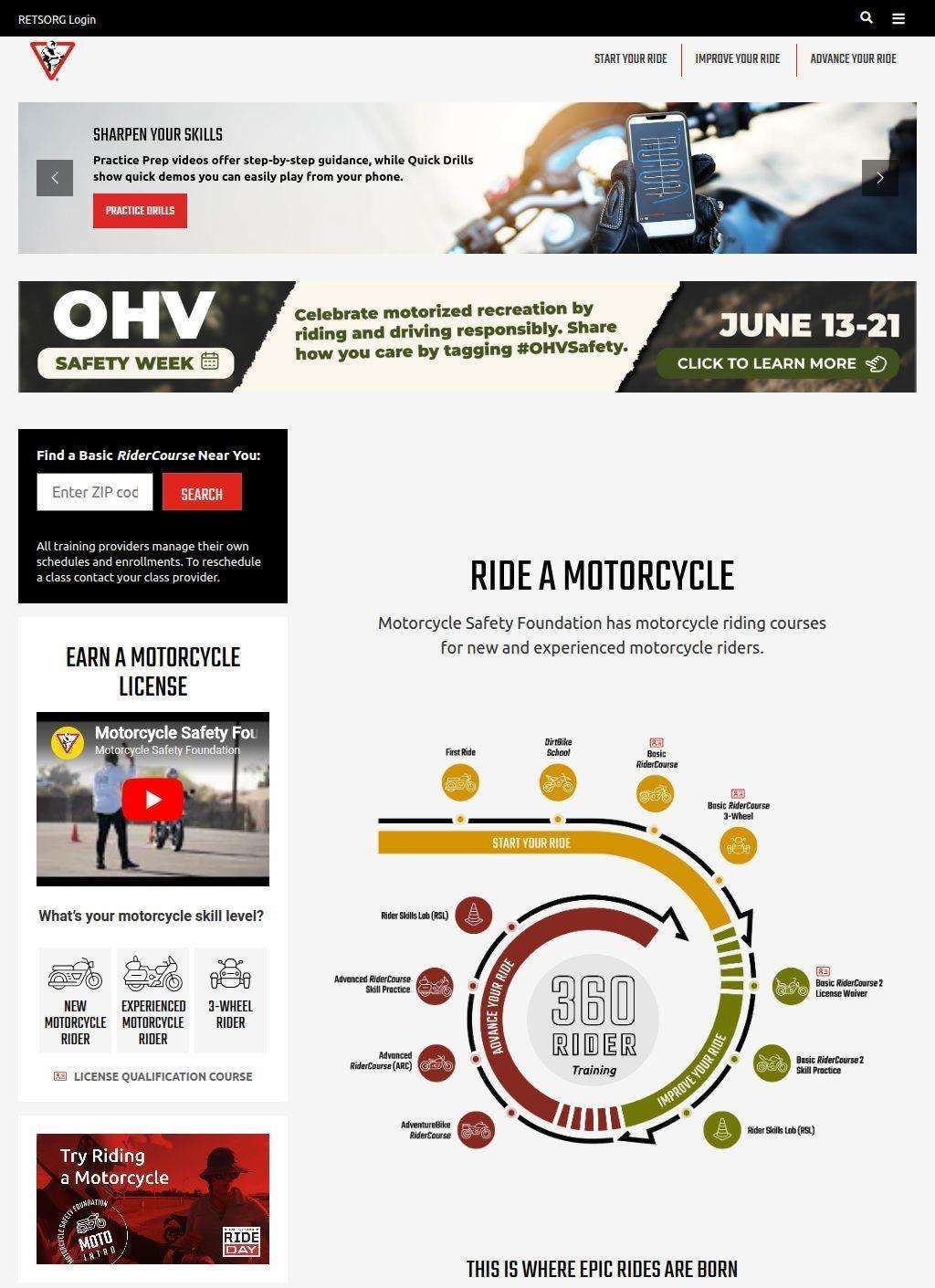
Most American motorcyclists run into the Motorcycle Safety Foundation (MSF) before they ever know what it is. They sign up for a weekend course at a community college or dealership lot, and the lesson plan, cone drills, and the rulebook handed to the instructor all trace back to the Motorcycle Safety Foundation (MSF). That reach is the single most useful thing to understand about the site before clicking into any of its sections.
Training courses for riders at every level
The training catalogue is where the substance lives. The Basic RiderCourse sits at the front, aimed at people who have never thrown a leg over a bike, and it is the program many states accept in place of the on-road licensing test, which is the practical reason most newcomers end up here in the first place. Beyond that entry point the Motorcycle Safety Foundation (MSF) lists Experienced RiderCourse variants for people coming back to riding or sharpening skills they already have, a 3-Wheel Basic RiderCourse for trikes and similar machines, and DirtBike School programs that sit slightly apart from the street-focused material. The spread is wide enough that the same household could plausibly use the site across very different stages of riding.
Online modules before in-person classes
For people who want to start before they are physically in a class, there is an online tier: a Basic eCourse, a Street Strategies module, and a Human Factors course. The Human Factors inclusion is more interesting than the licensing-oriented modules, because it addresses the part of riding that classroom cones cannot easily teach: the judgment and attention side of staying upright in traffic. These online pieces appear designed to feed into the in-person courses rather than replace them, which is the sensible arrangement for a skill that ultimately has to be performed on a real machine.
Research materials, guides, videos
The Motorcycle Safety Foundation (MSF) does not stop at structured courses. It maintains a library of research materials, quick-tip guides, practice drill videos, and a YouTube channel, so a rider who wants to keep working on slow-speed control or emergency braking between formal sessions has somewhere to go. There is a RiderCourse Rewards loyalty program and a merchandise store as well, which sit on the lighter, consumer-facing side of what the Motorcycle Safety Foundation (MSF) does and feel secondary to the education mission, though they are clearly part of how the organization keeps riders engaged over time.
Resources for deaf and hard-of-hearing riders
The breadth of audience the Motorcycle Safety Foundation (MSF) tries to serve is worth noting. New riders chasing licensure are the obvious group, but the site also speaks to returning and experienced riders, adventure and dual-sport riders, and, notably, deaf and hard-of-hearing riders, for whom specialized resources exist. Many training outfits skip that last category entirely; its presence here suggests the organization treats accessibility as part of the job rather than a footnote. Instructors and training providers are addressed too, which makes sense given that the Motorcycle Safety Foundation (MSF) effectively sits behind a national network of local courses as their curriculum supplier.
Safety information for car drivers
There is also a car-driver angle. Beyond rider education, the Motorcycle Safety Foundation (MSF) produces material aimed at people behind the wheel of a car who share roads with motorcyclists, a reasonable extension of a safety mission that cannot succeed if only one half of the road understands the other. Whether drivers seek out motorcycle-safety content in practice is another matter, but the resources exist, and a rider could point a nervous family member toward them.
Manufacturer support and curriculum standards
The funding structure is the part that deserves a clear eye. The Motorcycle Safety Foundation (MSF) is supported by U.S. motorcycle manufacturers and distributors, and it is affiliated with the ATV Safety Institute and the International Motorcycle Institute. For most uses this backing is a strength, since it is what lets the organization maintain a standardized national curriculum that states are willing to recognize. A skeptic could reasonably ask what it means for safety messaging to be funded by the companies that sell the machines, and the site is, understandably, not the place that question gets answered.
Finding local training providers
As a destination, the Motorcycle Safety Foundation (MSF) does the thing it claims to do: it is the curriculum authority behind a large share of American rider training, and the site reflects that role across courses, online modules, research, and instructor resources. The harder thing to judge from the outside is how much of the value lives on this site versus in the local providers who run the courses. A rider can read every guide and watch every drill video here and still need to find, book, and pay a separate training site to get the certification they are after, and how smoothly that handoff works is the question the Motorcycle Safety Foundation (MSF) leaves a visitor to resolve on their own.
Business address
Motorcycle Safety Foundation
15635 Alton Parkway, Suite 390,
Irvine,
CA
92618
United States
Contact details
Phone: (949) 727-3227