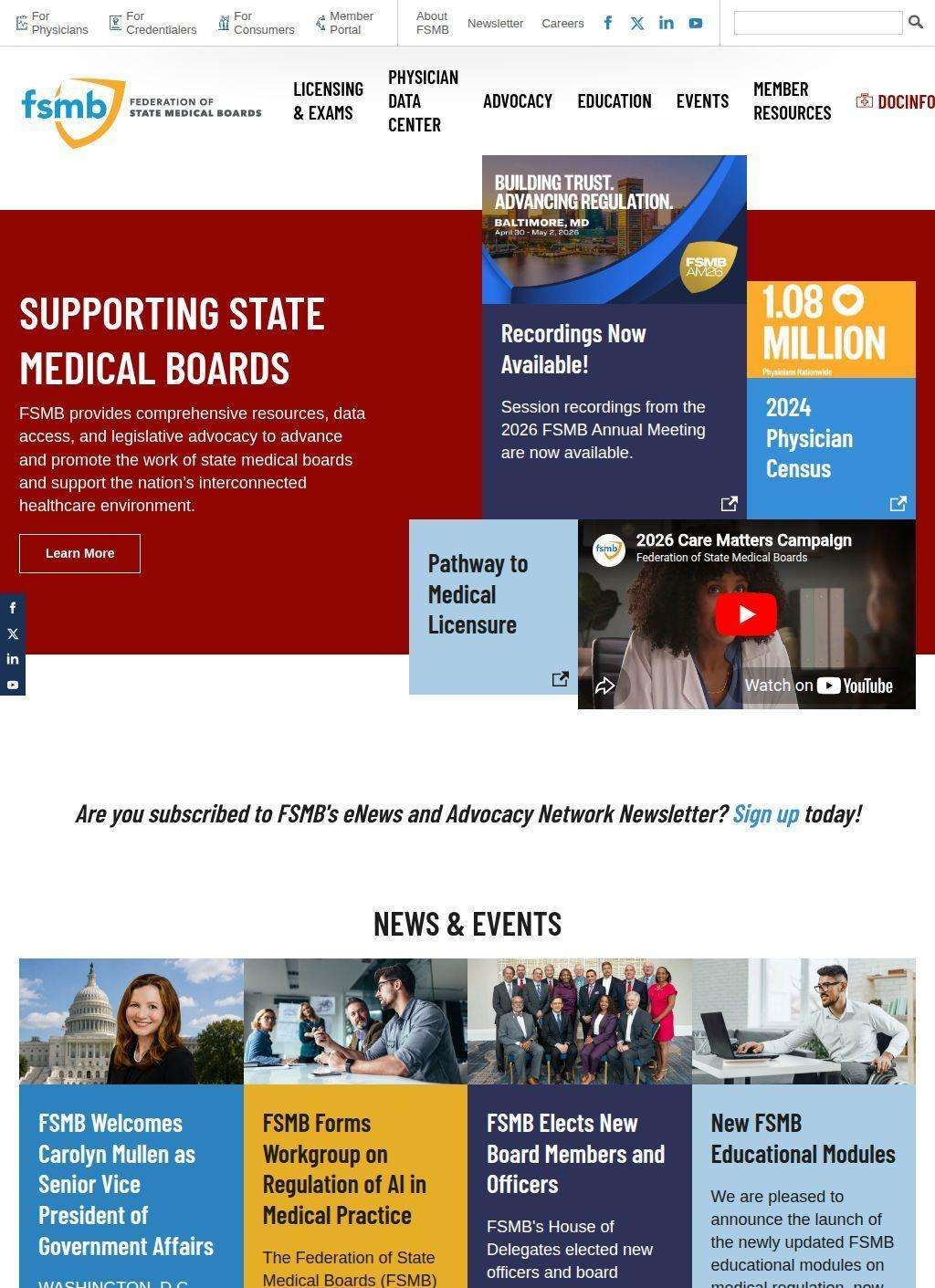
The Federation of State Medical Boards, usually shortened to FSMB, is the national nonprofit organization that represents the state medical and osteopathic boards of the United States and its territories. Those boards are the agencies that actually license physicians and, when necessary, discipline them. The Federation gives them a common forum, shared data, model policies, and a national clearinghouse for the records that follow a doctor from state to state. Anyone studying how medical regulation and physician accountability work in this country runs into the FSMB quickly, which is why it sits in this business directory's set of patient-safety and medical-oversight references.
Medical licensing structure in the United States
It helps to understand the structure of medical licensing first. There is no single national medical license in the United States. A physician is licensed by the individual state where they practice, and each state board sets its own rules, runs its own investigations, and issues its own disciplinary orders. That decentralization protects local control but creates an obvious gap: a doctor sanctioned in one state could, without some connective system, simply apply elsewhere. The Federation was founded in 1912 precisely to close that gap by helping boards coordinate, and that coordinating role remains its central purpose more than a century later.
Closing gaps between state boards
One of the FSMB's most concrete functions is the Physician Data Center, a national repository of licensure and disciplinary information contributed by the boards themselves. When a board takes an action against a physician, that action is recorded centrally, so a board in another state evaluating a new applicant can see the full history rather than only what the applicant chooses to disclose. This is the regulatory counterpart to credentialing checks done by hospitals, and it is one of the main mechanisms that keeps a sanctioned physician from disappearing and reappearing somewhere new. The data center has tracked disciplinary actions for decades and is a primary source for research on physician discipline trends.
Physician Data Center
For the general public, the Federation runs DocInfo.org, a free service where patients can look up a physician's licensure status, the states where they are or have been licensed, their medical education, and whether any board actions are on record. This is one of the few places where an ordinary person can check a doctor's regulatory standing across state lines from a single search rather than visiting many separate state board websites. The service is straightforward and free to use, and it draws directly on the data boards report to the Federation, which makes it more current and more complete than piecing the same information together state by state.
Public lookup through DocInfo.org
The FSMB also co-owns, with the National Board of Medical Examiners, the United States Medical Licensing Examination, the three-step exam that allopathic physicians must pass to be licensed. The Federation's involvement in USMLE ties it directly to the entry point of the profession. Beyond examination, it develops model policies and guidelines that state boards can adopt, on subjects ranging from telemedicine and opioid prescribing to physician sexual misconduct and the use of social media.
Examination and policy development
These models do not bind any board, since each board makes its own rules, but they shape the national conversation and give smaller boards a well-researched starting point they would struggle to produce alone. The Federation's policy on telemedicine, for instance, was widely referenced as states scrambled to write rules for remote care, and its guidance on physician wellness and on responsible opioid prescribing reached boards that had no in-house capacity to draft such documents themselves.
Model policies for state boards
Another effort here is the Interstate Medical Licensure Compact, which the Federation helped develop and continues to support. The compact creates a faster pathway for physicians who are licensed in one participating state to obtain licenses in others, which has become more important as telemedicine has grown and as rural areas have looked for ways to draw in specialists. The compact does not weaken the boards' authority; each state still issues and controls its own license and retains full disciplinary power. It simply streamlines the paperwork for qualified physicians, and the Federation acts as a central administrator for parts of the process.
Interstate Medical Licensure Compact
The scale involved is large. The Federation represents roughly seventy state medical and osteopathic boards across the states, the District of Columbia, and the territories, and those boards together license well over a million physicians and physician assistants. Its disciplinary database has accumulated decades of board actions, and its annual summaries of that data are watched closely by anyone tracking whether discipline is rising or falling and how it differs by state. The Federation also publishes census reports on the physician workforce, drawn from licensure records, that researchers use to study how many doctors are practicing, where, and in what specialties. Because that information comes straight from the licensing authorities rather than from surveys, it carries a weight that estimated figures do not.
Scale and research resources
The audience for the FSMB is layered. State boards are its members and primary constituents. Physicians interact with it through licensing exams, the data center, and the licensure compact. Hospitals and credentialing organizations use its verification services to confirm a physician's history. Researchers and policy analysts mine its disciplinary data and read its policy work. Patients use DocInfo to check a doctor. Attorneys handling medical malpractice or licensing matters sometimes consult board action records that ultimately flow through the Federation's systems, though the FSMB itself does not adjudicate complaints or represent any party.
Who uses FSMB services
That last point deserves emphasis. The Federation does not license physicians, and it does not discipline them. Those powers belong to the individual state boards, which are government agencies. The FSMB is a private nonprofit that serves and connects those boards; it has no authority to revoke a license or order a sanction. A patient with a complaint about a doctor must file it with the relevant state board, not with the Federation. Understanding that division of labor matters, because it is easy to assume a national-sounding organization holds national enforcement power, and in this case it does not.
What the Federation does not do
There are honest limitations to keep in view. Because each state board operates independently and reports on its own timeline, the completeness and freshness of the central data depend on the boards' own diligence, and standards for what counts as a reportable action vary from state to state. A clean record on DocInfo means no reported board action, which is not the same as a guarantee of competence or an absence of malpractice settlements, since malpractice payments are tracked through a separate federal system rather than by the boards in most cases. Users should read what the service actually shows rather than what they hope it implies.
The organization is headquartered in Euless, Texas, with an additional presence in Washington, where it engages on federal policy affecting medical regulation. Its website serves as the hub for member boards, the policy library, verification and data services, examination information, and links to DocInfo for the public. The material is written for a professional and regulatory audience for the most part, though the public-facing lookup tool is accessible to anyone.
For this business directory, the FSMB is the connective layer of the state-based licensing system, the body that keeps fifty-plus independent boards working from shared records and compatible policies. It is non-commercial, long-established, and authoritative on questions of physician licensure and discipline. A visitor who wants to verify a doctor's standing, understand how medical boards coordinate, or study national patterns in physician discipline will find primary, reliable material here. As with the other entries in this category, it answers a specific slice of the medical-accountability question rather than all of it, and it is precise about the boundary between its own role and the enforcement power that stays with the states.
Business address
Federation of State Medical Boards
400 Fuller Wiser Road, Suite 300,
Euless,
TX
76039
United States
Contact details
Phone: (817) 868-4000