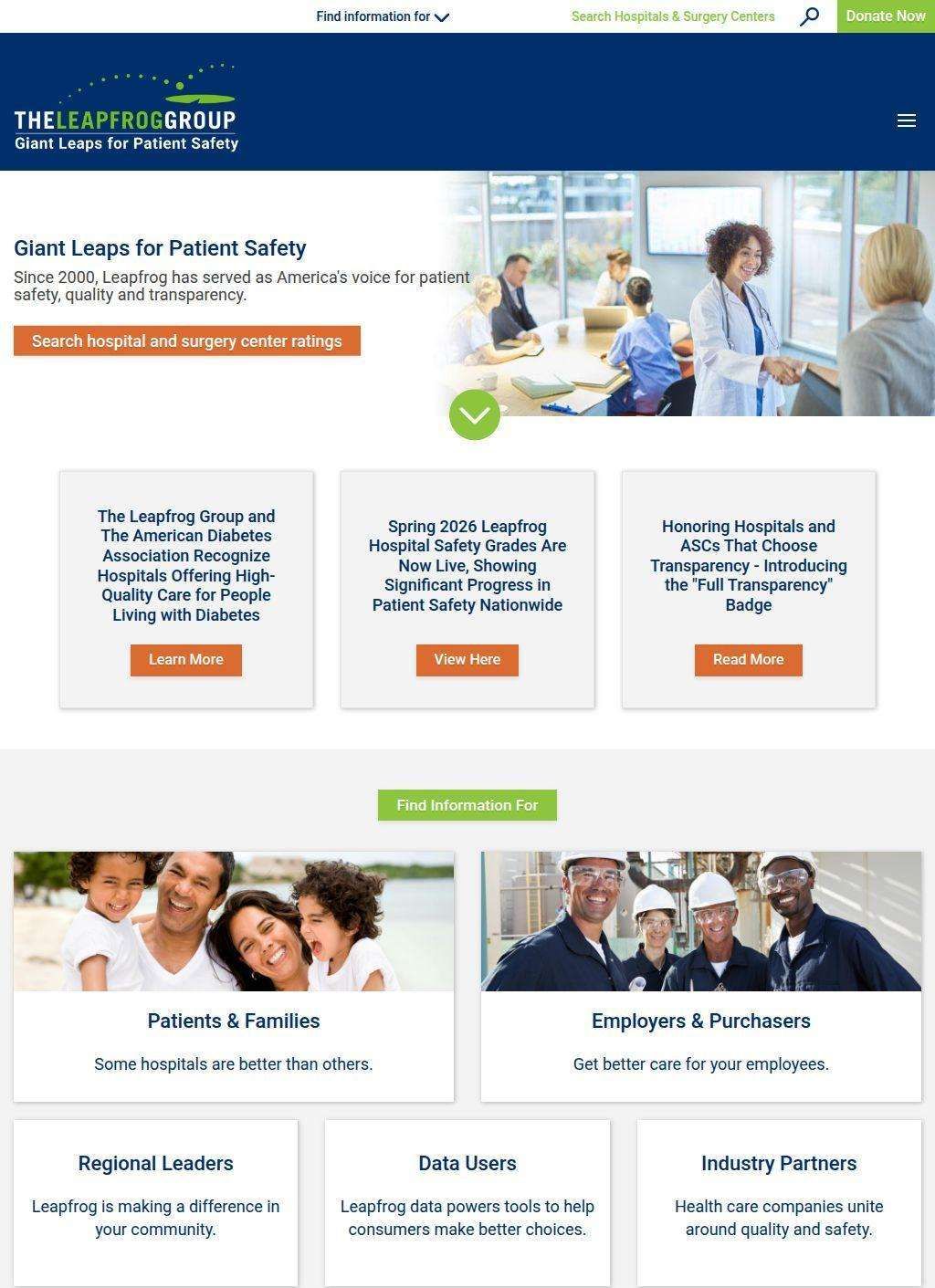
How do you find out whether the hospital down the road is any good at keeping its patients from being harmed? That question sits at the center of what The Leapfrog Group does, and the answer it gives is unusually concrete. The Leapfrog Group is a national nonprofit that has spent since 2000 collecting hard data on how American hospitals and surgery centers perform on safety, then handing that data to the public in a form ordinary people can read. It grades hospitals, scores surgery centers, and publishes the numbers instead of sitting on them.
Hospital Safety Grade system
The clearest expression of that mission is the Hospital Safety Grade. Facilities get a letter, A through F, built on measures tied to errors, accidents, injuries and infections. A letter grade is a blunt instrument by design, and that bluntness is the point: a patient facing surgery does not want to parse a forty-page methodology, they want to know if the place they are about to check into has a track record of hurting people. The Leapfrog Group translates a dense pile of clinical measures into something a worried family member can act on in a minute, and that translation, done honestly and updated year after year, is harder work than it looks.
Ratings database for detailed comparison
Sitting alongside the grades is the Hospital and Surgery Center Ratings Database, hosted on its own ratings subdomain, where the detail lives for anyone who wants to go past the headline letter. Individual facilities can be looked up to see how they report against specific safety and quality standards, since two hospitals with the same overall grade can differ sharply on the one procedure a person actually needs. The split between the plain-language grade and the deeper database is sensible: it serves the anxious first-timer and the methodical researcher without forcing either to wade through the other's material.
Annual Hospital Survey process
The engine behind all of it is the annual Hospital Survey that The Leapfrog Group runs. Hospitals voluntarily report data on their practices and outcomes, and that self-reported information, checked and standardized, feeds the grades and the ratings. Voluntary reporting has an obvious tension built into it, and The Leapfrog Group leans into transparency as the counterweight: a hospital that declines to report is itself a visible data point, and that creates a quiet pressure to participate. Over two decades that pressure has turned the survey into one of the more recognized benchmarks in the field.
Ambulatory Surgery Center reporting
There is a parallel track for outpatient care. The Ambulatory Surgery Center public reporting program extends the same idea to the freestanding surgery centers where a growing share of procedures now happen, places that historically drew far less public scrutiny than full hospitals. Bringing ASCs into the light is one of the more forward-looking parts of the program The Leapfrog Group runs, since it reflects where care is genuinely moving and gives a patient scheduled for a routine outpatient procedure a way to compare centers on safety that rarely existed before.
Diabetes Care recognition program
Beyond the core ratings, The Leapfrog Group runs a few targeted quality efforts. The Recognized Leaders in Diabetes Care program singles out facilities doing that work well, which gives the grading side a positive dimension too: it flags failures, but it also names performers worth emulating. There are educational resources for patients and families choosing a facility, along with case studies showing how the data plays out in real institutions, plus webinars and an annual Patient Safety Summit paired with an Awards Gala for hospital administrators, purchasers and regional health leaders who use The Leapfrog Group's data to push for improvement inside their own systems.
Who uses this data?
The range of who this site is built for is broad without feeling scattered. Patients and their families are the most visible audience, but employers who buy health coverage lean on the measures to steer their people toward safer care and to negotiate on quality. Regional health leaders use the regional and statewide patterns, researchers pull the underlying figures for their own analysis, and industry partners work with the programs directly. Each group meets The Leapfrog Group at a different door, and the site reads more like a specialized clearinghouse for hospital safety data than a general business directory.
The framing The Leapfrog Group uses for itself, America's voice for patient safety, quality and transparency, is a large claim, and the site mostly backs it with substance. A survey that runs every year, a grading system that has become a reference point, public databases anyone can query, and a steady stream of educational and recognition programs: that is a lot of moving parts pointed at a single goal, helping people avoid preventable harm when they are at their most vulnerable.
Is any of this a substitute for a conversation with your own doctor? Of course not, and The Leapfrog Group does not pretend otherwise. What it provides is the outside perspective a hospital's own marketing will never give. Marketing tells you about the new wing and the award-winning chef. This tells you whether patients tend to leave in better shape than they arrived, and those are different questions.
If there is a limit to the model, it is the one every voluntary-reporting system carries: the picture is only as complete as participation allows, and the grades reflect the measures chosen, not every dimension of care. The Leapfrog Group is candid about its methodology, and a reader who treats the grades as a strong indicator instead of a final verdict will get the most out of them. This entry belongs in the medical-safety category for a reason: the data often matters directly the moment someone is weighing a malpractice concern or picking the safer of two hospitals.
What keeps The Leapfrog Group credible across all of this is consistency. The grades come out on a schedule, the survey runs on a schedule, and the database stays public. There is no paywall between a scared family and the safety record of the hospital they are considering, and that free, open access is a large part of why hospital executives watch this organization closely.
The educational layer deserves a note of its own, since it is easy to overlook next to the flashier grades. Knowing that a hospital earned a C is only useful with some sense of what that means and what to ask about it. The guides on choosing care and the explanations of how to read a rating turn a number into a decision, and The Leapfrog Group puts real effort into that step instead of leaving people with a spreadsheet and no context.
For anyone about to schedule a hospital stay or an outpatient procedure, and for the family member helping them decide, The Leapfrog Group is a sensible first stop. Pull up the Hospital Safety Grade for the place under consideration, then open the ratings database and check how it performs on the exact procedure involved. On the purchasing or employer side, the survey results for hospitals in a given network are worth digging into on their own terms. Either way, the grade comes first, and a direct question to the facility about anything The Leapfrog Group's data raises comes second.
Business address
The Leapfrog Group
1775 K Street NW, Suite 400,
Washington,
DC
20006
United States
Contact details
Phone: (202) 292-6713