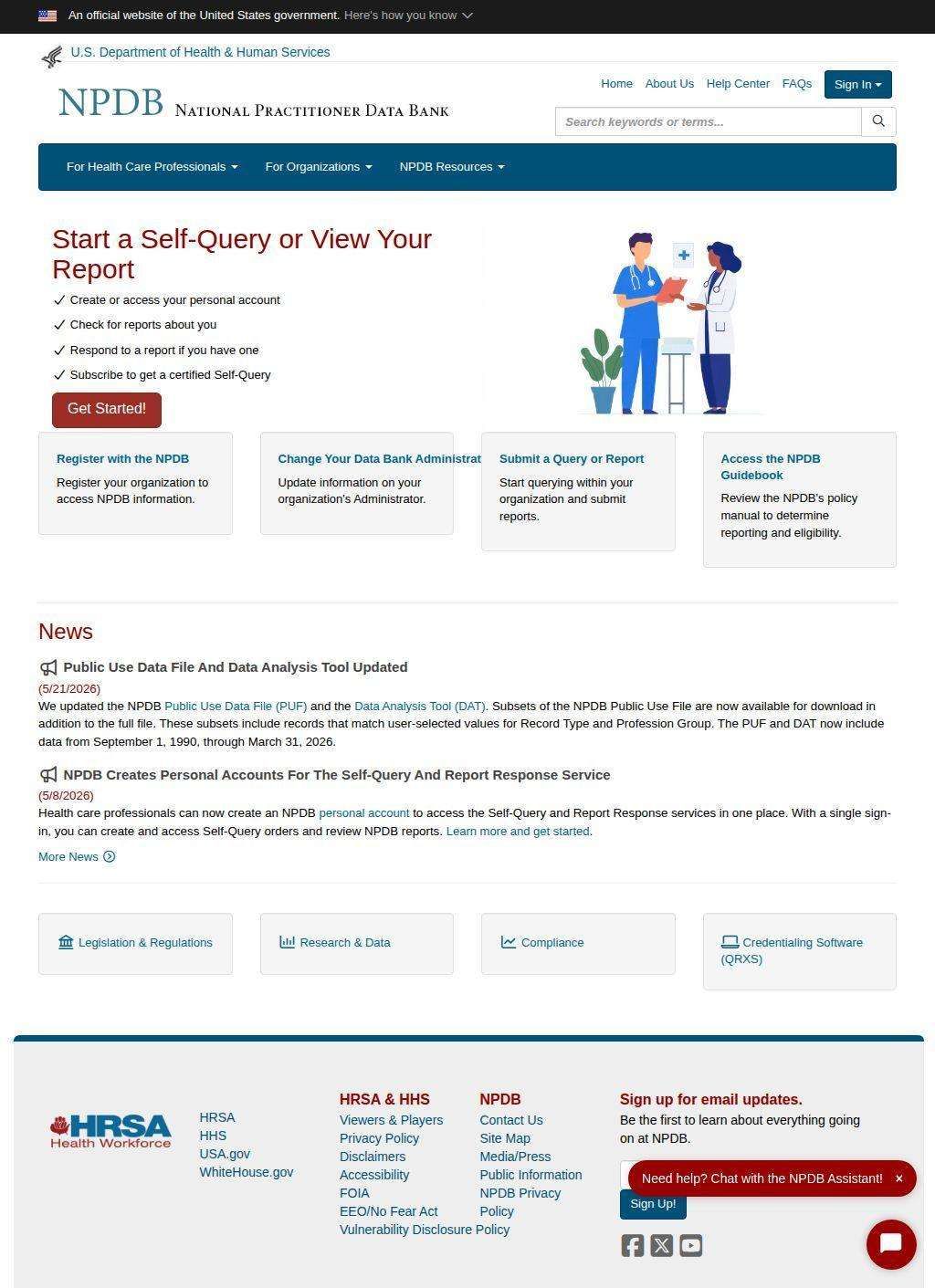
Type your own name into the Self-Query feature and, within a few business days, you can hold a printed copy of every malpractice payment, licensure action, or clinical privilege report ever filed against you under federal reporting rules. That single function tells you most of what the National Practitioner Data Bank (NPDB) is built to do: keep a permanent, queryable record of practitioner conduct that cannot quietly disappear when a doctor moves states or a hospital declines to renew privileges. Run by the Health Resources and Services Administration inside the Department of Health and Human Services, the site is the public face of a database that has been collecting reports since September 1990.
The reporting scope of the National Practitioner Data Bank (NPDB) is wider than the malpractice angle that brings most people here. Physicians and dentists are the household examples, but the records reach nurses, pharmacists, and other licensed providers, and the categories of reportable events stretch well past a courtroom settlement. Adverse licensure actions, restrictions or revocations of clinical privileges, professional society membership sanctions, DEA actions, exclusions from Medicare and Medicaid, and negative actions taken by health plans all land in the same file. A practitioner with a clean malpractice history can still carry a report for a privileging dispute or a program exclusion, which is exactly why credentialing offices treat a query as routine due diligence instead of an accusation.
Who can access NPDB records?
Access to the National Practitioner Data Bank (NPDB) is the part that surprises people who assume this works like a consumer review site. The general public cannot pull an individual practitioner's file. Querying is restricted to authorized entities: hospitals, other healthcare organizations, state licensing boards, federal agencies, and a defined set of organizations with a legitimate credentialing or peer-review reason to ask. Hospitals are required to query when a practitioner applies for privileges and again at set intervals, and the database is structured around that legal obligation. The design choice is deliberate. A national record of disciplinary history is a serious instrument, and the gatekeeping on who can read it is as important as the data inside.
Self-Query and dispute filing
That leaves practitioners with the Self-Query as their window into the National Practitioner Data Bank (NPDB). It is the one route an individual has to see the exact information a hospital or board would see, and the site pairs it with a meaningful right of reply. Anyone who believes a report misstates the facts can file a Statement of Dispute, which then travels with the report whenever it is disclosed. I find that detail more reassuring than any polished mission statement, because a permanent record without a correction mechanism would be a much harder thing to defend.
Administrator tools for organizations
The National Practitioner Data Bank (NPDB) also runs registration and account administration tools for the organizational side. Each participating entity designates a Data Bank Administrator who manages registration, user accounts, and querying permissions. None of this is glamorous, but it is the machinery that keeps the access rules from being theoretical rather than a buried afterthought.
Public Use Data File for research
For anyone studying patterns instead of individuals, the National Practitioner Data Bank (NPDB) opens up properly. The Public Use Data File is a downloadable, de-identified extract of the aggregate records, and the companion Data Analysis Tool lets you slice the figures without writing a single line of code. The coverage runs from September 1990 through March 2026, a long enough span to make trend work credible: shifts in malpractice payment sizes, changes in the volume of licensure actions, regional differences in disciplinary reporting. Journalists, health-policy researchers, and academics are the obvious audience.
Unified source for statistics and operations
One quiet strength here is that the research path and the credentialing path use the same underlying records, so a policy analyst studying national malpractice payment trends is reading from the same source a hospital relies on when it grants privileges. A claim made from the Public Use Data File can be traced back to the same reporting definitions that govern an individual report, and the Data Analysis Tool exposes those slices in a form a non-programmer can work with directly. For a federal system spanning three decades, having the public statistics and the operational data draw from the same source is more impressive than it first looks.
From regulations to educational resources
The policy side is consolidated in the NPDB Guidebook, which is the document people reach for when the rules get ambiguous. What counts as a reportable payment? When does a clinical privilege action cross the reporting threshold? The Guidebook is the federal answer, and having it sit alongside the database itself spares compliance officers from hunting through scattered regulations. A reference library of the underlying legislation backs it up for anyone who needs to trace a rule to its statutory source. Beyond the heavy reference material, there are educational videos and infographics aimed at people encountering the system for the first time, and they soften what is otherwise a dense regulatory subject.
It is worth being clear about what the National Practitioner Data Bank (NPDB) is not. It does not rank doctors, it does not publish patient-facing star ratings, and it will not tell a prospective patient whether a surgeon is any good. A report in the file is a record of an event, not a verdict on competence, and the system goes out of its way to frame it that way. People who arrive expecting a consumer scorecard tend to leave disappointed, while credentialing staff and researchers find it does precisely what it promises.
Pulling malpractice payments, board discipline, privilege actions, DEA matters, and program exclusions into one place is a genuinely hard coordination problem across fifty states and multiple federal agencies, and the National Practitioner Data Bank (NPDB) has been doing it for more than three decades. The Self-Query and Statement of Dispute give individuals a stake in accuracy, the access controls keep the data from being abused, and the Guidebook keeps interpretation consistent. For its intended uses, it is hard to fault.
A patient who wants to vet a specific doctor is better served elsewhere, and the National Practitioner Data Bank (NPDB) would be the first to say so. The natural comparison is a state medical board's public license-lookup, which a private individual can search directly and which surfaces a named practitioner's licensure status, public disciplinary actions, and board certifications without any authorization barrier. That is the right tool for the bedside question of whether this doctor in this state is in good standing. The National Practitioner Data Bank (NPDB) answers a different and broader question, the one a credentialing committee or a researcher asks: across the whole country and every reporting category, what is on the record.
Set the two side by side and the division of labor is clear. The state board is the consumer's first stop; the federal database is the institution's backbone. The National Practitioner Data Bank (NPDB) solves a problem no state-level system can: a practitioner's full history travels with them across jurisdictions, visible to any authorized body that asks. After more than thirty years of operation, the record shows it has done so consistently.
Business address
National Practitioner Data Bank (HRSA)
5600 Fishers Lane,
Rockville,
MD
20857
United States
Contact details
Phone: 1-800-767-6732