A family living near an old industrial site finds out the groundwater has been contaminated for years, and the questions come fast: what was in the water, what does long exposure to it do to the body, and is there any official record connecting the two. That is the moment the Agency for Toxic Substances and Disease Registry (ATSDR) becomes genuinely useful. It is a federal public health agency under the Department of Health and Human Services, and its work sits squarely where a chemical, a community, and a documented health effect intersect. For anyone working an environmental injury matter, that intersection is the whole case.
Toxicological profiles and substance index
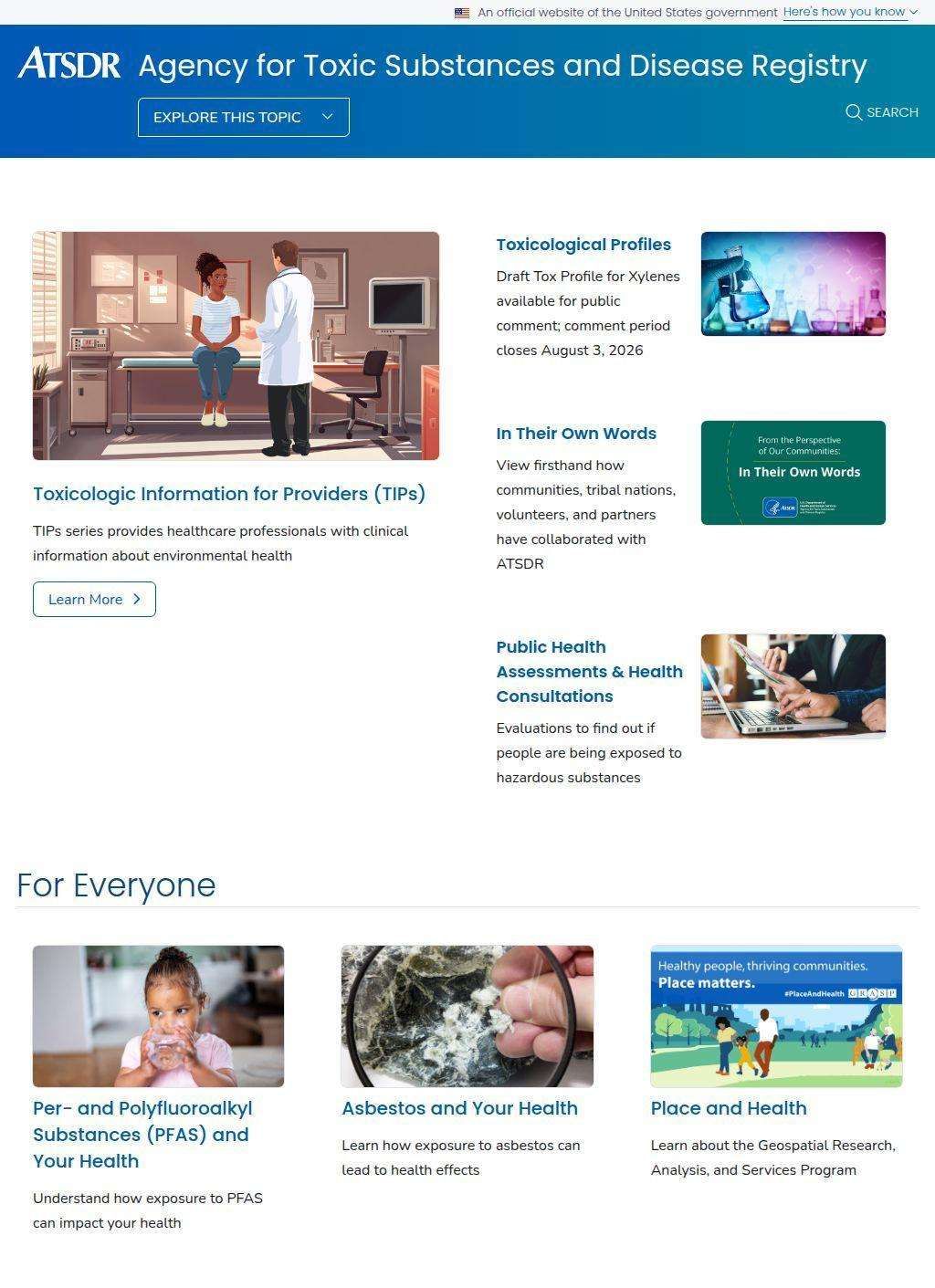
The backbone of the site is the set of Toxicological Profiles. These are long, peer-reviewed documents, each built around a single chemical, laying out the health effects, the routes of exposure, and the regulatory standards that apply. They are dense. They are also exactly the kind of source a lawyer, a treating physician, or an exposed resident needs when a vague worry has to turn into a specific, citable claim. The Agency for Toxic Substances and Disease Registry (ATSDR) pairs these with an A-Z substance index, so you can start from the name of a chemical and land on the science without wading through a dozen redirects. I went looking for a fairly obscure solvent and reached its profile in two clicks, which is not something I take for granted on a federal site.
Guidance for treating providers
The Agency for Toxic Substances and Disease Registry (ATSDR) keeps a separate track for clinicians. The Toxicologic Information for Providers (TIPs) section supplies guidance aimed at people who have to treat a patient walking in with a suspected exposure, which is a different job from cataloguing toxicology in the abstract. That split between the deep reference material and the bedside-oriented guidance shows the agency understands it has more than one audience.
Public health assessments of contaminated sites
Much of the field work shows up as Public Health Assessments and Health Consultations. The Agency for Toxic Substances and Disease Registry (ATSDR) evaluates specific contaminated sites, including Superfund and National Priorities List sites, and publishes what it finds. For an environmental injury matter, a published assessment of the exact site in question is close to the strongest non-litigation evidence available, because it predates the dispute and carries a federal name. Alongside that, the Assessment of Chemical Exposures (ACE) Program steps in after chemical releases to study what happened to the surrounding community, which fills the gap between a single incident and a measured population effect.
Topic-specific coverage for major contaminants
The topic-specific sections are where practical value concentrates. The Agency for Toxic Substances and Disease Registry (ATSDR) has built out dedicated PFAS coverage for the per- and polyfluoroalkyl substances that now drive a large share of contamination litigation, an asbestos section, and a Camp Lejeune area covering the water contamination there, with historical exposure data, health study results, and links to VA and DoD resources that bear directly on claims. That last one is particularly useful: Camp Lejeune cases turn on whether a person was present during a defined exposure window and whether their condition is among those the science links to it. The agency lays that groundwork out in the open instead of burying it.
National ALS registry for environmental exposure tracking
The National ALS Registry, administered by the Agency for Toxic Substances and Disease Registry (ATSDR), collects data on amyotrophic lateral sclerosis cases that may trace back to environmental exposure, an attempt to build a population-level picture of a disease whose causes remain hard to pin down. It will not resolve an individual case on its own, but it is the sort of long-horizon data collection that only a public agency tends to sustain.
From state partnerships to emergency response
The Agency for Toxic Substances and Disease Registry (ATSDR) also runs programs aimed less at the public and more at the institutions doing this work. The APPLETREE Cooperative Agreement Program funds state and local health departments to carry out environmental health activities, which is how a federal mandate reaches a county-level problem. Geospatial Research and Services provides mapping tools for analyzing where exposures fall across a population, useful when a contamination plume does not respect neighborhood lines. Regional offices handle emergency response to chemical incidents and support brownfield redevelopment, so the agency is working active sites alongside the historical record.
Breadth of audience is a real feature here. The Agency for Toxic Substances and Disease Registry (ATSDR) keeps content directed at tribal nations, at community groups trying to make sense of a local hazard, at government partners, and at healthcare providers. There is Spanish-language material, which for exposure events in many parts of the country is not a courtesy but a necessity. Annual reports round out the picture for anyone who wants to see what the agency did in a given period instead of taking its mission statement at face value.
What ATSDR does not do
What the site does not pretend to be is a substitute for a lawyer or a doctor. It is a reference. The Agency for Toxic Substances and Disease Registry (ATSDR) supplies the toxicology, the site evaluations, and the exposure data; turning that into a diagnosis or a filed claim is someone else's job. For the environmental injury context this listing sits in, that division of labor is the point. A claim resting on a Toxicological Profile and a published health assessment is standing on federal scientific work, which is a far sturdier footing than a general web search or a single expert's say-so.
There are limits worth naming. The material is technical, and a reader with no scientific background will find the profiles slow going. The agency reports associations and evaluates evidence; it does not assign legal liability, so no one should expect a document that says a particular company caused a particular illness. And because the science is cautious, conclusions are often hedged in ways that a layperson reading for certainty may find frustrating. None of that is a flaw in the work. It is the difference between evidence and advocacy.
The Agency for Toxic Substances and Disease Registry (ATSDR) is the primary scientific reference behind a large share of toxic exposure data used in environmental litigation and regulatory proceedings, and the site is structured to be used that way: start from a chemical, a site, or a known exposure event, and follow it to the documented findings. The A-Z index, the site assessments, and the Camp Lejeune and PFAS sections are the parts a researcher will return to most. They are detailed, sourced, and sitting in public view for anyone who needs to build a case on something firmer than worry.
Business address
Agency for Toxic Substances and Disease Registry
4770 Buford Highway NE,
Atlanta,
GA
30341
United States
Contact details
Phone: 800-232-4636