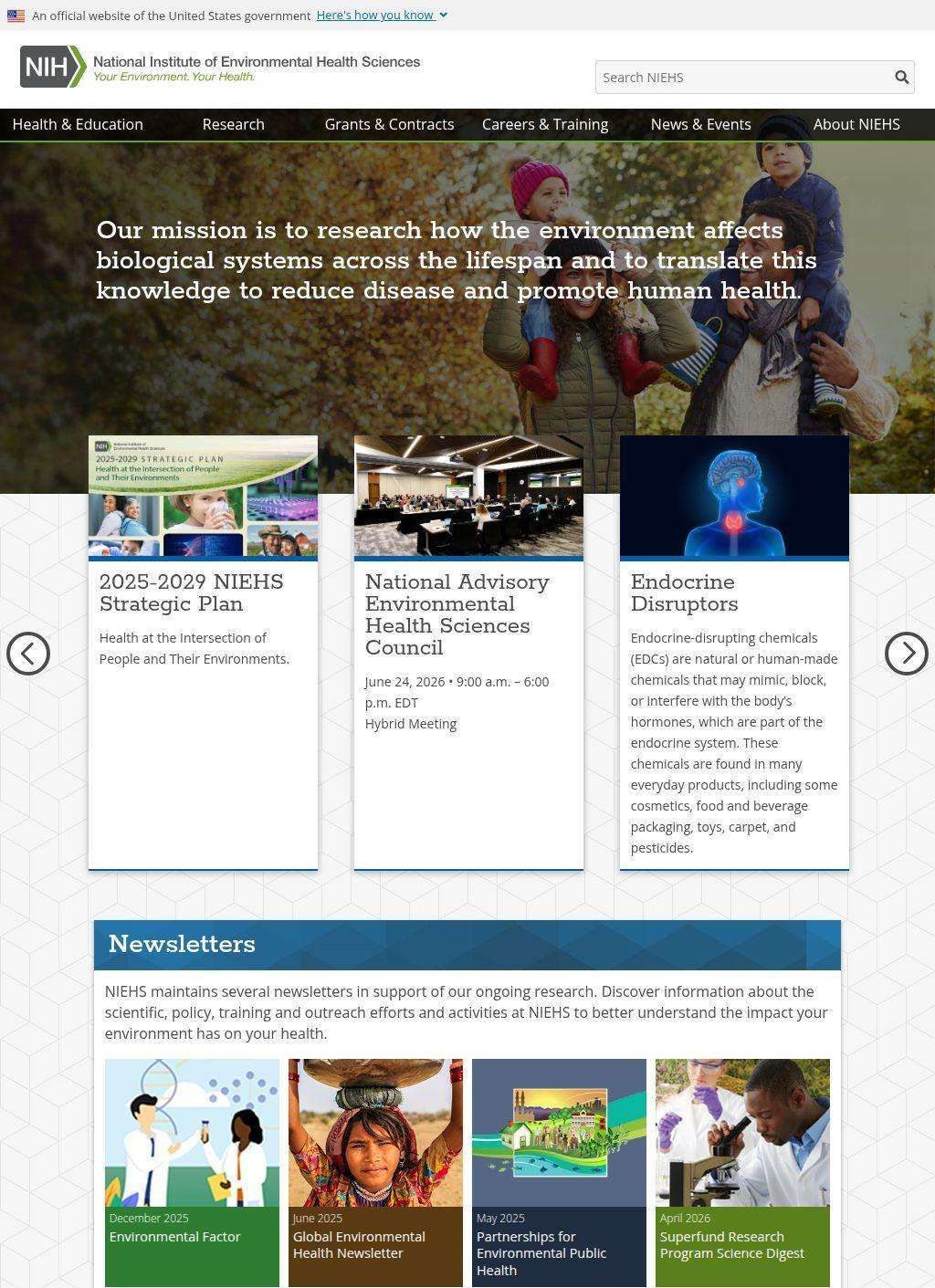
Run by the federal government and housed within the National Institutes of Health, the National Institute of Environmental Health Sciences (NIEHS) is the primary U.S. research body examining how environmental exposures shape human health and disease. Its base in Research Triangle Park, North Carolina, puts it at arm's length from the regulatory apparatus in Washington, though not from the science that apparatus ultimately depends on. For anyone arriving here from a category tied to environmental injury, that positioning matters: this is the research infrastructure that lawsuits and regulations are eventually built on, not the litigation itself.
Site organization and main sections
The site organizes itself into six main sections, and they cohere better than the typical federal portal. Health and Education is the part most general visitors will reach for first. It carries plain-language fact sheets on environmental health topics, guides explaining what a given exposure does to the body, and teaching material aimed at students and educators. A parent trying to understand lead, mold, or air quality can read something written to be understood, which is more than many government pages manage. The Research section goes the other direction, into the intramural and extramural divisions, the laboratories, and the specific scientific initiatives the National Institute of Environmental Health Sciences (NIEHS) backs. It is dense, but it is honest about what is being studied and by whom.
Health education resources
Grants and Contracts is where the National Institute of Environmental Health Sciences (NIEHS) shows its role as a funder as much as a lab. The section lists federal funding opportunities, grant databases, and the acquisition resources that researchers and institutions need to apply for money. Careers and Training runs parallel to it: federal job listings, fellowships, internships, and the worker training programs that prepare people who handle hazardous materials. Worker safety training is not an obvious offering from a research institute, yet here it is, treated as part of the core mission, not an afterthought.
Research funding opportunities
News and Events collects scientific meeting announcements, publications, podcasts, and media resources. About NIEHS handles the institutional plumbing: leadership, history, organizational structure, and community engagement. None of these are glamorous, but they are complete, and completeness is the point with a reference of this scope. You can trace who runs the place, how it is structured, and how it communicates with the communities its research touches.
Toxicology reports and chemical safety
The National Toxicology Program, administered by the National Institute of Environmental Health Sciences (NIEHS), conducts toxicity testing and publishes authoritative reports on carcinogens and chemical hazards. Those reports carry genuine authority. When a substance is formally evaluated as a probable carcinogen, this is often where that determination originates, and it is the kind of source regulators themselves cite when setting exposure limits. I found myself reading further into the NTP material than I expected to, simply because it answers what a chemical does instead of gesturing at consequences. For anyone investigating chemical exposure and its effects, the NTP reports are primary material, not a summary of someone else's primary material.
Open-access scientific journal
Environmental Health Perspectives, the peer-reviewed open-access journal that the National Institute of Environmental Health Sciences (NIEHS) publishes, adds something different. Open access means the research is free to read, so a member of the public, a student, or a clinician can pull the actual studies rather than abstracts behind a paywall. For a field where science is regularly contested in public and in court, having the underlying research openly available changes what a non-specialist can do with it.
Data repositories and research tools
The institute also maintains scientific data repositories, interactive research tools, and study protocols. These are aimed squarely at researchers, and a casual visitor will not need them, but their presence says something about how the National Institute of Environmental Health Sciences (NIEHS) operates. It publishes conclusions and exposes the data and methods behind them. The stated audience spans researchers, students, educators, healthcare professionals, policymakers, and ordinary readers, and the site genuinely tries to serve all of those groups. That breadth makes navigation feel layered, because the fact sheet a parent wants and the grant database a principal investigator needs live in different parts of the same institution, but both parts are present and maintained.
Searching for specific information
The breadth that makes the National Institute of Environmental Health Sciences (NIEHS) authoritative also makes it large, and finding the exact document you want can take several clicks through divisions and subsections. This is the trade common to comprehensive federal research bodies: the depth is there, the path to it is not always short. Someone arriving with a specific chemical or exposure in mind will do better using the site's search function than browsing category by category, and the fact sheets in Health and Education are the gentlest entry point for non-specialists.
Scientific foundation, not legal advice
It is worth being clear about what this resource is and what it is not, given the category it appears in. The National Institute of Environmental Health Sciences (NIEHS) does not give legal advice, name defendants, or help anyone file a claim. What it offers is the scientific foundation that environmental injury questions rest on: toxicology, epidemiology, exposure assessment, and chemical safety evaluation that establish whether and how a substance harms people. A reader who understands that distinction will find enormous value here. A reader expecting case law or attorney referrals is in the wrong building, and nothing on the site pretends otherwise.
Environmental justice and health equity
Coverage of climate and health, environmental justice, and reproductive and developmental toxicology is current and substantive, and it tracks where the field has moved in recent years. The National Institute of Environmental Health Sciences (NIEHS) does not shy from the harder, more politically charged corners of its subject, and the environmental justice material ties the abstract science back to the communities that bear disproportionate exposure. That connection is handled with care rather than slogans.
Set against the EPA's own public site, which leans toward regulation, enforcement, and compliance guidance, the National Institute of Environmental Health Sciences (NIEHS) occupies the upstream end of the same problem. The EPA describes what the rules are and how they are enforced; this institute describes what the underlying biology and toxicology actually show. A reader investigating an environmental injury question will probably need both, but if the goal is to understand the science of harm at its source, supported by primary studies and the toxicology reports that regulators rely on, the National Institute of Environmental Health Sciences (NIEHS) is the stronger and more candid starting point.
Business address
National Institute of Environmental Health Sciences
111 T.W. Alexander Drive,
Durham,
NC
27709
United States
Contact details
Phone: 919-541-3345