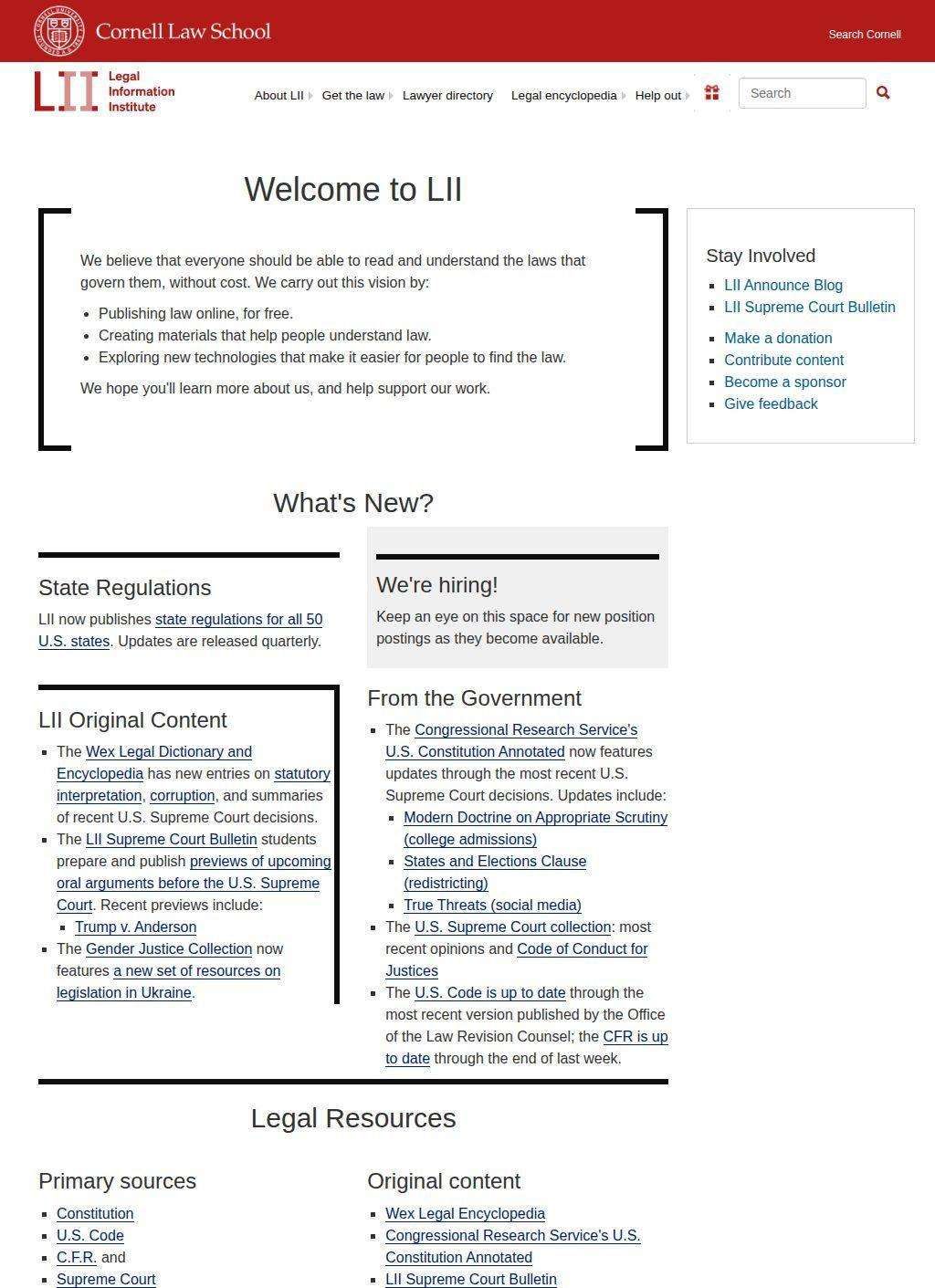
Someone whose dog has bitten a neighbor, or who has just been bitten themselves, usually wants two things fast: what the law in their state actually says, and whether the owner is liable regardless of prior incidents. Search engines bury that question under law-firm ad copy. The Legal Information Institute (LII), Cornell Law School cuts through that directly, letting a person reach statutory text without paying anyone or registering for anything.
Primary law indexed by topic
Dog bite and animal attack law does not sit in its own labeled aisle on the site. It lives inside the personal injury and state tort coverage, which is the honest way to organize it, since liability for a bite is a product of state statute and common law and not a single federal code. A reader who wants to understand strict liability can find the doctrine explained in plain language in the Wex Legal Encyclopedia, then jump to the actual code section that imposes it in a given jurisdiction. The Legal Information Institute (LII), Cornell Law School indexes state statutes and regulations alongside the full U.S. Code and the Code of Federal Regulations, so the path from a general concept to a binding text is short and direct.
Finding statutes and regulations
What separates the Legal Information Institute (LII), Cornell Law School from most free legal reference sites is that primary law comes first. The U.S. Constitution, Supreme Court opinions going back decades, federal court rules covering Appellate, Civil, Criminal, Evidence, and Bankruptcy procedure, the Uniform Commercial Code, uniform laws, and Executive Orders are all hosted in full and free to read. For a tort question that turns on a one-state quirk, the state statute locators and the Popular Names table do real work, letting a person track down a specific act by its common name when they have no citation in hand.
Using citation resolver and search tools
The citation resolver, called RiO, takes a legal citation and points the reader at the document it names, which is useful for anyone holding a complaint or a demand letter full of code references they cannot decode. Combined with site-wide search and the state statute locators, it turns what is normally a multi-tab scavenger hunt into something a non-lawyer can finish in one sitting. The Legal Information Institute (LII), Cornell Law School also includes a lawyer directory for the moment a person decides the matter is past self-help, which is a fair pointer given that a serious bite case often does cross that line.
Editorial explanations and reference materials
Beyond the raw codes, the editorial layer earns attention. Wex is the anchor, with definitions and short summaries that translate terms like negligence per se or comparative fault into something a worried dog owner can follow. The Congressional Research Service constitutional annotations, the Supreme Court oral argument previews, legal citation guides, and authority tables round out a body of explanatory material aimed at people who need context, context, not raw text alone. A Gender Justice Collection covering international legislation widens the scope past U.S. borders for researchers working in that area. The Legal Information Institute (LII), Cornell Law School does not treat its Wex entries as a substitute for the statutes themselves; the two layers are kept distinct and cross-linked, which stops the user from mistaking an editorial summary for binding law.
The topic span is broad without being shallow. Business, constitutional, criminal, family, employment, intellectual property, real estate, consumer protection, immigration, estate planning, landlord-tenant, personal injury, and administrative law all have dedicated coverage. For the dog bite reader specifically, the value is that the same resource that holds the statute also holds the surrounding tort framework, so the question does not require research across three different sites. The Legal Information Institute (LII), Cornell Law School does not try to tell a reader whether they have a winning case; it tells them what the rule is, and that distinction matters enormously for someone trying to understand their position before spending money on counsel.
Interpreting statutory language carefully
A practical caveat belongs here. The Legal Information Institute (LII), Cornell Law School publishes the law and explains it, but it does not interpret a particular incident. Strict liability rules differ sharply from state to state, so the person still has to read their own jurisdiction's section carefully. The one-bite rule, which survives in some states but has been replaced by strict liability statutes in others, is a good example of why a state-by-state read is necessary and not optional. That is the nature of the resource and not a flaw, though it is worth understanding before arriving with an expectation of a custom answer.
The Legal Information Institute (LII), Cornell Law School has held to its free-access model since 1992, when it was among the first resources to put primary law on the open internet. It has stayed registration-free while much of the legal database industry moved behind paywalls. It operates as a nonprofit inside Cornell Law School, funded through donations and sponsorships, which is part of why it can keep the full text of federal law open to anyone with a connection. For citation frequency and longevity among free resources in this space, the Legal Information Institute (LII), Cornell Law School has few peers.
The depth has a flip side the site does not hide. Statutory text is presented as written, which means dense, cross-referenced, and occasionally archaic phrasing. Wex softens that for the most common concepts, but a person reading a state's animal-control or strict-liability provision for the first time may still need to slow down and trace internal references carefully. The Legal Information Institute (LII), Cornell Law School gives the materials and the tools; it asks the reader to do the reading. For self-directed people that trade is well worth it. For those who want every clause explained in conversation, the Legal Information Institute (LII), Cornell Law School will feel demanding, and that is an honest description and not a criticism.
Set against the typical first page of results for a dog bite query, which leans heavily toward firms selling representation, the Legal Information Institute (LII), Cornell Law School is the place to understand the rules before talking to anyone with a financial stake in the outcome. A reader can confirm whether their state uses a strict liability standard or a negligence standard, learn what the one-bite rule means in practice, and walk into any later conversation already knowing the vocabulary.
Pull up the Wex entry for strict liability and tort law to fix the concepts, use the state statute locator to read your own jurisdiction's animal liability provision in full, and if that reading confirms a serious matter, the on-site lawyer directory points toward formal advice. The Legal Information Institute (LII), Cornell Law School has been doing this long enough that its archive of Supreme Court opinions predates the modern web as most people know it, and the record shows.
Business address
Legal Information Institute, Cornell Law School
Myron Taylor Hall, Cornell Law School,
Ithaca,
NY
14853
United States
Contact details
Phone: (607) 255-6550