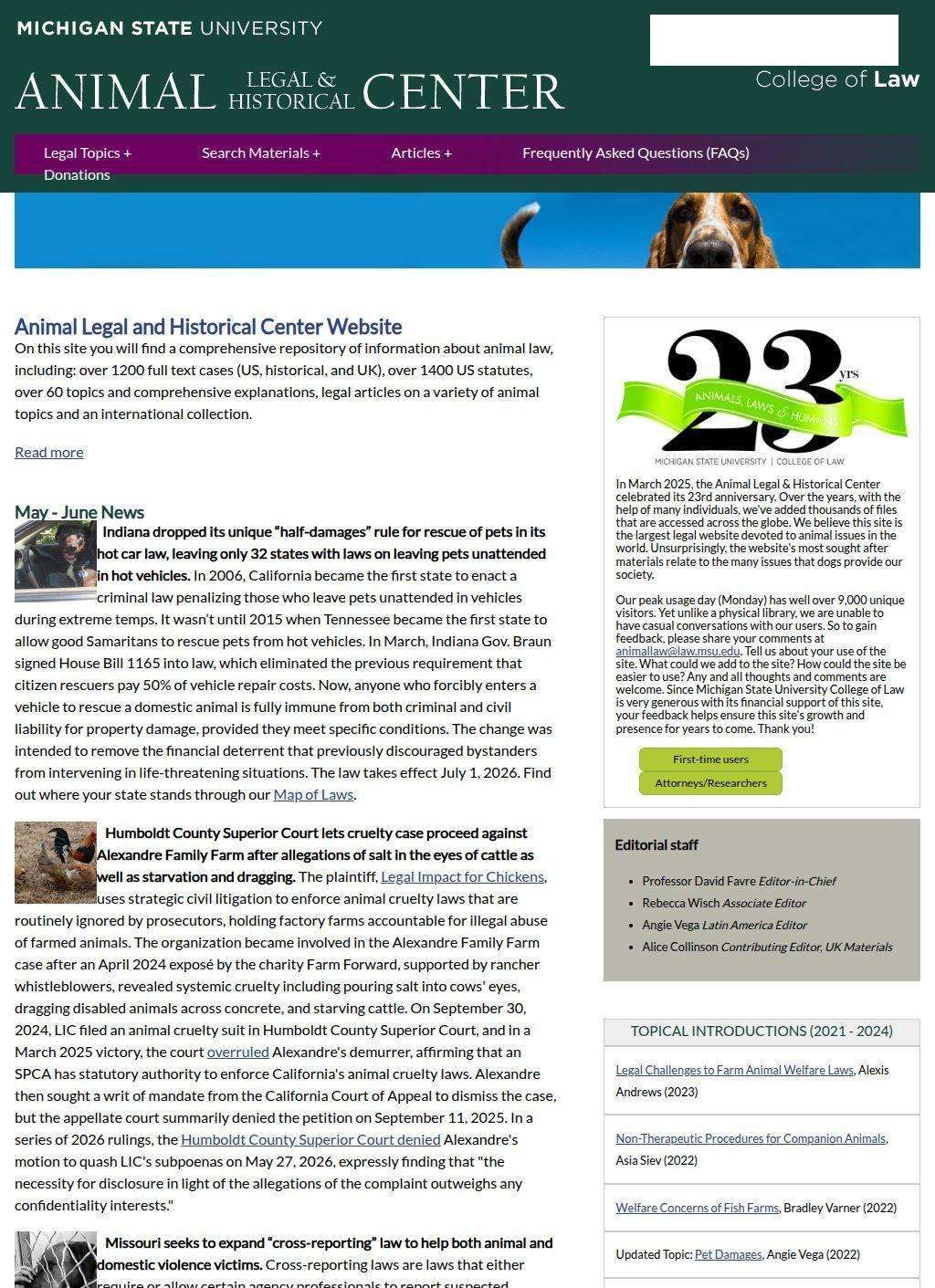
Few free legal libraries on a single subject carry the depth that the Animal Legal & Historical Center, Michigan State University College of Law has assembled, and the Animal Legal & Historical Center, Michigan State University College of Law has been building that collection for long enough that the breadth is real rather than claimed. Run out of the law school in East Lansing, it is an open-access digital collection of animal law materials: more than 1,200 full-text court cases spanning U.S., historical, and UK rulings, and over 1,400 U.S. statutes. For anyone trying to understand the legal exposure around a dog bite, that combination is close to essential, because liability usually turns on which state the incident happened in and whether its code reads as strict liability or something softer.
Collection size and legal materials
The structure rewards both the curious newcomer and the practitioner who already knows what they need. Resources can be filtered by topic, species, country, and jurisdiction, so a search does not start from a blank box. Over 60 topic-area introductions sit alongside the raw cases and statutes, written to explain a subject before the reader wades into the case law itself. A pet owner reading about dangerous-dog designations gets plain-language context first, then the actual statute, then the rulings that interpreted it. That layering is genuinely useful and not something most free repositories bother with.
Topic filters and plain-language introductions
On the dog bite question specifically, the Animal Legal & Historical Center, Michigan State University College of Law puts its comparative law tables and interactive maps to real work. Bite liability is a textbook example of state-by-state divergence, and seeing at a glance which jurisdictions impose strict liability versus a one-bite rule saves hours of cross-referencing. The FAQ section tackles the everyday versions of these problems too, covering dog bites, sick puppies, emotional support animals, and exotic pets in language aimed at people who are not lawyers. It is a sensible starting point for someone who arrived after an incident and wants to know where they stand.
Comparative liability tables for dog bite cases
It is a fair worry. At that scale, the Animal Legal & Historical Center, Michigan State University College of Law covers more than 80 categories, from dogfighting and farm animal welfare to companion animal procedures and zoning, plus an international collection with a dedicated Latin America section. A site this wide could easily bury the narrow topic a visitor came for. That is not what happens. The filtering by topic and jurisdiction keeps the dog bite and dangerous-dog material a few clicks deep no matter how large the overall collection grows.
Coverage across 80 animal law categories
The depth elsewhere also lends credibility to the parts relevant to bite cases. A repository that takes farm animal welfare, zoning, and comparative international law seriously is unlikely to be sloppy about the statute governing a Rottweiler in Ohio. The academic articles and law review pieces in the collection give a researcher or attorney the scholarly argument behind a rule, beyond the rule itself. For a working lawyer that scholarship can be the difference between citing a statute and understanding why a court read it the way it did.
Scholarship for understanding judicial reasoning
One thing to be clear about, and the site is clear about it: this is a legal information resource, and it states plainly that it does not provide legal advice. Nobody should mistake an FAQ entry for a substitute for counsel after a serious bite. Used as a map of the law it is excellent. Used as a replacement for a lawyer, it was never intended to be, and the disclaimer says as much.
Legal information versus legal advice
Scale matters too. The Animal Legal & Historical Center, Michigan State University College of Law reports drawing over 9,000 unique visitors on its busiest days, which tells you the material is being read and leaned on, not left idle. Michigan State University College of Law operating and maintaining it gives the content a stable institutional home, the kind of backing that keeps statutes current and prevents link rot. No dedicated third-party review profile for the center turned up in a public search, which is typical for academic legal repositories; reputation here runs through citations in law reviews and word-of-mouth among practitioners rather than star ratings.
Institutional backing and user traffic
Practically, the Animal Legal & Historical Center, Michigan State University College of Law openly serves first-time users, practicing attorneys, law students, academic researchers, and the general public, and the design genuinely supports that spread. A dog owner trying to figure out their position after a bite, a law student drafting a seminar paper, and an attorney checking a sister-state rule all find a usable path. The introductions cushion the beginner while the full-text cases and statutes satisfy the specialist.
How to use this resource effectively
The dog bite reader should go to the comparative tables and the bite-specific FAQ before anything else, then read the introduction for their own state and pull the statute it cites. A practicing attorney building a dangerous-dog matter should treat the Animal Legal & Historical Center, Michigan State University College of Law as a starting research layer: confirm the controlling statute through the jurisdiction filter, then move into the case collection and the law review commentary to see how courts have applied it.
If the situation involves an unusual animal or crosses into another country's law, the international and Latin America collections are worth checking first, since that material is genuinely difficult to find assembled elsewhere. As a free, well-maintained reference on a notoriously state-specific corner of law, the Animal Legal & Historical Center, Michigan State University College of Law is one of the stronger open resources available, with no meaningful free rival at the same scope.
Business address
Animal Legal & Historical Center, Michigan State University College of Law
648 North Shaw Lane,
East Lansing,
MI
48824
United States
Contact details
Phone: (517) 432-6800