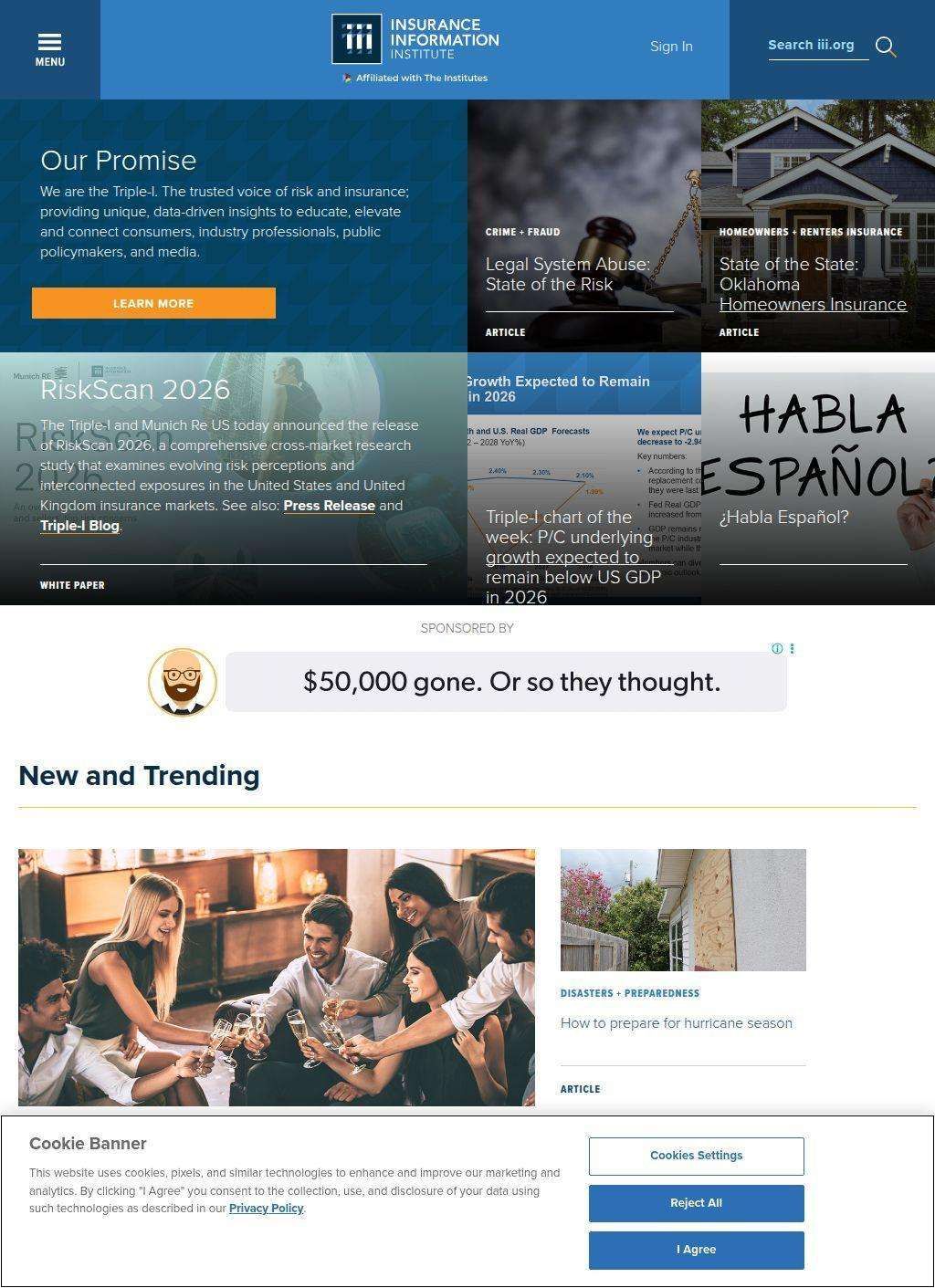
Courts, insurers, and reporters keep citing the same set of numbers when a dog bite claim becomes a question of who pays, and many of those numbers trace back to one nonprofit trade body. The Insurance Information Institute (Triple-I) produces the loss statistics, catastrophe figures, and risk-trend analyses that the property and casualty sector uses as reference benchmarks. That is the unusual thing about it: a single industry association ends up functioning as the neutral scorekeeper that everyone quotes, including in litigation and regulatory proceedings where both sides need a number nobody can wave away.
Claims data for homeowners insurance
For anyone reaching this listing through a dog bite category, the connection is the claims data. Homeowners insurance is where most dog bite liability ends up being settled, and the Insurance Information Institute (Triple-I) publishes the segment statistics that frame those conversations: how much insurers pay out, how claim counts move year to year, which categories of liability are climbing. That is the practical reason a personal injury researcher, an adjuster, or a journalist covering an attack would land here rather than on a law firm page. The data is the product, and it is the part the site does best.
Consumer education and research layers
Beyond the statistics, the site reads as two things stacked on top of each other. One layer is plain consumer education, covering auto, homeowners, life, and business insurance basics, plus financial planning and disaster preparedness guidance written for people who do not work in the field. The other layer is the research operation: proprietary data and analysis spread across auto, catastrophes, commercial lines, crime and fraud, homeowners, life and health, and technology. A glossary sits alongside all of it, which is more useful than it sounds when you are trying to read a policy clause or a claims report and the terminology keeps tripping you. There is also a Spanish-language section, a genuinely practical inclusion given how much of the consumer audience the Institute reaches.
Four distinct audiences served
The Insurance Information Institute (Triple-I) names four audiences openly: consumers looking for insurance guidance, industry professionals, public policymakers, and journalists who cover insurance topics. Most sites that claim to serve everyone end up serving no one cleanly, but here the split is visible in the material itself. The plain-language explainers clearly target the first group.
The statistical research and executive presentations are pitched at the other three, and the difference in tone between the two is obvious once you click around. That layered approach also explains the publication store, the video library, the newsroom, and the event calendar. These are the tools of an organization that expects to be cited and wants its output packaged for reuse, whether that is a reporter pulling a figure on deadline or a policymaker referencing a loss trend in a hearing. The newsroom and executive presentations in particular show that the Institute sees public commentary as part of its job, not an afterthought.
Inside the members-only research portal
There is a closed side too. The Insurance Information Institute (Triple-I) runs a members-only daily newsletter and member-exclusive research behind a separate login portal. For a free public visitor, that creates a clear ceiling: the most granular, most current material is reserved for paying members, and the public site shows you the shape of what exists without always handing over the depth. Whether that ceiling matters depends on what you came for. For a casual consumer trying to understand how dog bite liability flows through a homeowners policy, the open material is probably enough, and the glossary and explainers do real work.
For a professional who needs the underlying tables and current loss figures and segment-level breakdowns, the public pages function more as a directory of what the Institute publishes than as the full archive. The Insurance Information Institute (Triple-I) clearly has the data; the question is how much of it any given visitor can reach without a membership.
That structure is consistent across the segments. The Insurance Information Institute (Triple-I) presents itself as the primary educational and data resource for the sector, and the breadth of categories backs that claim. Auto, catastrophes, commercial lines, crime and fraud, homeowners, life and health, technology: each gets its own treatment, and the catastrophe and homeowners material is where the dog bite relevance concentrates. A researcher who knows exactly which figure they need will find the Insurance Information Institute (Triple-I) a reliable starting point, even when the trail eventually leads to a members-only page or a publication that has to be purchased from the store.
On outside reputation, there are no third-party consumer reviews of the Insurance Information Institute (Triple-I) on the usual platforms, which is expected for an industry research body rather than a product or service people rate. What the Institute has instead is citation frequency: its numbers appear in court documents, legislative testimony, and mainstream news coverage often enough that the acceptance is documented across those public records. That kind of recurrence across independent contexts is a meaningful indicator of how the sector treats this source.
Industry affiliation and source credibility
One more thing worth noting about how the Institute positions itself: it is a nonprofit trade association funded by and representing the insurance industry it reports on. The data it produces is widely accepted as a benchmark, and that acceptance is the whole basis of its usefulness. But the same affiliation that makes the Insurance Information Institute (Triple-I) authoritative also means its framing of an issue, on liability trends, on what drives claim costs, comes from inside the sector being studied. The numbers themselves get cited across litigation, regulation, and news coverage. How those numbers get interpreted, and whose interests that interpretation serves, is something a careful reader has to weigh independently, because the public site does little to make that tension visible.
Business address
Insurance Information Institute
110 William Street,
New York,
NY
10038
United States
Contact details
Phone: (212) 346-5500