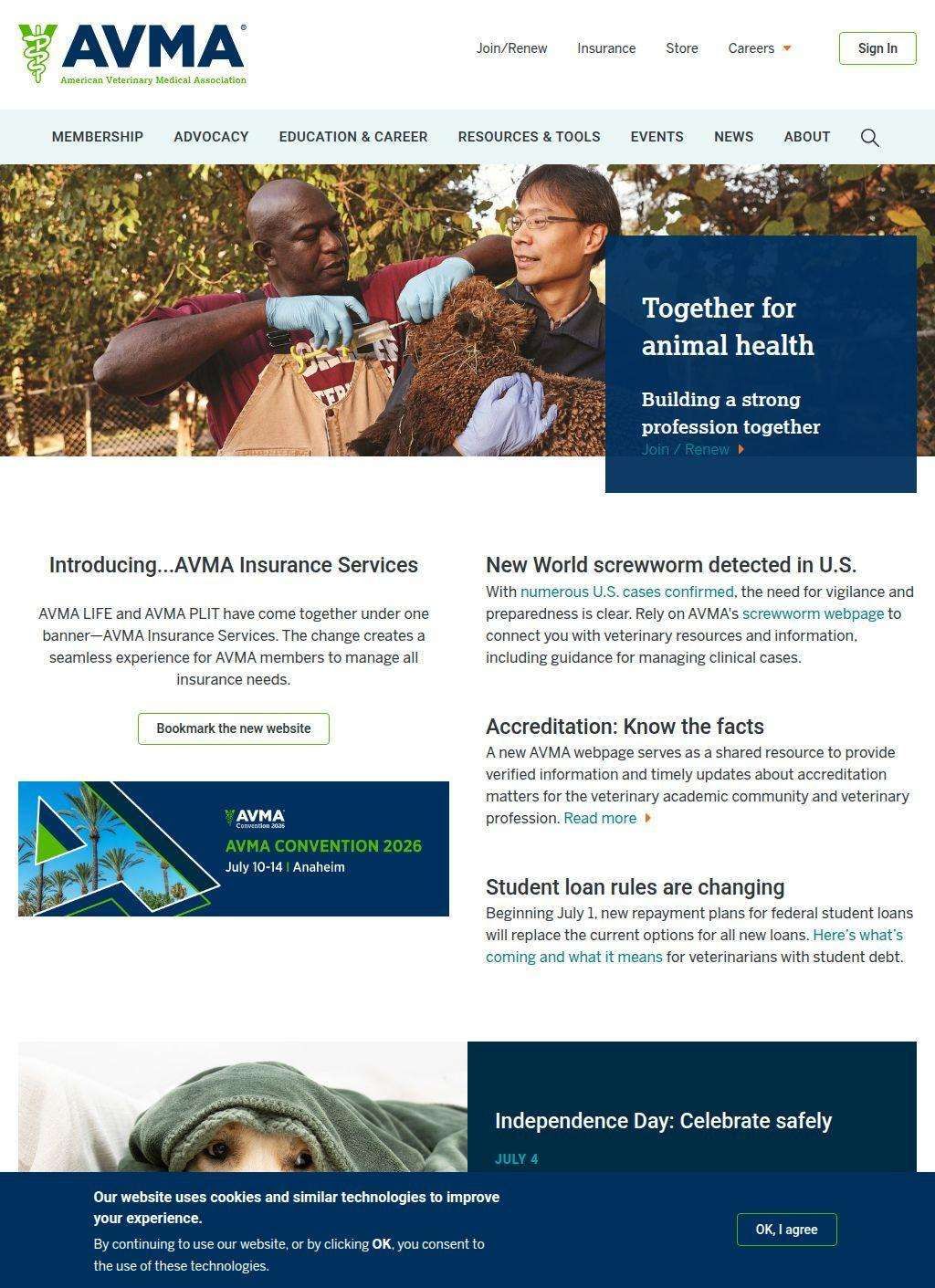
Founded in 1863 and headquartered in Schaumburg, Illinois, the American Veterinary Medical Association (AVMA) is the national professional body for veterinarians in the United States. Its appearance under a dog bite attorney heading takes a moment to explain. The American Veterinary Medical Association (AVMA) compiles and publishes data on dog bites, including annual fatality figures, alongside prevention guidance written for owners and clinicians. That material is what makes a veterinary association relevant to legal questions surrounding bite cases, and it is the part of the site worth understanding if you arrive from that direction.
Membership and advocacy focus
Most of the site exists to serve its membership, which runs past 99,000 veterinarians. The structure reflects that audience first. There is a membership area covering joining, renewal, a member directory, community groups, and the student arm, SAVMA, for those still in veterinary college. The advocacy section is where the American Veterinary Medical Association (AVMA) stakes out positions on animal health, pharmaceutical access, rural veterinary coverage, workforce shortages, and the heavy student debt graduates carry. These are policy stances, written plainly, and they show what the association is pushing for in legislative and regulatory settings. The tone throughout stays measured, the language of a body that answers to its profession and to lawmakers in roughly equal measure.
Dog bite prevention resources
For anyone arriving from a legal angle, the bite-related resources are the reason to stay. The American Veterinary Medical Association (AVMA) treats dog bites as a public health matter, and its prevention pages address breed-neutral approaches, owner responsibility, and how bites tend to happen in the first place. The statistics it releases get cited well beyond veterinary circles, which is part of why a dog bite attorney would find the source useful when building context around an incident. The framing leans on prevention and education, with breed legislation handled as an open policy question and not a settled answer.
Research behind the bite statistics
What sits behind that is an organization with a real research footprint, not a one-page fact sheet. The bite data connects to broader work on animal behavior and welfare guidelines, so the prevention advice comes from the same body that accredits the schools training the profession. That lineage puts the numbers on firmer ground than you would get from a general-interest source.
It is worth being clear about scope. The American Veterinary Medical Association (AVMA) does not give legal advice and does not pretend to. It supplies the epidemiological and behavioral groundwork, and the interpretation of that into a claim or defense is left to the people qualified to do it. A reader expecting case analysis will not find it here, and that boundary is actually a strength: the data stays clean of advocacy for either side of a lawsuit.
Education, journals and other services
Beyond membership and policy, the education and career arm is substantial. The American Veterinary Medical Association (AVMA) oversees accreditation for veterinary colleges, runs continuing education, and operates a job board at jobs.avma.org alongside career development tools, mentorship programs, and a digital learning portal called Axon. For a student or early-career veterinarian, this is the practical core of the organization, the part that touches training and first jobs directly.
The publishing side carries genuine academic standing. Two peer-reviewed journals come out of the association: the Journal of the American Veterinary Medical Association, known as JAVMA, and the American Journal of Veterinary Research, AJVR. These are not newsletters dressed up as scholarship. They are the venues where clinical and research findings in the field get published, and their existence is a fair part of why the American Veterinary Medical Association (AVMA) data on subjects like dog bites is taken seriously by courts and public health bodies alike.
Other resources include professional practice policies, practice management guidance, clinician wellbeing support, and public-facing pages aimed at pet owners rather than professionals. Events include the annual AVMA Convention and the Veterinary Leadership Conference. Insurance services exist too, handled through a partner organization rather than by the association directly. The breadth can make the site feel like several destinations stitched together, because in practice it is. A pet owner looking only for bite-prevention tips passes through a lot of professional infrastructure to get there, and the navigation assumes you know which audience you belong to. That is the trade-off of a body this size trying to serve students, practitioners, educators, and the public from one address.
Compared with the Centers for Disease Control and Prevention's dog bite pages, the two cover overlapping ground but with different depth. The CDC frames bites strictly as a public health and injury-prevention topic and stops there. The American Veterinary Medical Association (AVMA) places the same data inside the full apparatus of the profession that handles animal behavior day to day, with the journals, accreditation, and welfare guidelines to back it. For a reader who wants the prevention statistics alone, the government source is quicker to navigate; for one who wants those numbers anchored in veterinary expertise, this is the more complete resource.
Business address
American Veterinary Medical Association
1931 North Meacham Road,
Schaumburg,
IL
60173
United States
Contact details
Phone: (800) 248-2862