When another attorney has a personal injury case and decides not to keep it, the file has to go somewhere, and the receiving firm inherits both the work and the referring lawyer's professional judgment about who can handle it. Charleston Personal Injury Lawyers builds part of its caseload exactly this way, and it publishes a Case Referrals page that explains the arrangement: how other attorneys send files to the firm and why. The listing for Mickelsen Dalton LLC notes that this stream exists; Charleston Personal Injury Lawyers documents the mechanics of it. That single page does more analytical work than the star ratings, because a lawyer who routes a case elsewhere is putting a client relationship on the line in a way an anonymous Facebook reviewer is not.
How the firm receives cases from other attorneys
Most of what a directory visitor can verify about a law firm is self-described: the practice areas it claims, the case results it chooses to post, the testimonials it curates. The referral arrangement is structurally different. It is a claim about how the firm is regarded by other practitioners, and other practitioners are a skeptical audience with their own malpractice exposure and their own reputations attached to the handoff. If lawyers in and around Charleston are genuinely sending injury files to Charleston Personal Injury Lawyers, that is an external assessment from people positioned to make one.
External assessment from practicing lawyers
The Charleston Personal Injury Lawyers page describes the pipeline and the referral relationship, and that is where the value sits. It is also where the limit sits. The page explains the practice; it does not name the referring firms, quantify the volume, or let an outside reader confirm that the inbound stream is anything more than an aspiration. A firm can advertise that it accepts referrals without receiving many. Charleston Personal Injury Lawyers presents the structure plainly, which few injury shops bother to do, but the structure is only as good as the traffic running through it, and the traffic is the part a listing cannot show.
Limits of the referral claim without verification
That gap matters for how much weight to put on the rest of the profile. Take the referral claim as confirmed, and Charleston Personal Injury Lawyers reads as a firm other lawyers trust with their clients. Take it as unverified, and the firm reads as a competent multi-office practice making a reasonable pitch. Both readings are available from the same page, and only a prospective client asking the referring side directly can tell which one is true.
Office locations and named attorneys
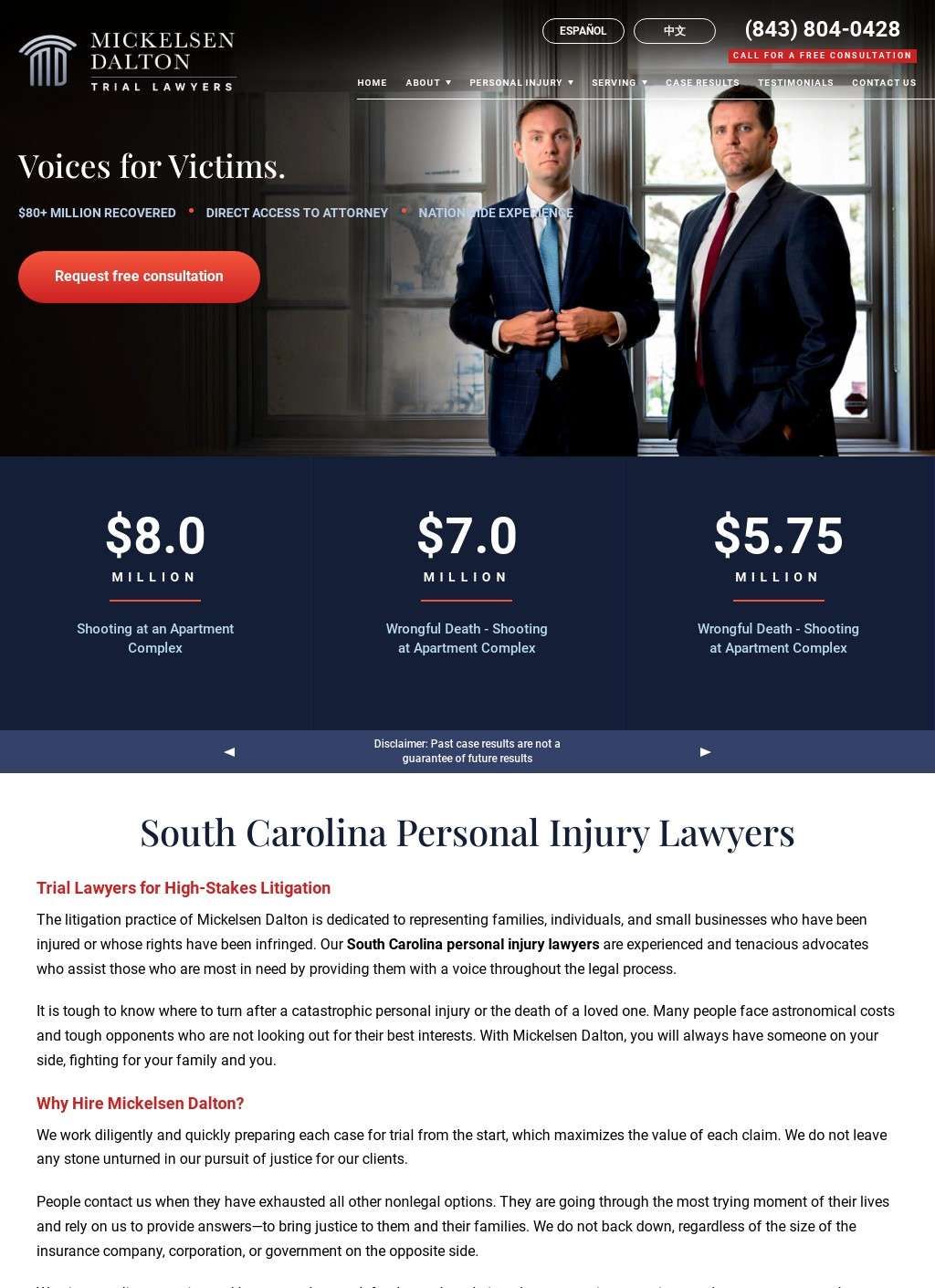
The operational facts around the referral claim are documented in detail. Charleston Personal Injury Lawyers works out of 25 Society St. in Charleston, South Carolina, with additional offices in Charlotte, North Carolina and Edmonds, Washington: three locations across two states, which puts it well past the single-address local practice. The two named attorneys are Daniel Dalton and Brian Mickelsen, both profiled on the site, and the firm carries their names, so a prospective client can look both lawyers up before calling. The site is built out with sections for About, Attorney Profiles, Practice Areas, Service Locations, Case Results, Testimonials, and a Blog. Case Results pages invite direct scrutiny, and many firms omit them for that reason; Charleston Personal Injury Lawyers publishes them.
Fourteen practice areas including contested liability work
The case-type roster runs wider than the firm's name implies, fourteen distinct categories by the listing's own count. Auto, car, motorcycle, and truck accidents anchor the list, the routine high-frequency work of any injury practice. Past that: wrongful death, medical malpractice, brain and spinal cord injuries, slip and fall, premises liability, negligent security, nursing home abuse, dog bites, product liability, and crime victim lawsuits.
Why negligent security and brain injuries matter
Negligent security and crime victim cases stand out, because they are low-volume and hard to prove, and many personal injury shops decline them instead of committing to aggressive discovery and a trial against an institutional defendant. Brain and spinal cord files make a related point: high-value, medically intensive matters that fall apart under weak preparation and rarely settle without a credible threat of trial. By putting both categories on the menu, Charleston Personal Injury Lawyers shows some appetite for contested liability, though the listing alone cannot confirm how deep that experience runs.
Service areas and direct contact options
The geographic coverage Charleston Personal Injury Lawyers claims extends past Charleston city limits to Florence, Goose Creek, Sumter, North Charleston, Mount Pleasant, and surrounding Lowcountry communities, then to Georgia and Washington state through the satellite offices. Someone in Sumter or Mount Pleasant can confirm coverage from the service-area listing without phoning in. Free consultations are offered, the standard arrangement for contingency-fee injury work, and stating it up front removes one small barrier to a first call. Phone, email, and a street address are all surfaced through a contact page without a multi-click hunt, and the firm does not gate a direct number behind a form. A prospective client in Sumter can call the Charleston number, walk into the Society St. office, or send a direct email, and none of those routes is buried.
Review counts across platforms
The published, firm-side material is substantial. The independent record on Charleston Personal Injury Lawyers is short, and it is worth stating in plain numbers instead of characterizing it. Facebook shows five reviews at a 100 percent recommend rate. Yelp has a single review that names attorney Danny Dalton, a specificity that reads like a real client account rather than a generic five-star drop. MapQuest lists one review at 5.0. A ProvenExpert profile exists, though its review count was not confirmed, and a FindLaw profile is listed without a visible tally. No Google, Trustpilot, or BBB figures surfaced for Charleston Personal Injury Lawyers.
What the small review volume suggests
Five Facebook reviews and one named Yelp account are not a data set anyone can lean on. That said, a trial practice that takes fewer, larger cases produces fewer review-leaving clients than a high-volume settlement operation, so the small count says less about the firm than the same number would at a different kind of shop. What exists is uniformly positive, and the Danny Dalton mention on Yelp lends a note of authenticity the aggregate numbers lack. Anyone who judges a law firm chiefly by review volume will come away unconvinced by Charleston Personal Injury Lawyers, and on that one axis the firm cannot answer the objection.
Strengths and remaining questions
The fuller picture is favorable. Charleston Personal Injury Lawyers documents named attorneys, a multi-office footprint, a published case-results history, a specific service geography, open contact paths, and a fourteen-category roster that includes the litigation-heavy work many competitors quietly avoid. Against that, the strongest doubt is not the small review count, which the firm's case profile partly explains. It is the referral stream itself, the one detail asked to carry the most credibility, and the one the listing leaves entirely unconfirmed: a page describing how attorneys send files to Charleston Personal Injury Lawyers is not the same as proof that they do, and only the referring lawyers, asked directly, can close that question.

Important pages
Business address
United States