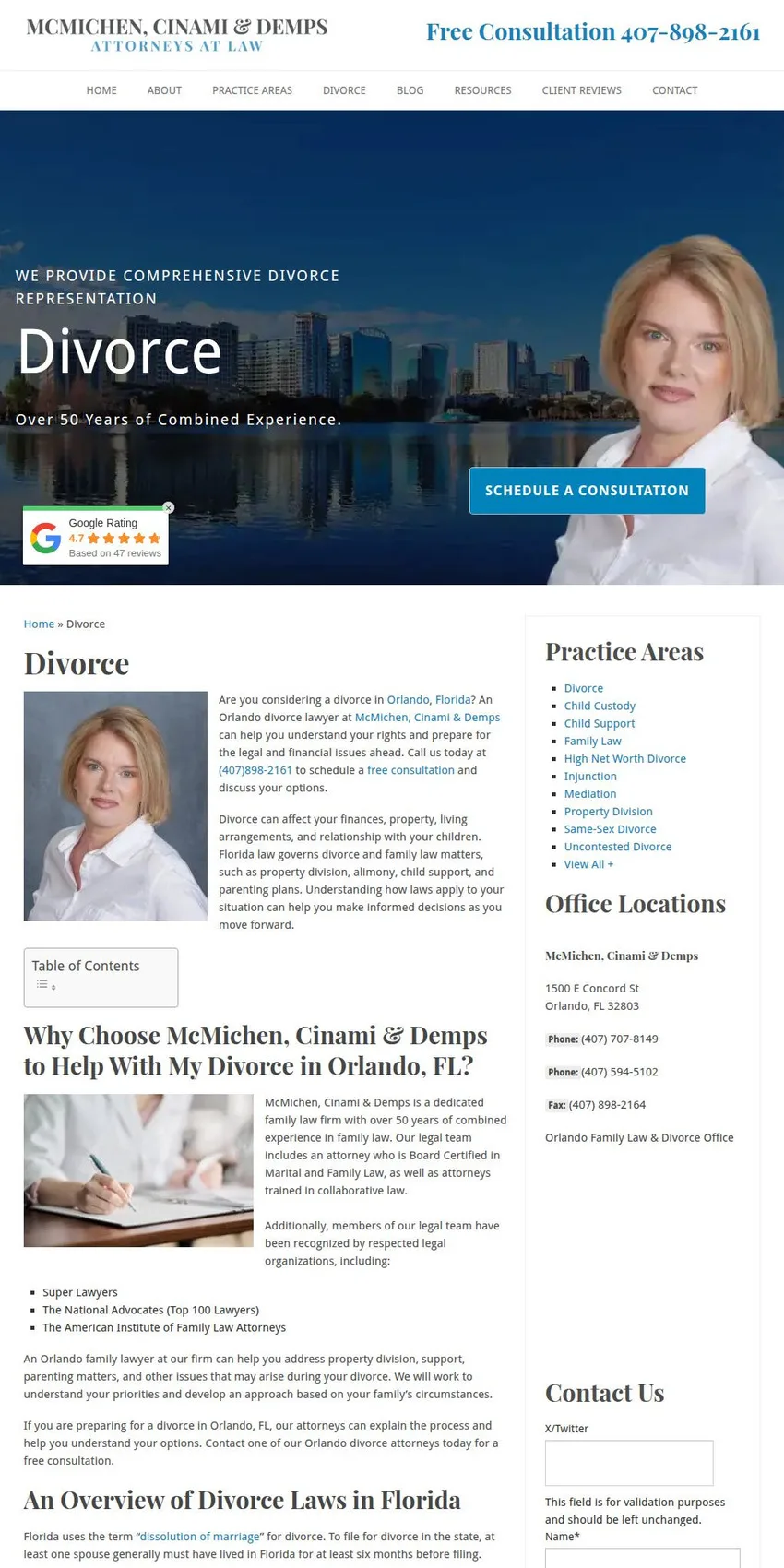
McMichen, Cinami & Demps is a law firm in Orlando, Florida, that specializes exclusively in family law. The page dedicated to divorce explains in detail how a marriage is dissolved in Florida and what services the firm offers for each type of case. The team has over 50 years of combined experience and works with clients throughout central Florida.
Who are the three attorneys?
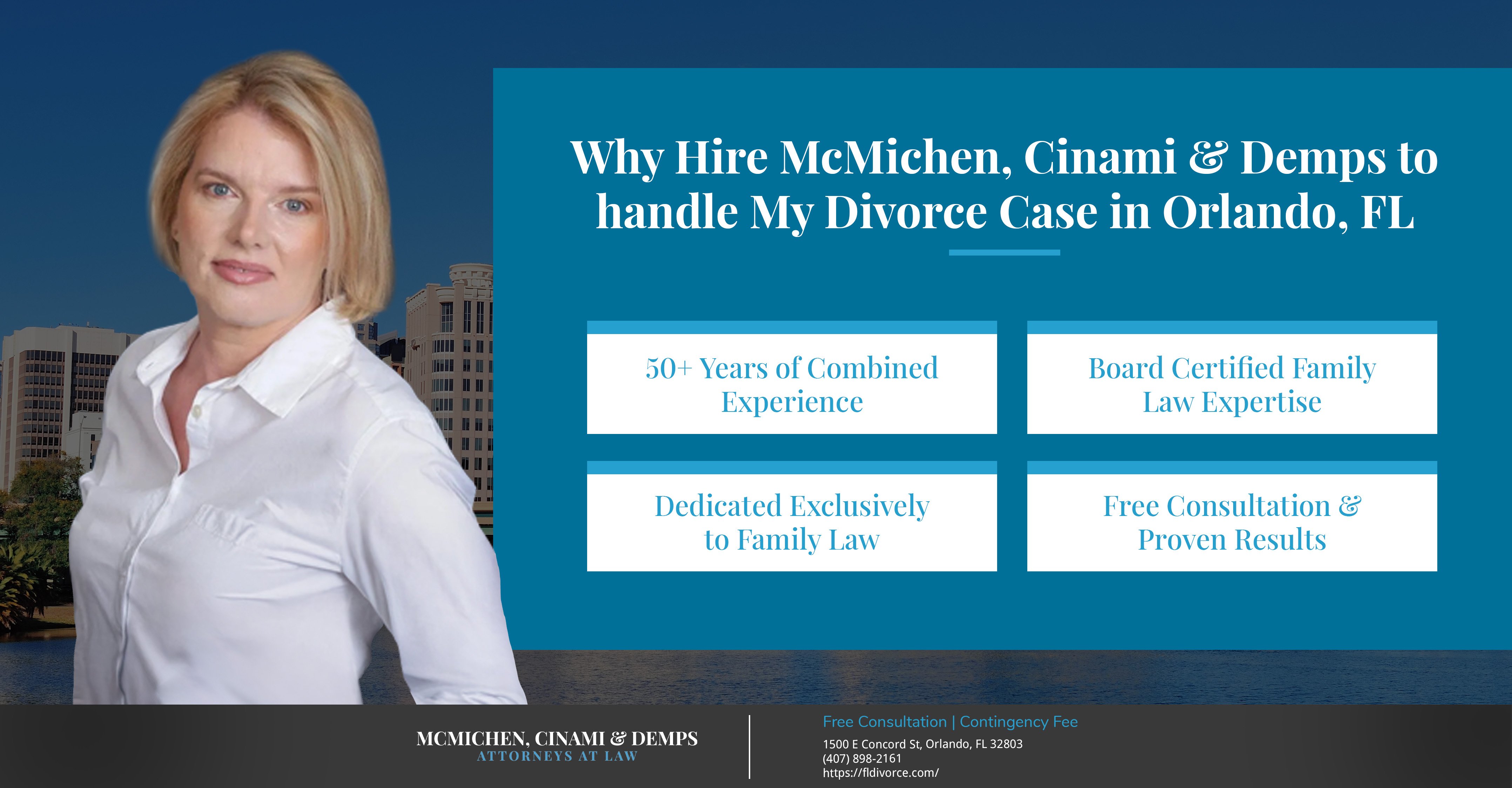
Dorothy J. McMichen, the senior partner, has been practicing since 1983 and is Board Certified in Marital and Family Law by the Florida Bar. According to the website, fewer than 1% of family law attorneys in Florida hold this certification. To earn it, she had to pass an exam, demonstrate courtroom experience, and receive evaluations from six colleagues specializing in divorce cases.
Melanie M. Demps has been practicing family law since 2002 and is trained in collaborative law. Courts frequently appoint her as a guardian ad litem—that is, the person who protects the child's interests in contested custody disputes. Sonica Rhodes Cinami is a family law mediator certified by the Florida Supreme Court and has received the Law Firm Award of Merit from the Orange County Legal Aid Society.
McMichen's profile also includes work at the court of appeals. She represented the respondent in Ayala v. Gonzalez (2008), a case that went before the Florida 5th District Court of Appeal eleven times. The court then sanctioned the opposing counsel for repeated and unwarranted motions to reargue.
What kind of divorce do you actually have?
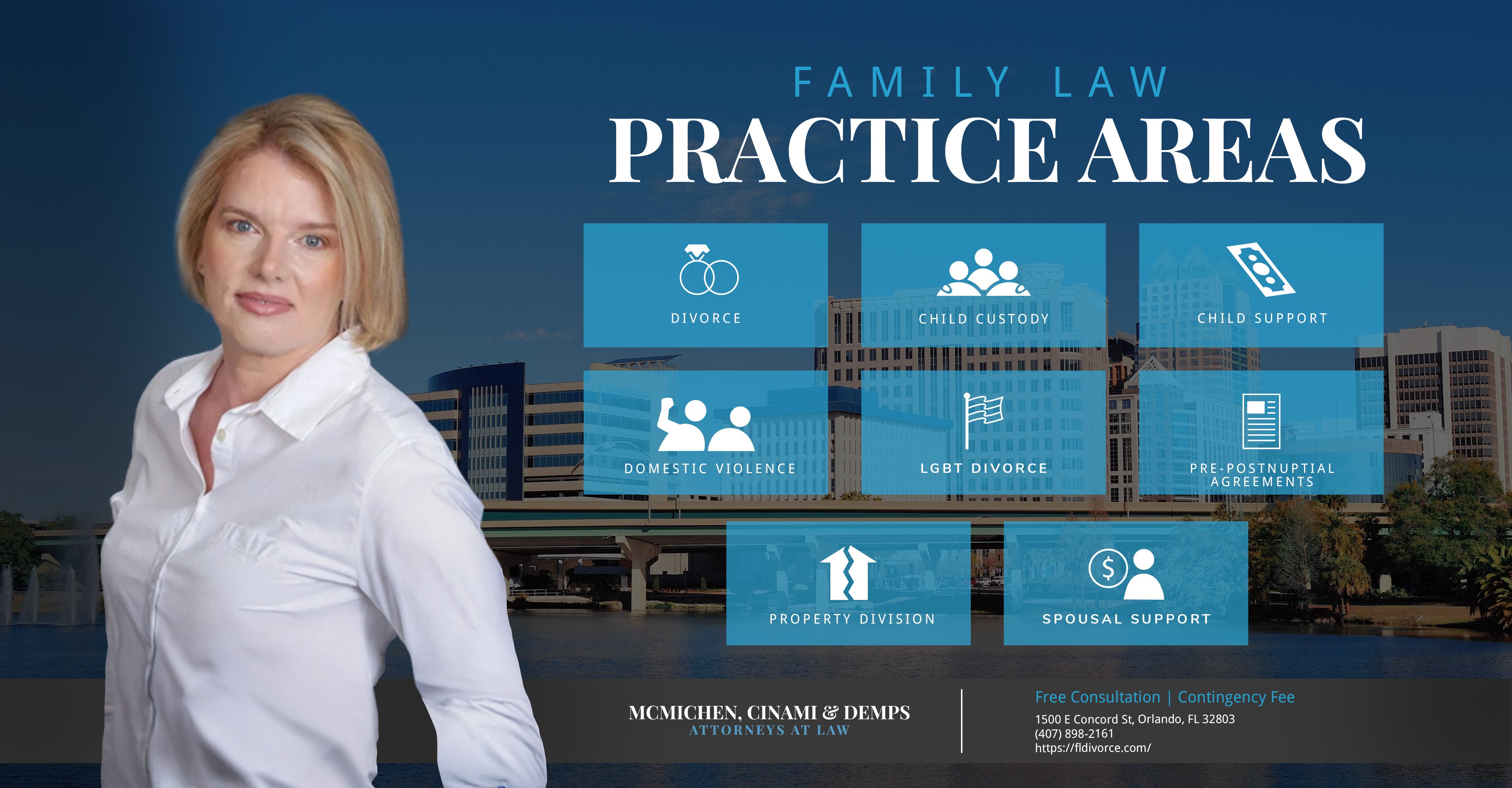
The page divides divorces into several categories. An uncontested divorce occurs when the spouses agree on all issues, while a contested divorce goes before a judge for the matters that remain in dispute. There is also a simplified dissolution procedure. The firm also handles fixed-fee divorces, high-net-worth divorces, and same-sex divorces.
Collaborative divorce holds a special place in their offerings. Each spouse brings their own attorney, and everyone works together at the same table, outside the courtroom. It resembles a well-run neighborhood meeting more than a trial. In addition, the firm offers mediation and arbitration.
The list of related services is extensive. It includes separation agreements, annulment of marriage, the effects of adultery, division and valuation of assets, as well as the connection between bankruptcy and divorce. It also covers psychological evaluations for custody and the recovery of attorneys' fees from the other party.
What does Florida law say?
In my opinion, the most useful part of the page is the explanation of the law, written in a way anyone can understand. In Florida, divorce is officially called "dissolution of marriage," and at least one spouse must have resided in the state for six months prior to filing the petition. The system is no-fault, and the primary ground for divorce is the irretrievable breakdown of the marriage. The alternative is the mental incapacity of one spouse, legally established for at least three years.
Assets are divided equitably (equitable distribution), based on the premise of an equal division of joint assets and debts, with exceptions. Each spouse's separate property and the family home are treated separately. Regarding spousal support (alimony), the website lists four types: temporary, transitional (bridge-the-gap), rehabilitative, and fixed-term. The court considers the needs, ability to pay, duration of the marriage, and standard of living.
Regarding children, Florida law uses the terms "parental responsibility" and "time-sharing," meaning the time spent with each parent. The parenting plan must be approved by the court, and the law starts with a presumption of equal time. Child support is calculated according to statutory guidelines and is handled separately from time-sharing.
Time limits also have their own rules. The final judgment generally cannot be issued earlier than 20 days after the petition is filed. If one spouse contests the dissolution of the marriage, the court may order counseling or postpone the case for up to three months. The court may also order one spouse to contribute to the other spouse's attorney's fees.
What does the process look like from filing the petition to the final judgment?
The page describes eight steps. It all begins with the petition and its service on the other spouse, followed by a response and the exchange of financial information. Then the points of dispute are identified, negotiated, or mediated, and whatever remains unresolved goes to the judge. The final step is the final judgment, and complex cases may involve additional steps.
It's like moving: you take inventory before the moving truck arrives. Negotiations can only proceed once the financial documents have been exchanged. As a reviewer, I appreciated that the website describes this stage in simple terms.
Where do you start?
The firm offers a free, no-obligation initial consultation, which can be scheduled directly on the website. The contact page has a form for your name, email, phone number, and a description of your situation, plus phone numbers for scheduling appointments. The email address and office hours aren't displayed, and a map shows the location of the Orlando office.
For those just beginning to consider divorce, the website also features a resources section, a blog, and a page about children and divorce. On Google, the firm has a rating of 4.7 out of 47 reviews, and clients also have a separate reviews page on the website.



Business address
McMichen, Cinami & Demps Divorce Lawyers Orlando
1500 E Concord St,
Orlando,
FL - Florida
32803
Mexico
Contact details
Phone: 4078982161