Somewhere on the homepage, in plain type, Injury Law Support tells you what it is not: "We are not a law firm." That single line reframes everything else on the page. Injury Law Support will not take a case, file paperwork, or argue with an insurer on anyone's behalf; it is a middleman. Its job is to collect a few details from someone hurt in an accident and hand that person off to a local personal injury attorney who has, at least according to the site, already been vetted to handle the claim.
That model is legitimate and common in this corner of the legal market, but a reader deserves to understand it before filling in a form, because it changes what a person is actually signing up for.
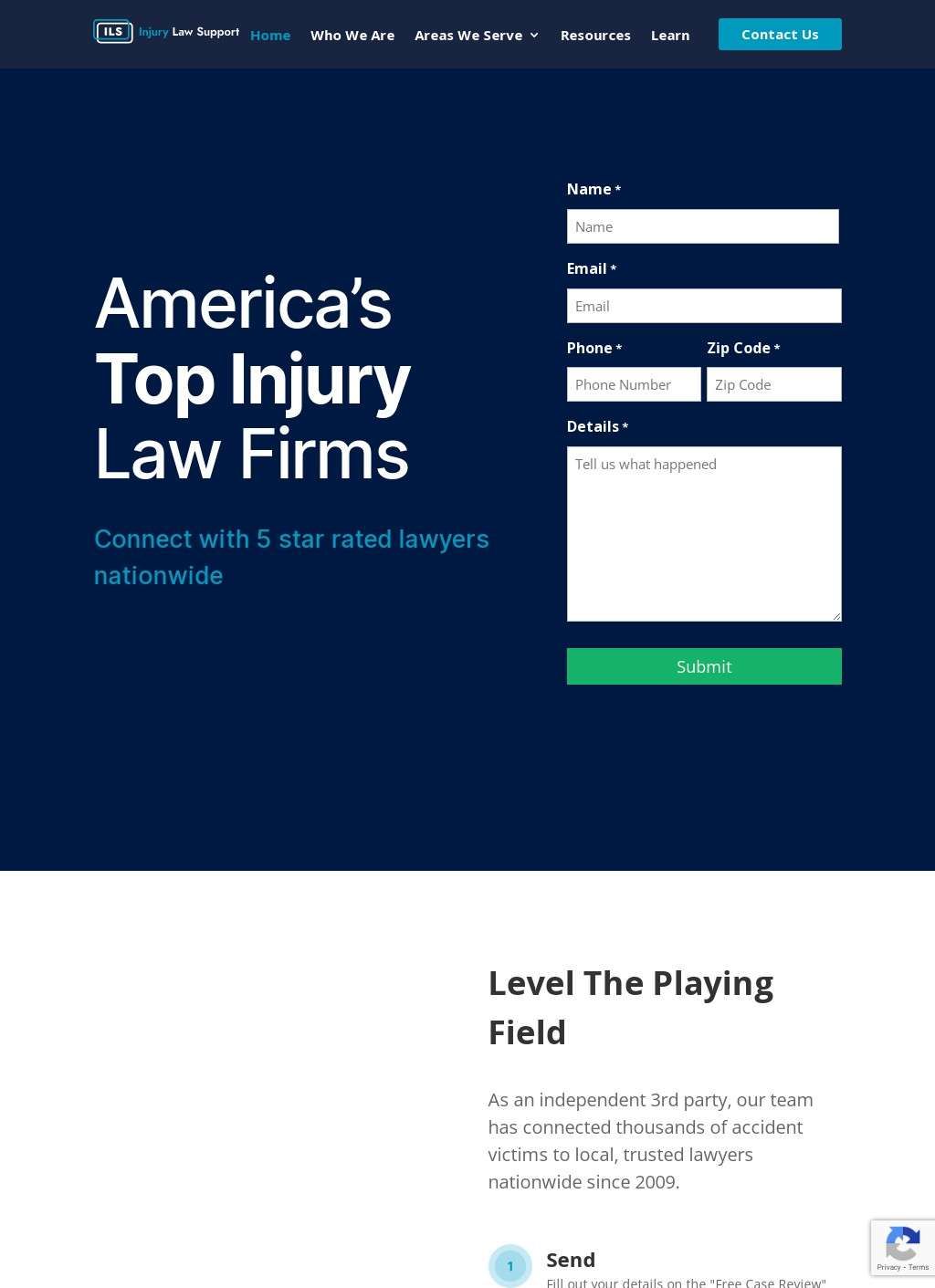
Once you know Injury Law Support is a referral service, the rest of the site reads more honestly. It is built to do one job: capture a lead and route it. The "Free Case Review" form asks for a name, an email, a phone number, and a zip code, and that zip code is the whole engine.
It decides which attorney in which city gets the details. There is no promise that a lawyer is on staff, because there are no staff lawyers, and Injury Law Support says so plainly rather than burying it in fine print. The site never pretends otherwise, and that candour is the strongest thing going for it.
The referral engine behind the free case review
Everything funnels toward matching. The pitch Injury Law Support makes is that it will connect an accident victim with a nearby attorney at no cost, and that the attorney will chase the "maximum compensation" the claim can support. Whether that maximum ever materialises has nothing to do with Injury Law Support and everything to do with the lawyer on the other end. Injury Law Support is a switchboard, not an advocate.
The intake process itself involves very little friction, and that seems to be by design.
What the intake form asks for
Four fields. Name, email, phone, zip. That is the entire ask, and it is a low bar to clear on purpose, since Injury Law Support exists to gather contacts and pass them along quickly. The upside for a hurt person is obvious: after a car wreck, nobody wants to compare a dozen firms while dealing with a claims adjuster and a body shop. A short form and a callback is genuinely easier.
The trade is that a phone number goes to a third party whose relationship with the receiving attorney is not spelled out anywhere on the page. How the lawyers are "vetted," and whether the platform is paid per lead or per signed case, is left unstated. Neither arrangement is improper, but a curious reader will not find the answer here.
Where the coverage reaches
Despite branding that sounds national, the footprint is narrow. Injury Law Support concentrates on three states: Illinois, Iowa, and Ohio. It backs that up with real geographic pages rather than empty promises of nationwide service. There are dedicated city and state landing pages, Chicago and Cedar Rapids and Cincinnati among them, mostly organised around car accident lawyers as the flagship topic. That specificity is a point in its favour. A platform claiming to serve all fifty states with no local pages would be less trustworthy than one that says, in effect, these are the places where we have attorneys.
Anyone hurt outside Illinois, Iowa, or Ohio is likely looking at a dead end here, and the site does not go out of its way to say so up front.
The blog and who it is written for
The resource section of Injury Law Support is more substantial than a pure lead-capture site usually bothers with. It runs a blog of legal-guidance articles covering auto accidents, insurance claims, and the odd corner cases people rarely think about: injuries from minor crashes, accidents involving replacement car parts, workplace auto accidents. There is also a "Who We Are" page giving company background. Taken together, the content is a genuine attempt to be useful ahead of the sales pitch, and it is the part of the site a visitor can benefit from without ever submitting the form.
Read these pieces for orientation, not as counsel. General articles about how an insurance claim works are fine for setting expectations, but they are written to funnel readers toward the intake form, and none of it substitutes for a conversation with an actual lawyer about the facts of a specific accident.
Reading the guidance with the right expectations
The topics chosen say something about the audience. Minor crash injuries and replacement-part accidents are exactly the situations where people assume they have no case and never call anyone, so an article that says otherwise has clear value and a clear commercial motive at the same time. Both things are true. The workplace auto accident angle is a smart inclusion too, since those claims can straddle personal injury and workers' compensation and confuse people about where to turn.
As educational material it does its job, and it is a fuller library than a typical lead page offers. Just remember who published it and why, and treat it as a starting point, not the last word.
How much you can verify before trusting it
Here the record gets harder to check, and that is the main reason to slow down before handing over contact details. Injury Law Support keeps its own contact information almost invisible. The visible homepage shows no phone number, no email, and no physical mailing address. Reaching a human means going through a "Contact Us" button or the case review form itself, and for a service whose entire value proposition is connecting people to someone they can trust, that opacity sits awkwardly.
A missing public email is nothing to hold against a business, since forms handle that and email invites spam. A missing phone number and any address at all is a different matter. It leaves a would-be user with no independent way to check who is behind the operation.
Beyond its own pages, Injury Law Support has not built up much of a public track record. Its Facebook page exists but sits at "Not yet rated," with zero reviews. A search for outside ratings on Google, Trustpilot, Yelp, or the Better Business Bureau turned up nothing specific to this business; the results that surfaced belonged to unrelated injury firms, not to Injury Law Support.
That is not evidence of anything bad. It is an absence of evidence, which for a service asking someone to route a legal claim through it is its own kind of caution flag. There is simply no crowd of past users to learn from yet.
None of this makes Injury Law Support a scam. A referral platform that is upfront about not being a law firm, that limits itself to three states it can actually cover, and that publishes real guidance articles is behaving more responsibly than plenty of lead brokers. The concerns here are about verification and transparency, not honesty.
Weighed against the obvious free alternative, a state bar referral service such as the Illinois State Bar Association's Illinois Lawyer Finder, the comparison is not close on transparency. That route also hands over a vetted, licensed local attorney, but it is run by the bar itself, publishes exactly who stands behind it, and lists a phone number that can be called directly.
Injury Law Support cannot offer the same. What it lacks is a visible way to verify who is actually running the operation, and until that changes, it remains a faster but less checkable option than picking up the phone to a bar-run referral line.