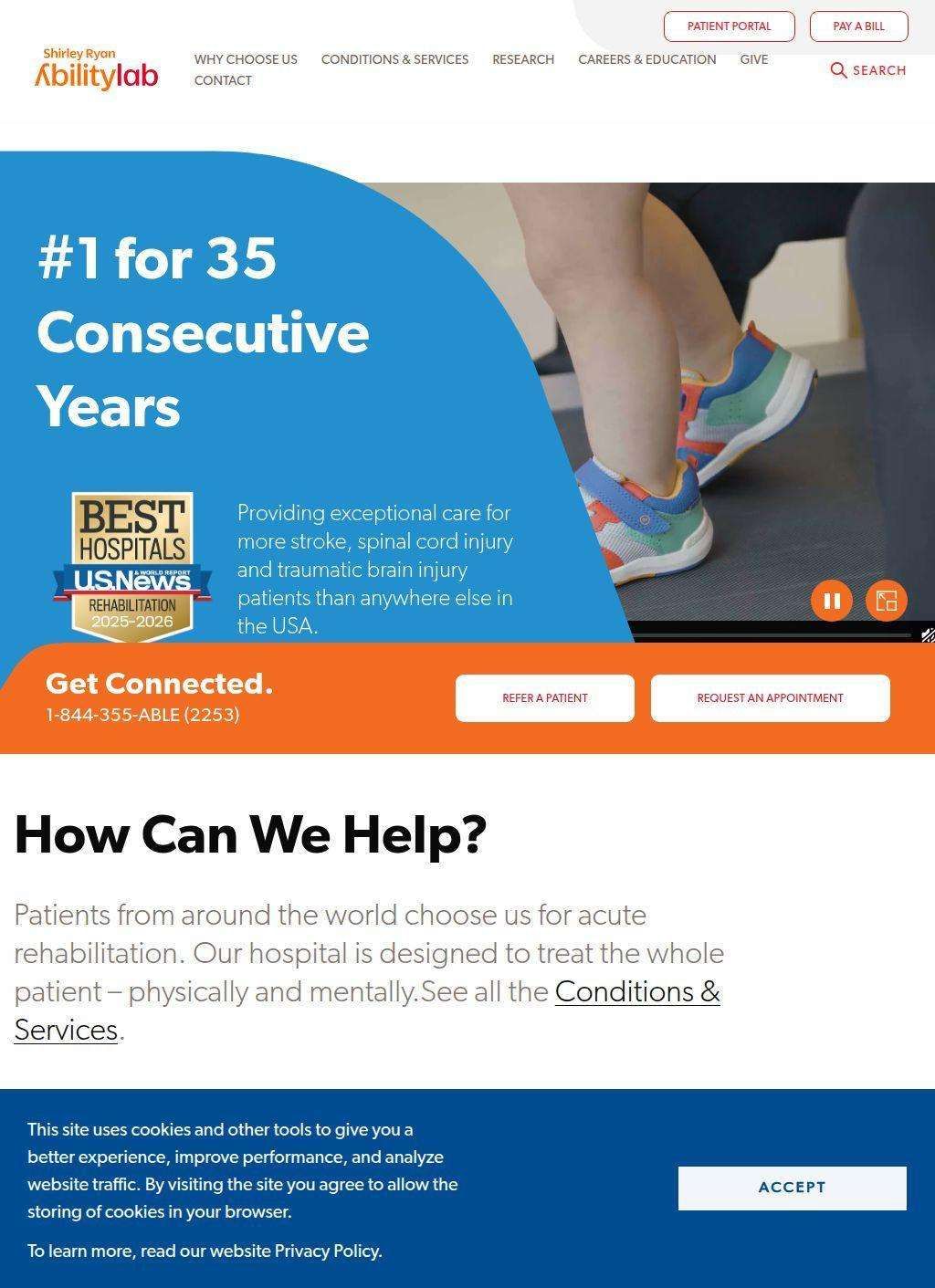
What does a hospital have to do to be called the best rehabilitation facility in the country for thirty-five years running? Shirley Ryan AbilityLab has held the top spot in U.S. News and World Report's ranking of rehabilitation hospitals for that long, and the site spends most of its energy explaining the work behind that number instead of repeating it. This is a nonprofit academic hospital in Chicago, treating adults and children recovering from injuries and illnesses that change how a body works: stroke, spinal cord injury, traumatic brain injury, Parkinson's, cancer, amputation, cerebral palsy. The catastrophic-injury context that brings someone to this listing is exactly the patient population the hospital describes treating.
Research units organized by function
The structure that gets the most attention is the set of research units Shirley Ryan AbilityLab calls Ability Labs. These are organized around function: cognition and speech, leg mobility, hand function, strength and endurance, and a pediatric unit. The pitch is that clinical care and active research sit in the same building rather than in separate institutions that occasionally compare notes. For a spinal cord or brain injury patient, that proximity is the difference between standard therapy and being near the people studying how recovery actually happens. The hospital runs clinical trials across many of those conditions, so a patient may be a candidate for something that is not yet routine practice anywhere else.
From acute care to specialized programs
Recovery from a catastrophic injury rarely follows one clean phase, and Shirley Ryan AbilityLab lays out the path reasonably clearly. Acute inpatient rehabilitation handles people who need intensive daily therapy under medical supervision. Outpatient care comes through the DayRehab Center for patients who have progressed enough to live at home but still need structured, frequent treatment. Specialized programs cover ventilator weaning, prosthetics and orthotics for limb loss, and pain management. That combination points to a facility built for the complicated end of the injury spectrum instead of routine post-surgical rehab.
Assessing outcomes and patient volume
The flagship building sits on East Erie in downtown Chicago, with more than thirty regional locations in the system. That geographic spread matters for outpatient care specifically, because the DayRehab model only works if a patient can get there several times a week. One claim worth noting with a clear eye: Shirley Ryan AbilityLab says it treats more patients for stroke, spinal cord injury, and brain injury than any other rehabilitation hospital, and that its functional outcomes run above national averages. Volume and outcomes are the two things that genuinely matter in this field, so leading with them is the right instinct, though a prospective patient would still want to see the outcome figures broken out by their exact condition rather than the institution's aggregate.
Training the next generation of clinicians
Education runs through the place in a few directions, and the offering here is more substantial than a typical hospital website manages. The LIFE Center handles patient and family education, which is the part of recovery that families usually have to piece together on their own. On the professional side there are Academy training programs, medical residencies, and fellowships: the apparatus of an institution that trains the next generation of rehabilitation clinicians instead of only employing the current one. The site notes that over half its therapists hold advanced degrees, which fits the academic-hospital framing.
The detail that does the most to back up the research claims is the Rehabilitation Measures Database, which Shirley Ryan AbilityLab makes publicly accessible. It catalogs standardized assessment tools clinicians use to track whether a patient is improving. Putting that out in the open, free for any therapist anywhere to consult, is the kind of move an institution makes when it is genuinely confident in its methods. It is also useful to clinicians who will never set foot in Chicago.
On outside reputation, Shirley Ryan AbilityLab draws broadly positive patient reviews on Google and Healthgrades, with several hundred entries across those platforms. Given the case complexity the hospital handles, ratings skew higher than you might expect from a facility dealing mainly with catastrophic injury, which is its own endorsement of the patient experience.
So the case for Shirley Ryan AbilityLab is strong: top ranking, high patient volume, integrated research, and a serious education arm. The harder question is the one every family in this situation faces. A nationally ranked hospital with above-average outcomes is still an average across thousands of patients, and stroke recovery is not brain injury recovery is not spinal cord recovery. Whether Shirley Ryan AbilityLab is the right place for one particular injury, with one particular set of complications, is a judgment the rankings and aggregate numbers cannot make. That decision rests with the patient, their physicians, and a close look at outcomes for their exact diagnosis.
Business address
Shirley Ryan AbilityLab
355 East Erie Street,
Chicago,
IL
60611
United States
Contact details
Phone: 312-238-1000