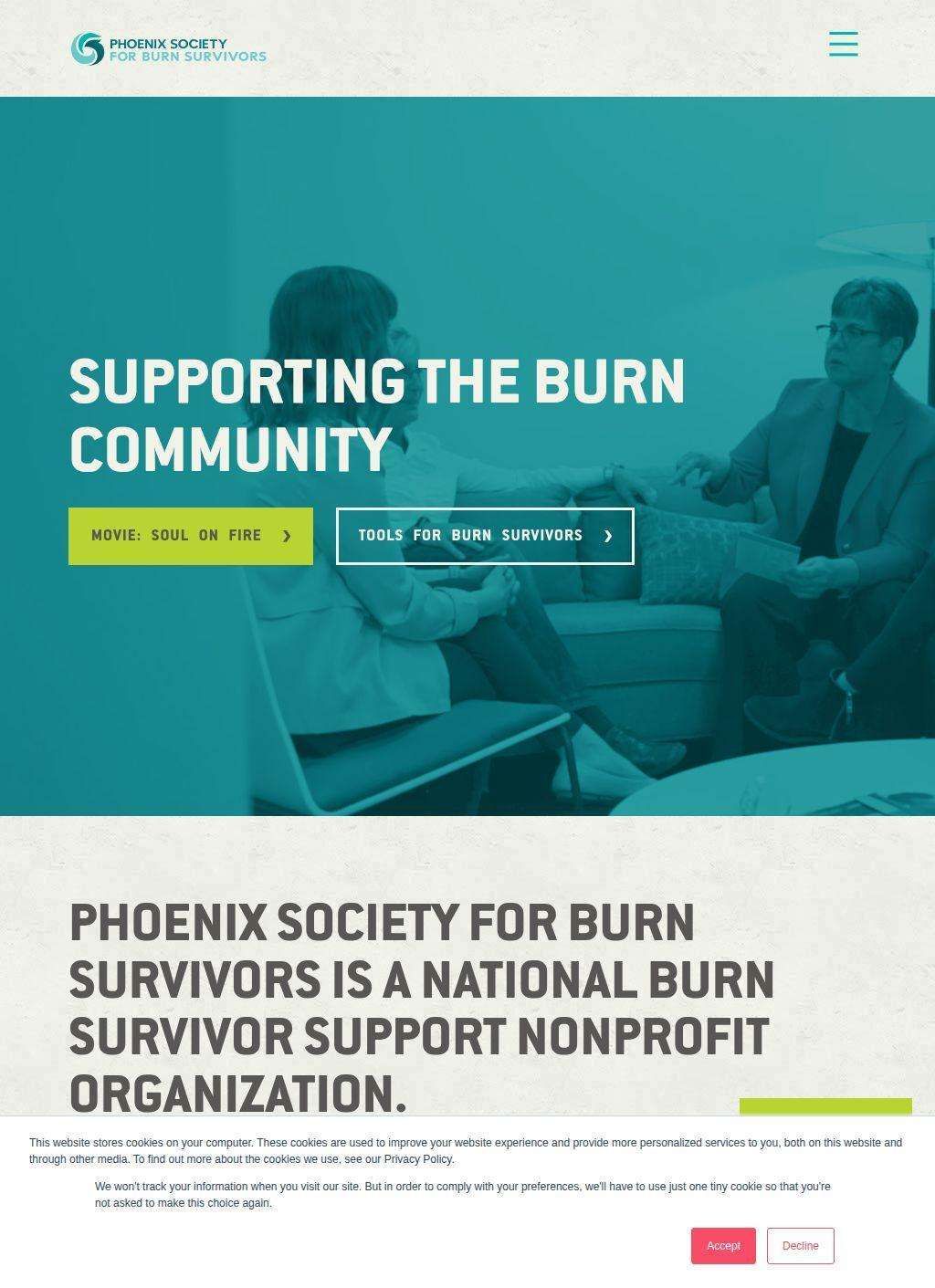
Phoenix Society for Burn Survivors is a national nonprofit based in Kentwood, Michigan, founded in 1977 to help anyone whose life has been touched by a burn injury. It does not fit cleanly under the legal category it is filed beneath here, and that is worth saying up front: Phoenix Society for Burn Survivors runs a Legal Referral Line (888-377-8081) that connects survivors with vetted attorneys, but the organization is a support and education charity first, not a law firm. Anyone arriving expecting a personal injury practice will find something broader and, for most burn survivors, more useful.
Peer support through mentors and trained counselors
The heart of the work is peer support. The Phoenix SOAR program pairs survivors with trained mentors who have been through burn recovery themselves, which is the sort of program that is hard to staff well and easy to do badly, so seeing it run by an organization with this many decades behind it adds real credibility. Alongside it sits a Support and Resource Line that offers one-on-one help, so a caller reaches a person instead of a menu of downloads. The Legal Referral Line is folded into that same support structure, which is a sensible way to handle it: a survivor who needs counsel after a fire gets steered toward screened resources instead of being left to sift through advertisements on their own.
Resource center with educational guides
Beyond the phones, Phoenix Society for Burn Survivors carries a Resource Center and Marketplace stocked with educational guides and recovery videos. There is the Girls with Grafts Podcast, built around interviews with survivors, which gives the recovery story a human voice instead of leaving it as clinical advice. For the clinical side, Phoenix Society for Burn Survivors publishes Professional Education materials that carry nursing contact hours, aimed at the staff who treat burns day to day. That last piece tells you the audience is wider than survivors and their families; fire service members and burn care professionals are addressed directly too.
World Burn Congress brings together international experts
The most visible event Phoenix Society for Burn Survivors runs is the Phoenix World Burn Congress, an international educational conference with the next gathering set for Grand Rapids, Michigan, on November 2 to 5, 2027. A recurring conference of that scale is one of the clearer indicators that an organization is doing real, sustained work, since pulling survivors, caregivers, clinicians, and researchers into one room year after year takes infrastructure that a newly formed group simply cannot replicate. The Michigan location lines up with the Kentwood headquarters, which adds a note of geographic consistency to the picture.
Programs designed for specific audiences
What comes through clearly on the site is how precisely Phoenix Society for Burn Survivors names its constituencies: burn survivors, caregivers, burn care professionals, fire service members, and the wider global burn community. Each group gets something specific, from peer mentoring for survivors to contact-hour education for nurses. The breadth could read as scattered, but the through-line holds, because every program circles back to the same thing, which is recovery after a burn and the people who carry it forward.
Contact details and social media presence
Contact information is easy to track down. The physical address at 6026 Kalamazoo Ave SE in Kentwood is published, the Legal Referral Line number is on the site, and accounts on Facebook, Twitter, LinkedIn, and Instagram are listed. For a nonprofit that handles sensitive calls from people in crisis, having a real street address and a staffed phone line out in the open does more practical good than any polished landing graphic, and Phoenix Society for Burn Survivors meets that standard without fuss.
Accreditation and financial transparency records
On credibility, the external record is solid in the ways that count for a charity. BBB Give.org lists Phoenix Society for Burn Survivors as an Accredited Charity with a published accountability report, and Candid (GuideStar) carries its nonprofit profile under EIN 23-2062352. Those two together cover the questions a careful donor or referrer would ask about governance and financial transparency. Phoenix Society for Burn Survivors also has its own Wikipedia article as a recognized U.S. nonprofit, which is not something a recently launched group accumulates.
The social following for Phoenix Society for Burn Survivors backs that up without overstating it. The Facebook page sits at roughly 11,700 likes with several dozen check-ins, and LinkedIn shows around 1,400 followers, numbers that read as an engaged community rather than a purchased one. Worth flagging honestly: there are no consumer star ratings from Google, Yelp, or Trustpilot. For a nonprofit that is normal, since people who have been helped through a burn recovery rarely leave a five-star review the way they would for a restaurant, and the charity-accountability accreditation does the trust work those platforms would otherwise do.
How does Phoenix Society compare to other burn organizations?
If a survivor or a family member is weighing where to turn, the natural comparison is something like the American Burn Association, which is excellent on professional standards and clinical research but is built for clinicians rather than for the survivor sitting at home wondering how to get through the next month. Phoenix Society for Burn Survivors occupies a distinct place there, and the difference is not a fine distinction. It puts mentorship, a human voice on the phone, and a vetted path to legal help in reach of the people living through the recovery, and on the evidence here it has the longevity, the transparency, and the program depth to be trusted with that role. The published accountability record and the decades of continued operation back that role on the evidence already on the page.
Business address
Phoenix Society for Burn Survivors
6026 Kalamazoo Ave SE, #221,
Kentwood,
MI
49508
United States
Contact details
Phone: (888) 377-8081