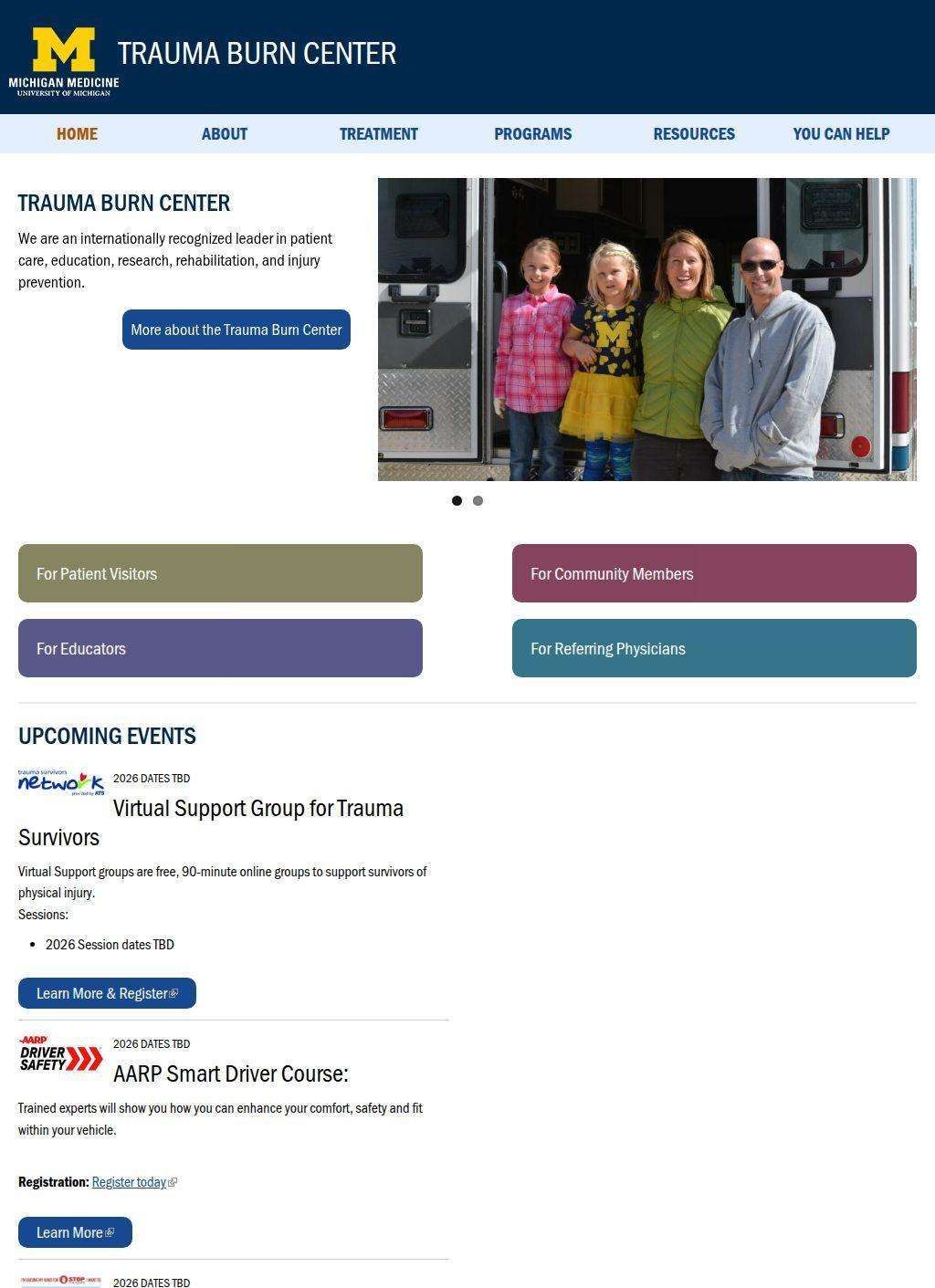
A skin bank sitting inside the research operation tells you quickly what kind of place this is. The University of Michigan Trauma Burn Center treats acute trauma and burn patients, then keeps following them long after discharge, and along the way it runs a tissue bank that supports both clinical work and laboratory study. That combination of bedside care and research infrastructure under one roof is the thread running through almost everything the site describes.
Clinical care and long-term follow-up
The clinical side is the obvious core. Patients arriving with severe burns or major trauma get acute treatment, and the site is clear that care does not stop when the immediate crisis passes. Aftercare and long-term follow-up are given their own space, a practical concern for burn survivors who often face months or years of reconstruction, scar management, and physical therapy. The University of Michigan Trauma Burn Center also runs virtual support groups for trauma survivors, a recognition that recovery is psychological as much as surgical. The center frames itself as a leader in patient care, education, research, rehabilitation, and injury prevention, and the breadth of sections gives that claim something to stand on.
Research laboratory and tissue bank
Research gets real estate beyond the skin bank. The University of Michigan Trauma Burn Center describes a laboratory program and positions itself with an international research profile, the sort of standing you would expect from a unit attached to Michigan Medicine. For anyone trying to gauge depth, the presence of both a working tissue bank and a stated research mission is more telling than any number of adjectives. The place generates knowledge rather than merely consuming it, and that distinction shapes the whole identity of the operation.
Education for referring physicians
Part of the answer is patients and their families, who get patient and visitor information laid out as its own area. But a large share of the content speaks past patients to other audiences. There is a section addressing education for referring physicians and medical professionals, which is a strong sign the University of Michigan Trauma Burn Center functions as a regional and national referral hub. A community hospital sending a complex burn case wants to know how the receiving center handles transfers and what it teaches, and that material is built for exactly that reader.
Community injury prevention programs
The other audience is the surrounding community, and this is where the offering gets unexpectedly broad. The University of Michigan Trauma Burn Center runs Stop the Bleed training, which fits a trauma unit cleanly, since the program teaches bystanders to control serious bleeding before help arrives. Less predictable are the AARP Smart Driver courses on driver safety and the virtual Tai Chi classes. Both connect back to injury prevention, the first by reducing crashes and the second through balance and fall reduction, so the logic holds even if the menu looks eclectic at first glance. Prevention outreach clearly sits alongside treatment as a stated priority.
Volunteer opportunities and donations
Volunteer and donation opportunities round out the public-facing material. A center that invites community participation and contributions is presenting itself as more than a closed clinical box, and the University of Michigan Trauma Burn Center leans into that civic role.
Why Michigan Medicine affiliation matters?
What holds the whole thing together is the University of Michigan Health System affiliation. Michigan Medicine is one of the larger academic medical systems in the country, and a burn center operating under that umbrella inherits a degree of accountability and resourcing that a standalone clinic would struggle to match. The site treats that affiliation as the spine of its identity, and it is the single most useful fact for anyone weighing where to send a serious burn or trauma case.
The category here is burn injury lawyers, and the University of Michigan Trauma Burn Center is a clinical and academic institution, not a law firm or a legal resource. Someone pursuing a burn injury claim might find it useful as background on what high-level burn treatment and long-term care involve, since understanding the medical reality is part of valuing an injury, but the center offers care and research, not legal representation. A visitor arriving with a legal question is in the wrong room.
The site organizes itself sensibly across patient and visitor information, research, education, community programs, and aftercare support resources. Each of those is a genuine destination with substance behind it, and the navigation reflects an institution that knows it serves several constituencies at once. There is no padding apparent in the structure; the sections map to real activities the center conducts.
For its true purpose, comprehensive burn and trauma care backed by an academic research engine and a tissue bank, the University of Michigan Trauma Burn Center is a credible and substantial resource. The international research profile and the Michigan Medicine backing put it in a tier most regional centers cannot reach. The qualification is narrow but worth stating plainly: judged against the legal category it appears under, the fit is awkward. As a destination for understanding or accessing serious burn care, the University of Michigan Trauma Burn Center rewards careful attention and has the depth to justify it.
Business address
University of Michigan Trauma Burn Center
1500 E. Medical Center Drive, UH 1C-421,
Ann Arbor,
MI
48109
United States
Contact details
Phone: (734) 936-9690