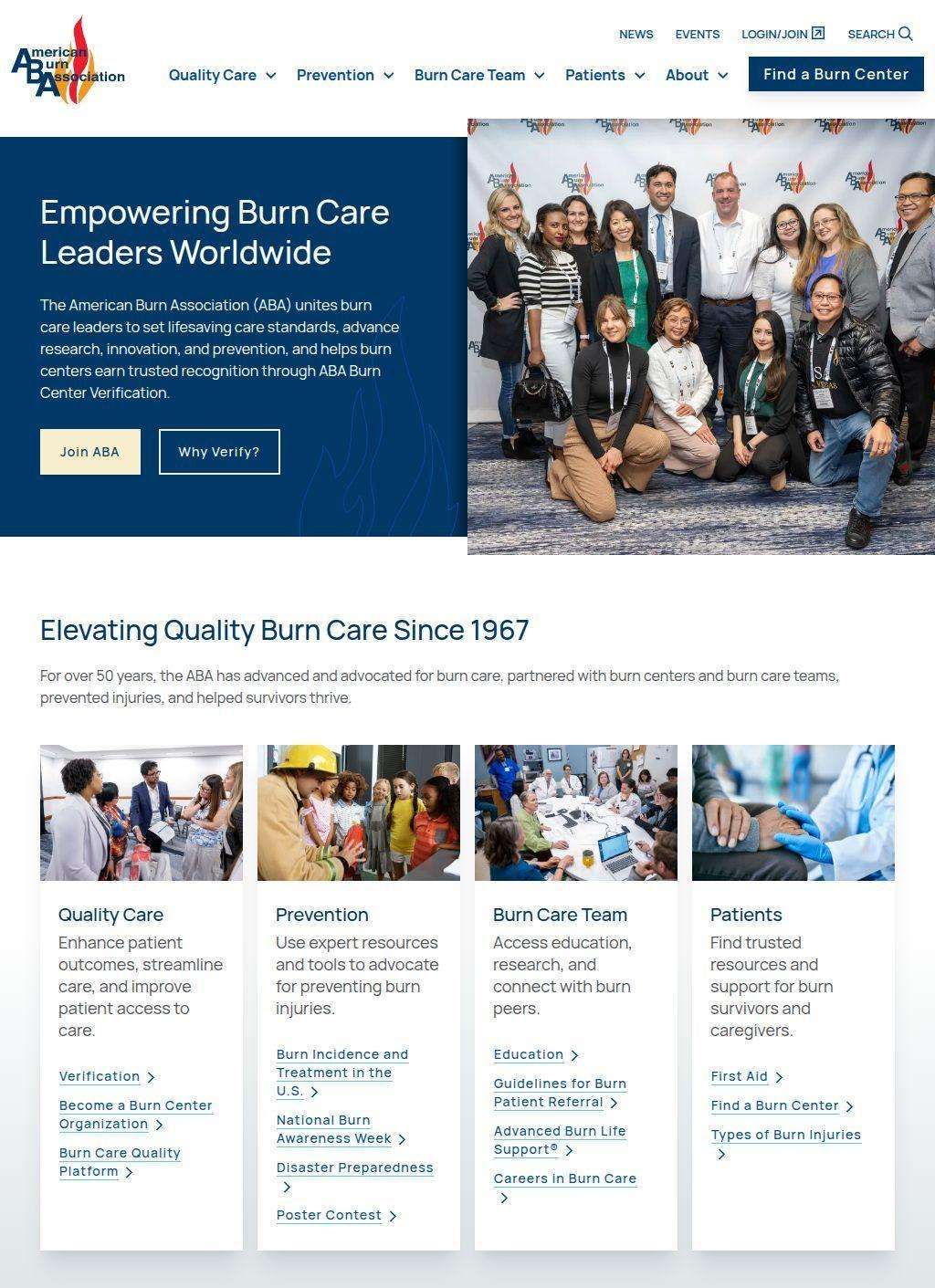
Burn center verification is the main thing the American Burn Association does, and it is work no other body in the country takes on. A hospital cannot put "verified burn center" on its signage without going through a process that puts staffing, equipment, transfer protocols and patient outcomes under formal review. For a family trying to decide where serious burn treatment should happen, that single function shapes more of the picture than most people realize when they are searching online at the worst possible moment.
Burn center verification and outcomes measurement
Membership sits at the centre of the operation, with more than 3,000 people worldwide. The roster includes surgeons, nurses, therapists and other clinicians who work directly with burn patients, alongside burn centers as institutional members, and survivors and their families. That combination is notable: the same body that sets clinical standards also makes room for people who lived through a burn injury and the relatives who cared for them. Special interest groups, networking channels and community platforms give members somewhere to compare notes, which is the quieter half of what a professional society does. The American Burn Association draws on that membership base for almost everything else it produces, since the standards, the training and the research all come from the same pool of practitioners.
Training clinicians in burn care
The training side is substantial. Advanced Burn Life Support, usually shortened to ABLS, is the education and certification track that teaches clinicians how to assess and stabilise a burn patient in the first critical hours, the window where decisions about fluids, airway and transfer have the most consequence. Beyond that, the American Burn Association supports a Verified Burn Fellowship Training pathway for physicians specialising in the field, plus broader career development resources. None of this is consumer-facing, and it is not meant to be; it is the scaffolding that produces and maintains the people who staff a burn unit.
The quality platform tracks patient results
Burn Center Verification is the headline program, but it pairs with something less visible and arguably just as important: the Burn Care Quality Platform, or BCQP, which tracks patient outcomes. Standards on paper are one thing; data showing how patients actually fare tells a center whether its practice holds up over time. A registry like this lets participating centers compare themselves against a wider pool, which is hard information to come by in a specialty this narrow.
The combination is worth pausing on. Verification asks whether a center is built to handle severe burns, and the quality platform asks whether the results bear that out. Together they push the field toward measurement over reputation, and they give the American Burn Association credential something concrete to stand on. A hospital that earns the designation is signing up to be looked at on an ongoing basis through the outcomes work, well beyond a single inspection.
Research feeds the same loop. The American Burn Association publishes the Journal of Burn Care and Research, described as the only journal in the United States devoted entirely to burn prevention, treatment and recovery. A specialty with a single dedicated national journal tells you how small and how concentrated this field is. The organization also backs research support initiatives, which keeps a pipeline of new findings flowing into the standards and the training.
Resources for patients and families
For people outside the profession, the site offers a different layer. There is first-aid guidance for burns, a locator to find a verified burn center, and plain educational material on burn types and how they are treated. These are not deep clinical documents, and they should not be; the value is in giving an anxious person somewhere reliable to start rather than a frantic web search. The American Burn Association keeps this material readable, which is the right call for an audience that may be reading it minutes after an accident. The burn center locator connects directly to the verification work, since it points people toward facilities that have been through the formal process.
Prevention and disaster preparedness
Prevention gets real attention too. National Burn Awareness Week is the organization's annual public push, supported by fact sheets aimed at reducing the injuries that fill burn units in the first place. There is also disaster preparedness material, which speaks to the grim reality that mass-casualty events involving fire or explosion need burn capacity planned well in advance. Prevention is unglamorous and easy to underfund, so a professional body that keeps producing this material is doing something its members benefit from indirectly: fewer preventable admissions. The American Burn Association treats prevention as part of its remit, not an afterthought added for optics.
The yearly calendar centres on the Annual Meeting, the field's main gathering, with the next one set for 2027. For a specialty dispersed across many hospitals, an annual meeting is where standards get debated, research gets presented and people who rarely see each other in person finally do. It anchors the membership year and gives the whole apparatus a regular point of renewal. Scheduling the next one well ahead suggests the American Burn Association plans its calendar around a stable, recurring event rather than improvising.
What comes through across all of it is how tightly the pieces interlock. The American Burn Association sets the verification criteria, measures outcomes against them, trains the clinicians who meet them, publishes the research that refines them, and runs the public prevention and patient resources that sit on top. Each function reinforces the others, which is what you would want from a body that has positioned itself as the standard-setter for a narrow and high-stakes area of medicine. There is no padding here, no program that exists only to look impressive on a homepage.
The site is built for two audiences at once, and it mostly keeps them straight. A burn surgeon comes for ABLS, the fellowship pathway, the quality platform and the journal. A frightened parent comes for first-aid steps and a way to find the nearest verified center. Serving both without confusing either is harder than it sounds, and the American Burn Association manages it by keeping the professional machinery and the patient material in clearly separate lanes. Going by the published content alone, there is enough here to be useful to both.
Business address
American Burn Association
311 S. Wacker Drive, Suite 4150,
Chicago,
IL
60606
United States
Contact details
Phone: (312) 642-9260