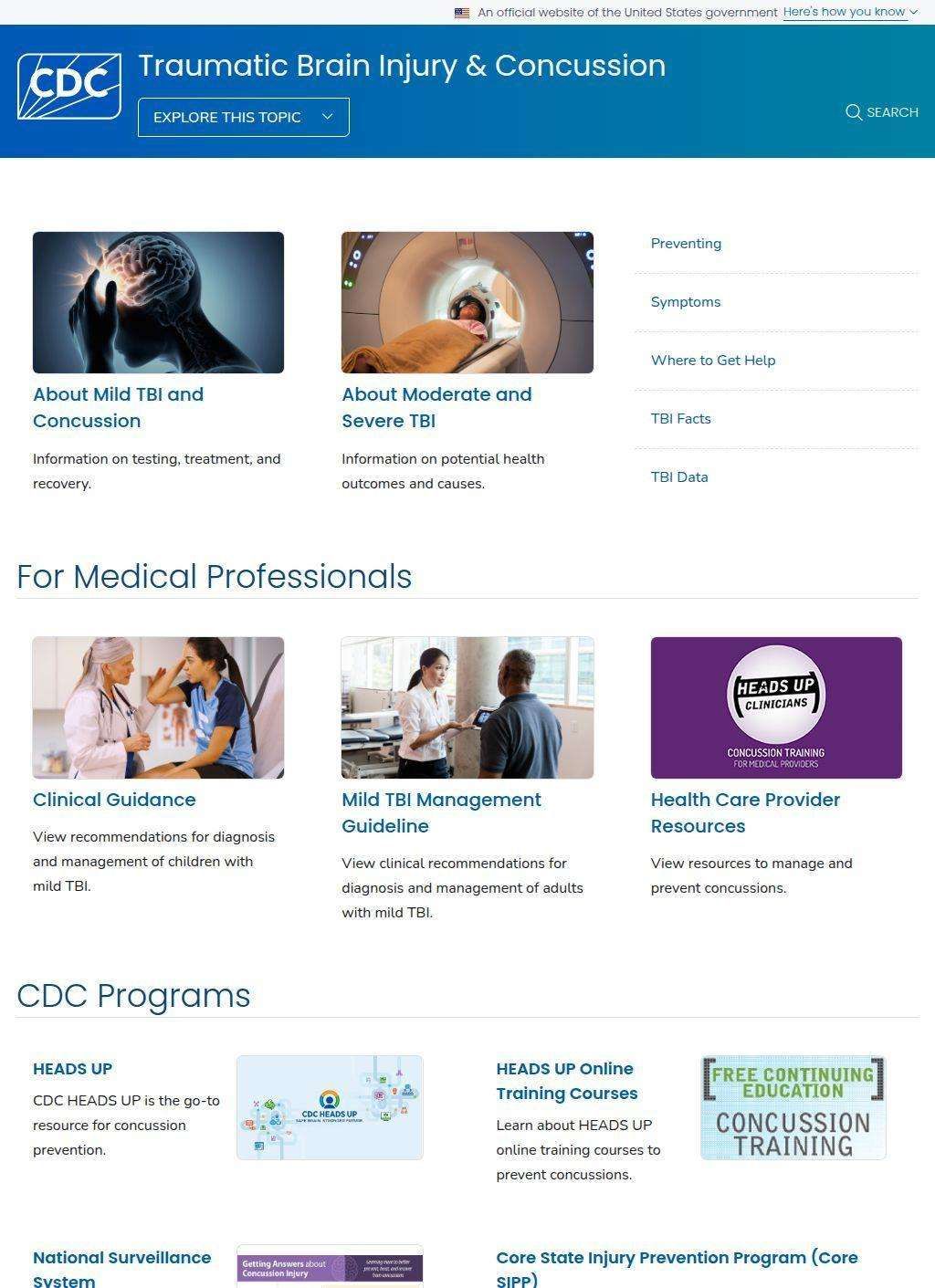
A concussion is filed here as a brain injury, full stop, and that framing colours everything else on the page. CDC Traumatic Brain Injury and Concussion treats the bump on the head a kid takes at soccer practice and the severe head trauma that lands someone in intensive care as points on one continuum, an injury that affects how the brain works. That single editorial decision pulls the casual reader toward material they might otherwise assume was meant only for doctors, and it gives the whole resource a coherence that a lot of scattered health pages lack.
Surveillance data on traumatic brain injury
The spine of the resource is data. There is epidemiological work on how common traumatic brain injury is across the United States, who carries the most risk, and where health disparities fall, drawn from a National Surveillance System that tracks incidence nationwide. CDC Traumatic Brain Injury and Concussion does not present these numbers as decoration. They sit underneath the prevention message and the clinical guidance, so a parent reading about symptoms is reading something anchored to actual surveillance figures, not a generic wellness column. The statistics never feel bolted on, which is harder to pull off than it looks when one site is trying to talk to several different readers at once.
Content for multiple audiences
And CDC Traumatic Brain Injury and Concussion is talking to several. The material splits clearly along three lines: the general public, parents and educators, and the medical and clinical community. For the public there is plain explanation of mild TBI and concussion, what the symptoms look like, how recovery tends to go, and what people can do to lower their risk. For clinicians the register shifts entirely, with evidence-based recommendations and clinical guidelines for diagnosing and managing mild traumatic brain injury, separated into pediatric and adult guidance. Most public health portals pick a lane. This one runs both, and it labels them well enough that a worried parent is unlikely to wander into a dense clinical recommendation by accident.
HEADS UP concussion awareness
For all the depth in the surveillance data and the clinical recommendations, the piece of CDC Traumatic Brain Injury and Concussion that reaches the widest audience is almost certainly HEADS UP. It is a national concussion awareness and prevention initiative built for coaches, parents, athletes and educators, the exact people standing on a sideline when a head injury happens and the exact people who usually have no medical training to fall back on. Concentrating effort there is a sound choice, because those are the moments where a clear rule of thumb changes what someone does in the next five minutes.
Training courses for coaches and clinicians
The program is backed by online training courses and continuing education resources, so a youth coach can work through structured material on spotting and handling concussions, and a clinician can pick up continuing education credit on the same subject. Pairing free public training with formal CE on one platform is a genuinely useful design. It means the volunteer parent and the licensed professional are at least drawing on a shared baseline, which matters when a concussion call gets passed up the chain from a field to a clinic.
Support services and referrals
CDC Traumatic Brain Injury and Concussion also points toward support services and referrals, so the resource does not simply explain a problem and leave the reader holding it. Someone who arrives frightened after an injury can move from understanding what happened to finding actual help. A lot of medical reference sites quietly skip that throughline from explanation to action.
Federal agency guidance and authority
The institution behind CDC Traumatic Brain Injury and Concussion shapes how its content should be read. Produced by the Centers for Disease Control and Prevention, the federal agency inside the U.S. Department of Health and Human Services, the clinical recommendations here are not one practitioner's opinion. They are agency-level guidance assembled from evidence, which is why the same recommendations appear in school sports policies and pediatric protocols across the country. When the surveillance section reports who is most at risk, those figures draw on a national tracking system rather than a survey somebody ran once.
Free and open access to resources
Everything is free and openly accessible, which fits the public health mission and removes the friction of paywalls or sign-up gates that block so much specialized medical information. A school nurse, a high school athletic director, a pediatrician and a frightened parent can all reach the same material at no cost, and CDC Traumatic Brain Injury and Concussion scales its language to whoever shows up. For a subject where the right early decision can shape a recovery, putting authoritative guidance in front of anyone who needs it is the entire point of the resource.
Medical scope, not legal guidance
If there is a limit worth naming, it is one of scope rather than quality. CDC Traumatic Brain Injury and Concussion is a public health and clinical resource, so it covers the injury itself, the surveillance picture, prevention, and management, and stops there. It is not built to walk an injured person through filing a claim, calculating damages, or the legal mechanics that follow a brain injury caused by someone else. A reader who arrives here under a brain injury law heading is getting the medical and epidemiological foundation, the part a case is built on, not the legal process itself.
How this resource compares to advocacy organizations
That distinction is exactly where CDC Traumatic Brain Injury and Concussion sits against a more legally oriented destination such as the Brain Injury Association of America, which leans into advocacy, state-chapter support, and connecting families to services and, by extension, to representation. The Association is the better first stop for someone whose immediate need is navigating support networks and the practical aftermath of an injury. CDC Traumatic Brain Injury and Concussion is the better reference when the question is what the injury actually is, how it is diagnosed and managed, and what the national data says, the substance a strong claim rests on. The published evidence that CDC Traumatic Brain Injury and Concussion puts forward, from surveillance to clinical guidelines to the HEADS UP training record, does the work of establishing that standing without needing to be argued for.
Business address
Centers for Disease Control and Prevention
1600 Clifton Road,
Atlanta,
GA
30329
United States
Contact details
Phone: 800-232-4636