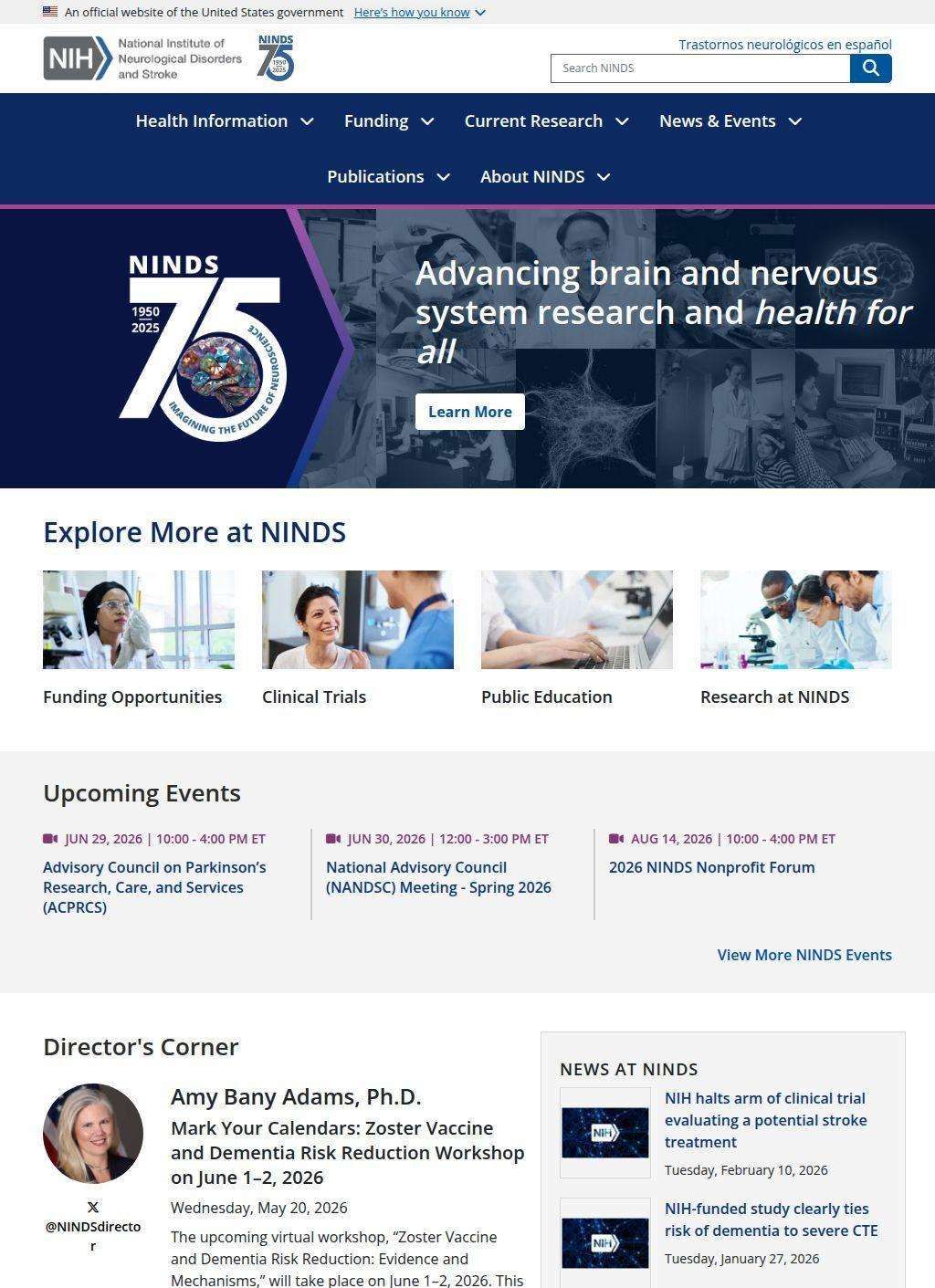
Buried partway through the site, a searchable index of NINDS-funded and in-house clinical trials on brain and nervous system disorders sits open to patients, caregivers and researchers without a login. That single feature tells you what the National Institute of Neurological Disorders and Stroke is built to do: move research out of the lab and into the hands of people who need it. As a component of the National Institutes of Health under the Department of Health and Human Services, the National Institute of Neurological Disorders and Stroke sits at the federal center of neurological science in the United States, and the site reflects that scope without much fuss.
Finding information about neurological conditions
Most visitors arrive looking for something specific about a condition, and the Neurological Disorders A-Z index is where that search lands. It runs across stroke, Parkinson's disease, traumatic brain injury, epilepsy, multiple sclerosis, dementia and neuropathy, among many others. The writing in the Brain Basics patient education materials is plain enough for a worried family member to follow, and the National Institute of Neurological Disorders and Stroke also offers orderable print publications. A caregiver sitting in a hospital waiting room is not always reading on a phone, and a printed booklet can travel between specialists in a way a web browser tab cannot.
Tools for tracking health and managing risk
There is also a practical, tool-driven side that is easy to miss at first. The Migraine Trainer app gives migraine sufferers a structured way to track triggers, and the Mind Your Risks program connects cardiovascular health to stroke and longer-term brain health in a way aimed squarely at the general public. These are not white papers. They are things a person can pick up and use, which makes the National Institute of Neurological Disorders and Stroke feel less like an archive and more like a working resource. Spanish-language neurological disorder content runs alongside the English pages, extending real reach into communities too often left with English-only medical information.
Resources for clinical practice
Honestly, several audiences at once, and the structure handles that better than sprawling federal sites usually manage. Patients and caregivers get the disorder index, the Brain Basics materials and the public-facing apps, all written so that someone with no medical training can follow along. Clinicians have their own lane: the Health Professionals section links out to the NIH Stroke Scale, Brain Attack Coalition resources and PubMed Central, the kind of references a neurologist or emergency physician actually reaches for during a working day.
Funding opportunities for researchers
Researchers and would-be researchers get the deepest treatment. The site catalogs current and past funding opportunities and walks through grant application guidance step by step: preparing applications, gauging the likelihood of funding, and managing awards once they land. There is a Small Business Program for neuroscience-related startups, which means the National Institute of Neurological Disorders and Stroke wants commercial as well as academic ideas in the pipeline. For people earlier in their path, the Training and Career Development section and the Building Up the Nerve podcast tackle the messy realities of navigating grants and building a research career, topics that rarely get this kind of plain treatment from an official source.
That breadth is the strongest case for the National Institute of Neurological Disorders and Stroke as a destination. A single domain listed in any general business directory for health resources would not capture it, because it covers ground that no single category fits: frightened parent, grant-writing postdoc, stroke neurologist and startup founder can all arrive and find their section without wading through content meant for the others. It is rare for a body this large to keep its many audiences sorted, and the National Institute of Neurological Disorders and Stroke manages it page after page.
Organizing research by disorder or method
Underneath the patient-facing material is the actual mission: advancing research into brain and nervous system disorders and translating it into better public health. The current research coverage is organized two ways, by disorder and by scientific tools and topics, plus a set of trans-agency initiatives that reach across other parts of the NIH. For anyone trying to understand where federal neuroscience money and attention are going, that organization is a quiet gift, because it lets you approach the work either from a disease you care about or from a method you study. The National Institute of Neurological Disorders and Stroke does not bury its research agenda; it lays it out and invites navigation.
Staying current with institutional news
News releases land regularly, the Director's messages give some sense of institutional priorities, and advisory council meeting schedules and event listings are published openly. This is the connective tissue that turns a static reference into something worth checking back on. The funding and grant sections are admittedly dense, but that density is appropriate; a casual reader is not the target there, and the people who are will appreciate that the National Institute of Neurological Disorders and Stroke has not softened any of it.
What holds the whole thing together is consistency of purpose. Every section, from the A-Z index to the Small Business Program, ties back to understanding the nervous system and improving how its disorders are diagnosed, treated and prevented. The National Institute of Neurological Disorders and Stroke does not scatter its attention, and that focus shows. The traumatic brain injury coverage is a good test case, because it threads the disorder pages, the clinical trials index and the clinician tools into one coherent path through a notoriously complicated subject.
One caveat worth naming: this is a research and education body, so the patient material informs without diagnosing. The National Institute of Neurological Disorders and Stroke will tell you what traumatic brain injury is, point you to relevant clinical trials, and link to the tools clinicians use, but it is a starting point for understanding, not a substitute for seeing a doctor. Read in that spirit, the depth on offer is hard to match anywhere else, and the breadth of the National Institute of Neurological Disorders and Stroke means you are unlikely to outgrow it quickly.
A caregiver or patient newly facing a stroke, epilepsy or traumatic brain injury diagnosis should start at the Neurological Disorders A-Z index, read the relevant Brain Basics page, then search the clinical trials database to see whether a study fits the situation. Researchers and trainees should head straight to the funding opportunities and grant guidance, and anyone weighing a neuroscience startup should look up the Small Business Program. The National Institute of Neurological Disorders and Stroke rewards a visitor who arrives with a clear question, and most leave with a sharper one.
Business address
National Institute of Neurological Disorders and Stroke
P.O. Box 5801,
Bethesda,
MD
20824
United States
Contact details
Phone: 1-800-352-9424