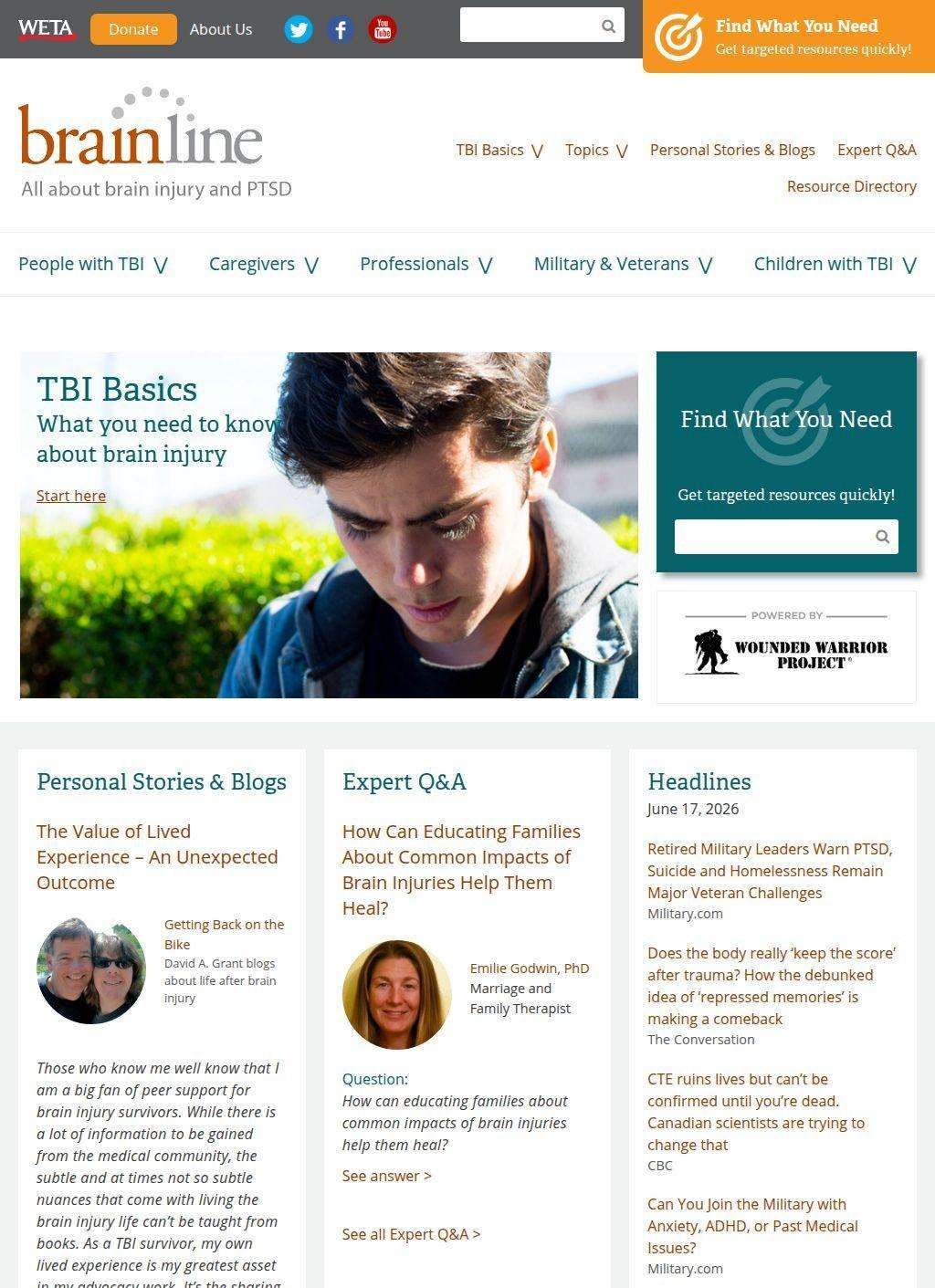
BrainLine is a national educational resource on traumatic brain injury and PTSD, produced by WETA, the public broadcaster based in Arlington, Virginia. It sits in a law category as background reading rather than as a firm you would hire, and that distinction shapes everything: nothing here pitches a legal service. What it does instead is explain, in plain terms, what a brain injury is, how it is treated, and what living with one looks like over months and years. For someone trying to understand a diagnosis (their own or a family member's) before they ever speak to an attorney, that grounding is the point. It is the difference between walking into a meeting able to ask informed questions and walking in lost.
TBI basics, symptom checkers and treatment hub
The core of the site is its explainer material. There is a TBI Basics section that starts from the ground up, an interactive brain tool that lets you click through regions and see what damage to each can affect, and symptom checkers that help a person put vague experiences into recognisable categories. A treatment hub gathers the medical side, and there is a separate hub devoted to disorders of consciousness, which is a narrow and genuinely difficult subject that most general health sites skip entirely. That last editorial choice is telling, because covering coma and minimally conscious states well takes real subject expertise and a willingness to handle questions families dread asking.
Survivor blogs and expert Q&A sessions
Beyond the clinical explainers, BrainLine leans hard into lived experience. Survivors keep personal blogs on the site, writing about recovery in their own words, and there are expert Q and A sessions where specialists answer the kinds of practical questions that come up at two in the morning. That mix of professional and first-hand voices is harder to assemble than it looks. Clinical accuracy on its own can read as cold; survivor stories on their own can drift from the evidence. Putting both in one place, and keeping them distinct so a reader knows which is which, is a sensible editorial call. The survivor writing in particular does something the explainers cannot: it shows the slow, non-linear shape of recovery, the good weeks and the setbacks, which is exactly the part doctors struggle to convey in an appointment.
Audiences from veterans to children
BrainLine does not write for a single audience. The content is sorted for people living with TBI, for the family members and caregivers around them, for healthcare professionals, and for military personnel and veterans, who carry a disproportionate share of brain injuries and PTSD. There is a dedicated track of veteran-focused material, which reflects how often the two conditions overlap in that population. Children and adolescents get their own coverage too, since a young brain injured at eight is a different problem from an adult one, both medically and in terms of school and family.
Continuing education for clinicians
For clinicians specifically, BrainLine offers online continuing-education courses, the sort that count toward professional requirements. That moves the site past consumer information and into a working tool for the people delivering care. It also publishes research updates and current brain-health news, so a returning visitor finds more than a static library. A practical touch worth naming: a resource directory for locating local services, which turns understanding into action by pointing someone toward help in their own area. Spanish-language materials widen the reach to households that English-only health sites leave out.
Keeping many subjects organized
The breadth could easily tip into clutter, and it mostly does not. Each audience has a clear path in, and the heavy subjects (consciousness disorders, pediatric injury, veteran PTSD) are treated as their own areas rather than footnotes to a general overview. A resource people actually return to needs that kind of internal order, and BrainLine has it.
Why a public broadcaster funds this
A traumatic brain injury throws a family into territory they have no map for, and the search results they hit first tend to be either ads or articles that amount to a few paragraphs before asking for a call. A site backed by a public broadcaster, with no product to push, fills a different role in that landscape. The funding model shapes the tone: the writing aims to inform, not to convert, and a reader can sense the absence of a sales motive within a few paragraphs. The information-only stance is the asset, not a limitation. Whether someone arrives because of a car crash, a fall, a sports concussion, or a combat injury, BrainLine meets them at the explaining stage, before the medical and legal decisions pile up.
What BrainLine does not do
It is fair to flag what BrainLine is not. It does not diagnose, it does not treat, and it does not represent anyone in an injury claim. A reader who lands here from a legal search should treat it as the homework done before the consultation, not a substitute for either a doctor or a lawyer. The site is upfront about this, and the honesty is part of why it reads as trustworthy. Nobody is being funneled anywhere. That neutrality also makes it a reasonable thing for an attorney's site to link to, since the reference does not compete with anyone and only helps a prospective client understand what they are dealing with.
Comparing BrainLine to MedlinePlus
Set against a more general health reference such as MedlinePlus, BrainLine trades breadth for depth. MedlinePlus will give a reader a solid, encyclopedic page on traumatic brain injury and move on to the next thousand conditions; BrainLine stays on this one subject and goes deep, with the survivor blogs, the veteran track, the interactive brain, and the consciousness-disorder hub that a general medical encyclopedia has no room for. For a person who wants to understand head injuries broadly, the general reference is the faster stop. For anyone living with one, caring for someone who is, or treating patients professionally, this is the site worth bookmarking and returning to, because BrainLine was built for exactly that situation and keeps adding to it.
Business address
BrainLine (WETA Public Television)
3939 Campbell Ave.,
Arlington,
VA
22206
United States
Contact details
Phone: 703.998.2020