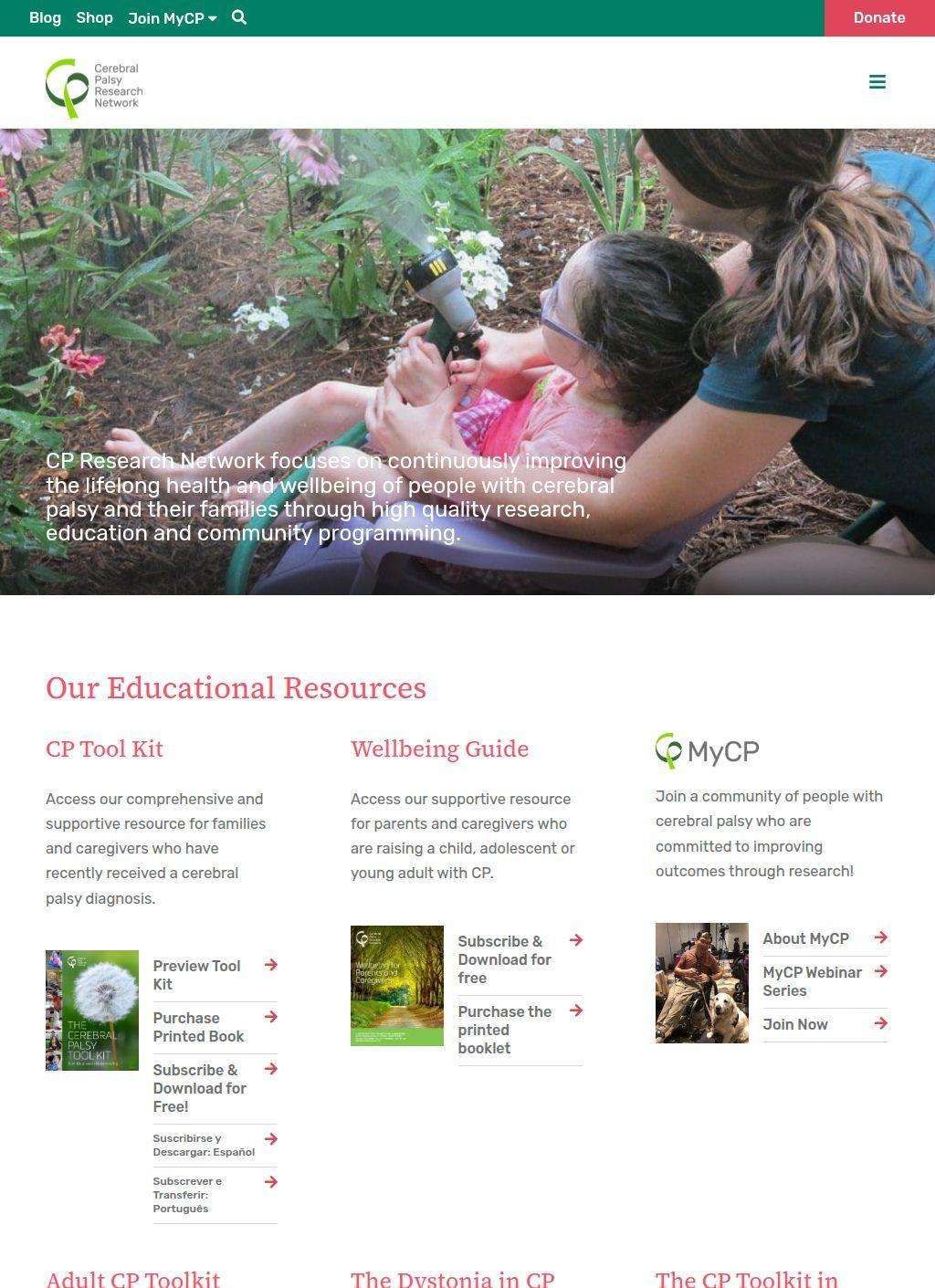
Run a search for cerebral palsy resources online and the Cerebral Palsy Research Network (CPRN) comes up consistently, though the bulk of its public reputation lives in research and clinical circles, not on general consumer review platforms. No meaningful rating trail turned up on Google, Yelp, or similar sites, which is entirely predictable for a research nonprofit whose audience is patients, families, clinicians, and researchers, not casual shoppers. What the organization does have is a clear record of published work and an active study database, and those are more useful to evaluate than star counts.
CPRN is a nonprofit focused on the lifelong health and wellbeing of people with cerebral palsy. The CP Toolkit sits at the center of what the Cerebral Palsy Research Network (CPRN) puts in front of visitors, and it arrives in three languages: English, Spanish, and Portuguese. That detail tells you who the site is built for. The audience named is broad: people living with CP, their families, caregivers, clinicians, and researchers. A site trying to speak to all five groups at once could easily turn shapeless, but the material here is sorted by who needs it and by the question being asked.
Toolkits organized by life stage
The toolkits multiply as the life stage changes. Alongside the main CP Toolkit there is a Wellbeing Guide for Parents and Caregivers, an Adult CP Toolkit, and a Dystonia in CP Toolkit. That last one is a useful indicator of how specific the coverage gets. Cerebral palsy is not one fixed condition, and a resource that breaks out dystonia as its own topic is treating it the way clinicians and affected families experience it, in subtypes and complications rather than a single label.
Clinical topics and daily living sections
On the clinical side, the Cerebral Palsy Research Network (CPRN) covers diagnosis, the types and causes of CP, and the classification systems used to describe it. Treatment gets its own substantial section: therapies, medications, surgeries, and adaptive equipment map most of the decisions a family faces over years. Then there is a layer that many medical sites skip entirely: the conditions that travel alongside CP. Communication, nutrition, pain, sleep, vision, and mental health all get named coverage. Pain and sleep and mental health tend to be undertreated and under-discussed in general health publishing, so giving them dedicated space is a meaningful editorial choice.
The daily living section is where the Cerebral Palsy Research Network (CPRN) stops reading like a medical reference. Adaptive clothing, education, employment, and travel are the four topics here. None of those is a diagnosis or a procedure; all of them are parts of a life. Adaptive clothing next to employment next to travel is a quiet acknowledgment that a person with CP is planning a wardrobe, a career, and a trip alongside managing symptoms.
Research database and webinar series
What holds these pieces together is that CPRN is grounded in research. It maintains a database of current and completed research studies, which lets a family or a clinician see what is being investigated and what has already been answered. A webinar series sits alongside that database, extending the same material into a format people can follow over time.
MyCP community platform
MyCP is the community side of the organization, a platform built for peer discussion and for research participation. Those two functions in one place is a sensible pairing. The people most motivated to compare notes with others who share the condition are often the same people willing to contribute to studies, and routing both through one platform keeps the community and the research feeding each other. For a network whose stated purpose is improving outcomes through research, a participation channel sitting right next to the discussion board is doing actual work.
Checking current and completed studies
The research database deserves a second mention because of what it implies about how the Cerebral Palsy Research Network (CPRN) operates. Listing both current and completed studies is a transparency move. A visitor can check whether a question they care about is being studied now, whether it has already been looked at, and trace where the educational content is coming from. That connection between published guidance and an underlying body of studies is the difference between a content site and a research network that happens to publish.
The breadth is genuinely wide: diagnosis through adult life, clinical procedures through travel planning, peer discussion through formal study enrollment. Sites that try to be this comprehensive often pad out half their sections with placeholder content and call it coverage. Whether every topic here is filled out to the same depth is the open question, and only sustained use would settle it. The structure is sound; the consistency across so many topics is harder to confirm from the outside.
Some practical limits are worth naming. The Cerebral Palsy Research Network (CPRN) is one network's set of resources, and a family weighing a treatment decision would still want to bring the material to their own clinical team rather than treat any toolkit as the final word. The webinar series and the study database are only as current as their last update, and a research-driven site lives or dies on whether that maintenance keeps pace. Those are the natural boundaries of what one nonprofit's library can do.
On balance, the Cerebral Palsy Research Network (CPRN) gathers an unusually complete spread in one place and ties it back to actual studies. The multilingual toolkits and the split between clinical topics and daily living show real thought about who is reading. What keeps this from being an unqualified recommendation is the unanswered question of how evenly that ambition is sustained across every section. The Cerebral Palsy Research Network (CPRN) is plainly worth consulting, and most visitors in its intended audience will find something relevant; how deep that something runs varies by topic and is worth checking directly.
Business address
Cerebral Palsy Research Network
PO Box 8347,
Greenville,
SC
29604
United States
Contact details
Phone: (402) 302-2776