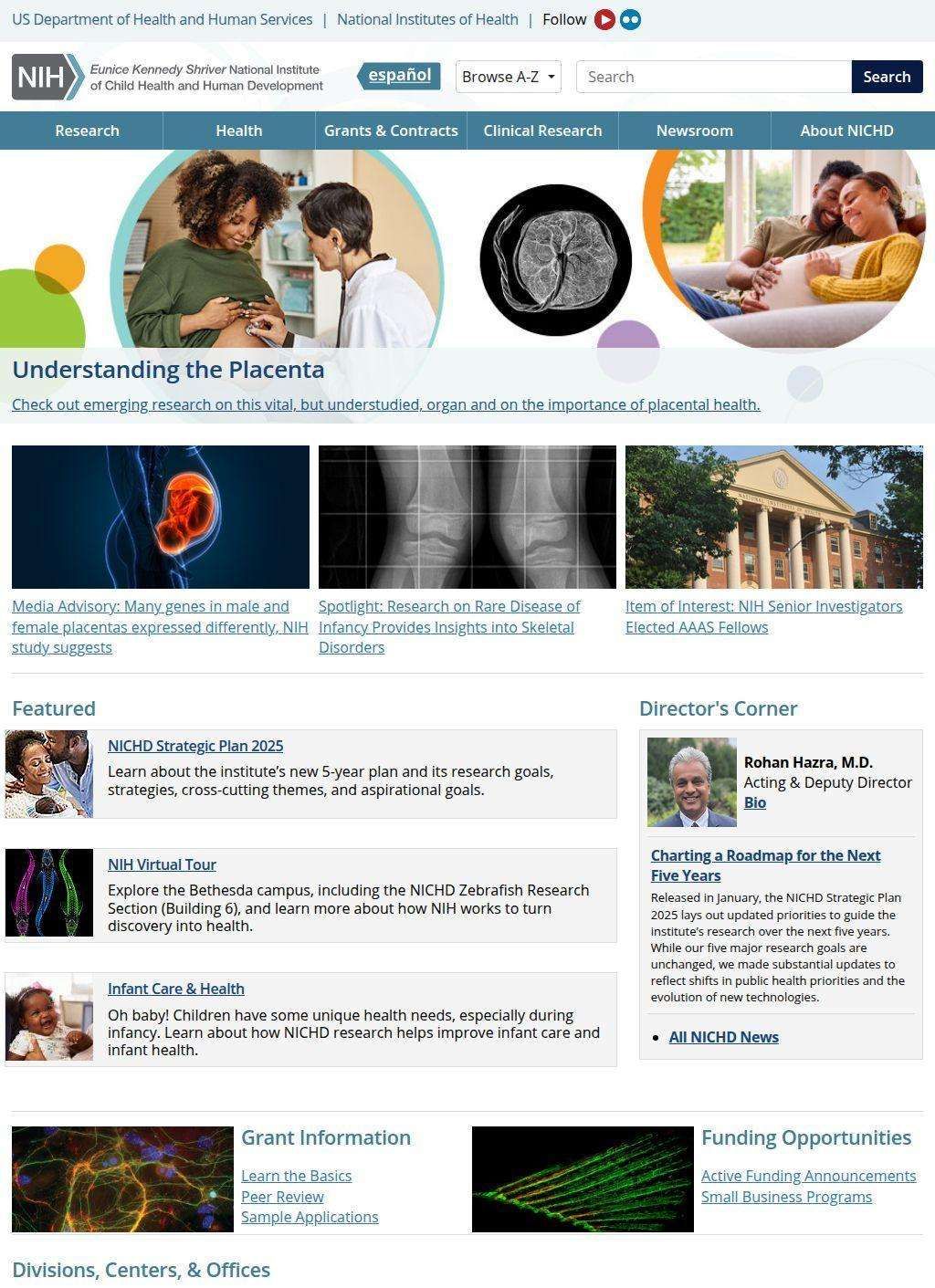
A family trying to understand whether a difficult birth caused their child's cerebral palsy quickly hits a wall of conflicting claims, and the science underneath those claims has to come from somewhere credible. That somewhere is often the Eunice Kennedy Shriver National Institute of Child Health and Human Development (NICHD), the federal research institute under the National Institutes of Health that funds and runs much of the work on what happens during pregnancy, labor, and the first months of life. For anyone landing in the orbit of birth injury questions, whether a parent, a clinician, or an attorney building a perinatal asphyxia case, this is the layer of primary evidence the rest of the conversation rests on.
What the institute studies and funds
The institute's reach is wide. The Eunice Kennedy Shriver National Institute of Child Health and Human Development (NICHD) covers fetal development, maternal health, reproductive medicine, genetics and genomics, and the broad area of intellectual and developmental disabilities. Some of that happens inside NIH labs as intramural work, and a larger share goes out as extramural grants to universities and hospitals. The result is a portfolio that touches preterm birth, obstetric complications, and the causation questions that surface when a delivery goes wrong. None of it is pitched as legal evidence, but it is the data that medical standards are eventually written from.
A-to-Z health topics library
The most directly useful part of the site for a non-specialist is the A-to-Z health topics library, which runs to more than eighty conditions. Preterm birth, Down syndrome, Fragile X syndrome, autism spectrum disorders, sudden infant death syndrome, endometriosis, and labor and delivery complications all get their own entries. Each one is written to be read by someone without a medical degree, which is harder to pull off than it sounds when the underlying material is this technical. A caregiver can start there and come away with the actual vocabulary clinicians use, which changes the quality of every conversation that follows.
Safe to sleep campaign for infants
Sitting alongside that library is the Safe to Sleep campaign, once known as Back to Sleep, which puts out consumer materials on infant sleep safety aimed at lowering the risk of sudden infant death syndrome. This is one of the clearer cases where research from the Eunice Kennedy Shriver National Institute of Child Health and Human Development (NICHD) gets translated into something a parent can act on the same day they read it. The material is plain, repeated across formats, and tied back to the evidence that produced it. It is public health communication doing what it is supposed to do, without dressing the recommendations up.
Research feeds directly into public explanations
What makes the topics library worth returning to is that it is maintained by the same organisation funding the studies behind it. The distance between the research and the explanation is short. When the Eunice Kennedy Shriver National Institute of Child Health and Human Development (NICHD) describes the mechanics of perinatal injury, it is summarising work it paid for, which is a different thing from a secondhand health article rewriting a press release. That institutional proximity shows up in the precision of the language and in how carefully qualifications are handled, particularly on contested causation questions where a careless summary could mislead badly.
Funding opportunities for researchers
For the professional audience, the funding side of the site is dense and practical. There are active NIH funding opportunity announcements, the SBIR and STTR small business research programs, training and career development grants, and peer review guidance for people preparing applications. This is the working machinery of how pediatric and maternal research gets paid for in the United States, laid out for applicants who already know roughly what they are looking for. A student or early-career researcher could spend a long time here mapping out where the money flows. The Eunice Kennedy Shriver National Institute of Child Health and Human Development (NICHD) publishes enough process detail that even a first application is not a shot in the dark.
Clinical trials, guidelines and data repositories
Beyond grants, the Eunice Kennedy Shriver National Institute of Child Health and Human Development (NICHD) offers a clinical trial finder for supported studies, care recommendations, and practice guidelines aimed at clinicians. There are also the research networks: supported consortia, shared data repositories, and listings for scientific meetings. The data repositories deserve attention on their own terms, because shared perinatal datasets are exactly what feed the obstetric injury and cerebral palsy causation literature that birth injury cases eventually lean on. A clinician can pull guidance, and a researcher can pull the underlying data, from the same place.
Rounding it out are the National Child and Maternal Health Education Program resources for public health outreach and a newsroom carrying press releases, videos, podcasts, and health updates. The newsroom is the most general-audience corner, and it tends to flag new findings as they land. Taken together, the offering serves several very different readers at once, and the Eunice Kennedy Shriver National Institute of Child Health and Human Development (NICHD) does a reasonable job of keeping those audiences from tripping over each other, though a first-time visitor may need a few clicks to find the right door.
Where the site falls short for legal questions
The placement under birth injury is where some friction shows. Put plainly, the Eunice Kennedy Shriver National Institute of Child Health and Human Development (NICHD) is a research institute, not an advocate, an advisor, or anyone who will weigh in on a specific case. The connection to birth injury litigation is substantive: the Eunice Kennedy Shriver National Institute of Child Health and Human Development (NICHD) portfolio directly underpins the medical standards used in perinatal asphyxia cases and cerebral palsy causation arguments. But a parent arriving with the raw question of whether their child was harmed by negligence will find the science here and nothing resembling guidance on what to do with it. The Eunice Kennedy Shriver National Institute of Child Health and Human Development (NICHD) explains the biology of the injury and leaves every other question alone.
That is the honest tension worth naming. As a primary source on child health, pregnancy, and the developmental conditions that follow a hard birth, the depth and reliability of the Eunice Kennedy Shriver National Institute of Child Health and Human Development (NICHD) are hard to match anywhere. The work published and funded here is the foundation a serious inquiry should start from. Someone hunting specifically for legal footing in a birth injury matter may walk away still needing a different resource for the next step, because the most pressing question they brought is the one this institute was never built to answer, but on the underlying science, no comparable source exists.
Business address
Eunice Kennedy Shriver National Institute of Child Health and Human Development
P.O. Box 3006,
Rockville,
MD
20847
United States
Contact details
Phone: 1-800-370-2943