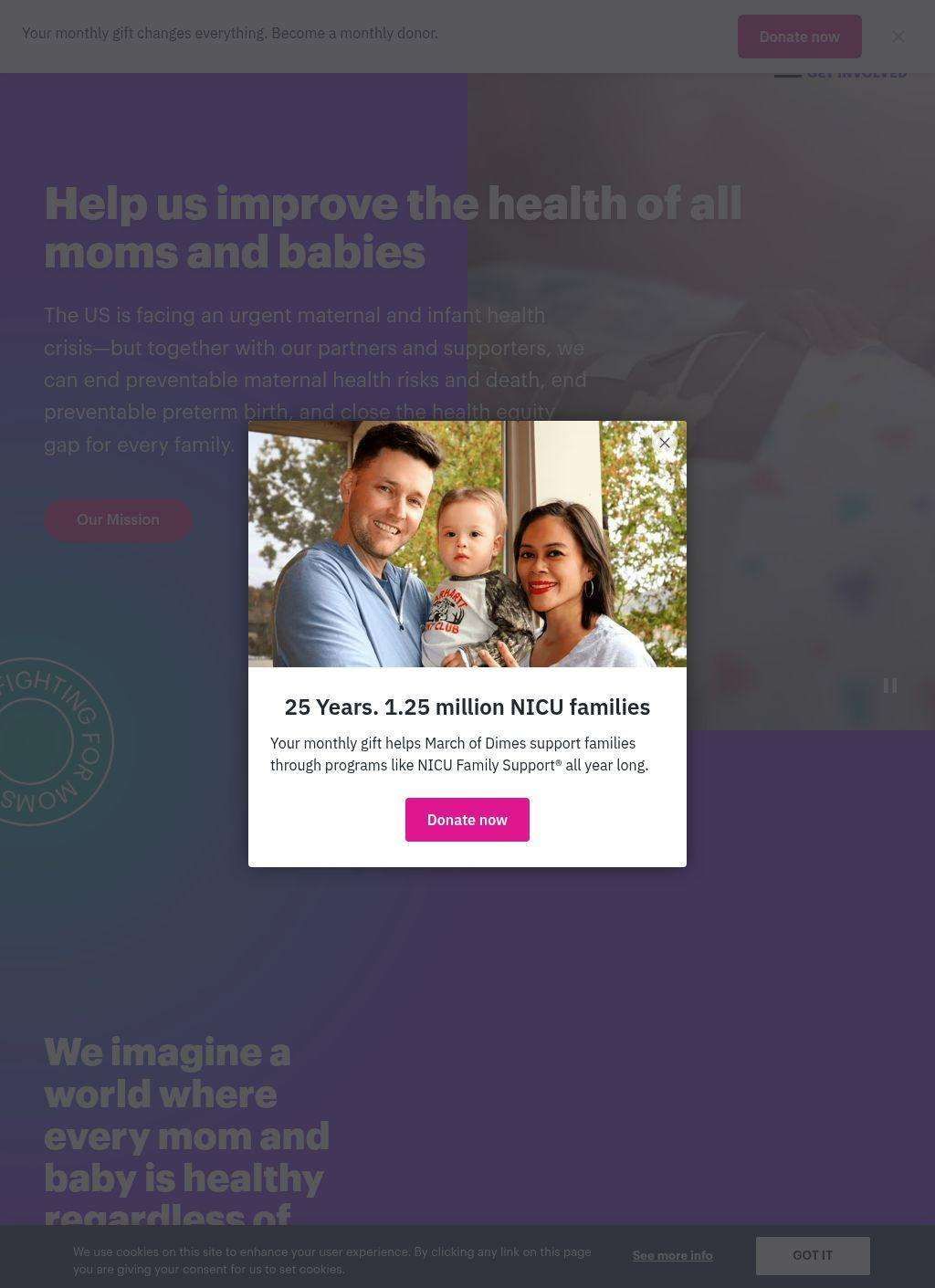
Birth injury lawyers is a strange category to find March of Dimes in, because there is no law firm anywhere in sight. What this address leads to is a public health nonprofit that has been working on maternal and infant health since 1938, organized as a 501c3. The gap between the label and the reality is the first thing a visitor has to make peace with. Once that is set aside, the site reads as exactly what it is: the home of a long-running charity that funds research, runs care programs, and pushes for policy changes around pregnancy and newborns. Anyone who arrived hoping for a malpractice attorney will need to look elsewhere, but anyone trying to understand premature birth, birth defects, or NICU life has landed somewhere genuinely useful.
Educational content for pregnancy and newborn care
The educational material is the part most visitors will touch first, and it runs deep. March of Dimes walks through pregnancy planning before conception, prenatal care month by month, what happens during birth, the realities of a NICU stay, and postpartum recovery. The tone is aimed at people who are anxious and looking for plain answers, not clinicians. The NICU sections in particular felt grounded in the specifics families face. A first-time parent and a parent on their fourth child need different things, and the material stretches to cover both: planning pages assume nothing, NICU pages assume a household already in crisis. March of Dimes keeps the reading level accessible throughout, a deliberate choice when the subjects involve genetics, neonatology, and obstetric complications that could easily be written in language nobody outside a hospital would follow.
Research funding through the Innovation Fund
Behind the consumer-facing content is the older spine of the organization: paying for science. March of Dimes channels money into scientific research and clinical trials through its Innovation Fund, with the stated aim of improving outcomes for mothers and babies. This is the strand that connects the modern charity back to its origins, when the same name was tied to one of the defining public health campaigns of the twentieth century. The site does not lean on that history as decoration; it points the funding at current problems like prematurity and birth defects, a more honest use of a famous legacy than many organizations of this age manage.
Tracking where money goes
Research funding is hard for an outside reader to judge from a website alone. What you can see is the direction of travel: the money aimed at the causes of premature birth and the conditions that land newborns in intensive care, not vague wellness messaging. For donors trying to figure out where a gift goes, that focus carries something, even if the granular results live in reports. March of Dimes gives you the shape of the commitment without pretending a homepage can prove a research outcome.
A clear thread running through the programs treats racial and socioeconomic health disparities as a stated priority. March of Dimes names the fact that outcomes for mothers and infants in the United States differ sharply by race and income, and builds that recognition into how it describes its work. That willingness to be specific about an uncomfortable subject reads as more serious than the usual nonprofit gloss.
Mobile clinics and family support programs
The program that gives March of Dimes its most concrete physical footprint is the Mom and Baby Mobile Health Center. These are vehicles that carry prenatal and postpartum care directly into communities that are short on it, a practical answer to a problem the educational pages can only describe. A website can tell a pregnant woman what prenatal care should look like; a mobile clinic in a neighborhood without a nearby provider is what delivers it. That distinction is what separates March of Dimes from an organization that only publishes advice, and it is the part of the operation most worth paying attention to.
NICU support for parents
The NICU family support work runs along a similar line: support groups and educational resources for parents of premature or sick newborns, the people sitting beside an incubator trying to understand machines and terminology nobody prepared them for. Pairing emotional support with information is the right instinct for that audience, because the fear and confusion arrive together. March of Dimes resources for these families read as written by people who have watched the experience up close, and the tone does not condescend.
Advocacy and policy work at state and federal levels
Volunteer recruitment and community engagement run nationwide and feed back into all of this. March of Dimes frames itself as serving pregnant people and new families regardless of income, race, or geography, and the program mix backs that claim up. Mobile clinics, NICU groups, and free educational content are the kinds of programs that reach people who would never pay for them, which is the practical test of whether a charity's stated reach matches its operations. Advocacy is the quieter fourth leg: March of Dimes works at both the federal and state levels for legislation meant to improve maternal and infant health outcomes, which means part of its effort is invisible to a casual visitor.
It happens in committee rooms and statehouses, and it is a substantial part of how the organization tries to move the numbers, consistent with the research-and-programs approach. The same name that funds a clinical trial is also pressing lawmakers, and the two efforts point at the same goal from different angles.
Pulling the strands together, the picture is of an organization doing four distinct things at once: funding research, running direct care, supporting families through the hardest weeks of a newborn's life, and lobbying for better policy. The risk with any charity covering that much ground is a website that says everything and shows nothing. Here the program detail is specific enough to avoid that trap. You can tell what the mobile clinics do, what the NICU support involves, and where the research money points. That specificity gives the March of Dimes presentation its weight.
Worth noting from a directory standpoint: March of Dimes does not belong in a business directory under birth injury law. A visitor with a legal claim who lands here will leave without help. What they will find is the medical and emotional context around the events those cases involve, which is not a small thing, but it is a different service. The entry would serve readers better filed under maternal health or nonprofits.
The obvious comparison for anyone weighing March of Dimes against an alternative is a clinical reference like the Mayo Clinic's pregnancy pages. Mayo will give you a tighter, more medically authoritative explanation of a specific condition. Where March of Dimes pulls ahead is everything surrounding the information, and what March of Dimes brings that Mayo does not: the mobile clinics that bring care to people, the NICU groups that sit with frightened parents, the advocacy and research aimed at the system itself. The mismatch in this listing's category is a genuine friction, but the resource behind it does what it says it does, and the depth of the programs is documented rather than promised.
Business address
March of Dimes
1550 Crystal Dr, Suite 1300,
Arlington,
VA
22202
United States
Contact details
Phone: (888) 663-4637