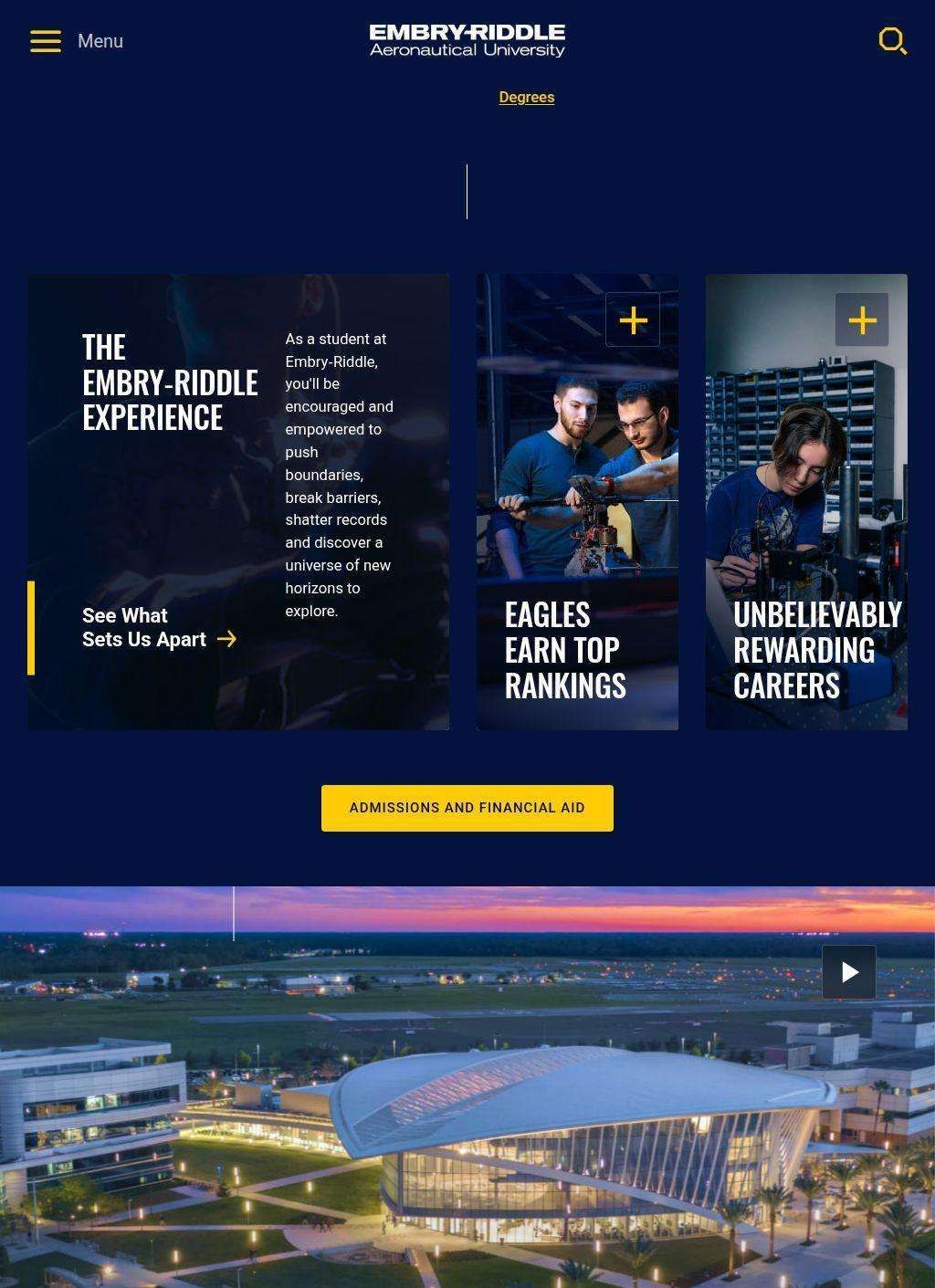
Aviation and aerospace education in the United States is dominated by a handful of institutions, and Embry-Riddle Aeronautical University sits at the top of that list by almost any measure. It is a private, nonprofit university built almost entirely around aviation, aerospace, and the technical disciplines that surround them, with residential campuses in Daytona Beach, Florida and Prescott, Arizona, plus a Worldwide and Online division and an Asia campus in Singapore. That single programmatic focus is the thing to understand first. Many universities treat aviation as one track tucked inside a larger engineering school. At Embry-Riddle Aeronautical University the priority runs the other way, and the catalog bears it out: more than a hundred undergraduate and graduate degrees spread across seven discipline clusters, covering aviation, engineering, applied science, business, computers and technology, security and intelligence and safety, and space.
Seven discipline clusters
The residential side is organized into named colleges, including a College of Aviation, a College of Engineering, and a College of Arts and Sciences, with separate college-level business units. The College of Aviation is the part that justifies the rest of the institution, and flight training with FAA certifications sits alongside the academic degrees rather than being contracted out to a third party. For a category like aviation accident work, that combination is more than incidental. The same institution that teaches someone to fly also teaches the engineering and human-factors reasoning behind why aircraft fail, which is a narrow but genuinely useful overlap that most aviation-adjacent programs cannot replicate.
College of Aviation and flight training
The research footprint at Embry-Riddle Aeronautical University is the most concrete evidence of institutional depth: more than 160 active labs and centers, and over 162 active research awards reported in fiscal year 2023 to 2024. Plenty of universities advertise research capacity. Fewer can point to centers this specific to the subject. The list includes the Boeing Center for Aviation and Aerospace Safety, the Center for Advanced Air Mobility, the Center for Aerospace Resilient Systems, the Center for Space and Atmospheric Research, and the Robertson Safety Institute. Each one maps onto failure analysis, resilient-systems design, and the human-factors questions that accident investigation turns on, and the naming is specific enough to trace to a real line of inquiry.
Research centers and active labs
The Robertson Safety Institute name is worth dwelling on. Safety as a formal academic discipline is exactly what someone researching accident causation would look for, and a dedicated institute carrying that brief is a different kind of resource than a general engineering department that touches the subject occasionally. The Boeing-named center points the same direction: institutional attention to the conditions under which aviation systems fail, studied at the component and systemic level by people whose day job is the question.
Safety as formal academic discipline
Whether research output from these centers is accessible to someone outside the university, as opposed to enrolled students and faculty, is a separate question the public-facing material does not fully answer. A center can produce serious work and still publish little that a non-academic can read without a subscription or institutional access. The published record confirms these centers exist and are active. It says less about what they put into the open literature or how a practitioner outside the university would reach that knowledge.
From online degrees to ROTC programs
Beyond the labs, Embry-Riddle Aeronautical University runs the full apparatus of a residential university. The Worldwide Campus delivers flexible online degrees in aviation, business, and related fields, which is how a working professional midway through a career, an air-traffic controller, a maintenance technician, or a safety officer, would realistically engage with the institution without relocating. ROTC programs for the Air Force, Army, and Navy are available on the residential campuses, and given the heavy military-to-civilian overlap in aviation careers, that is a structural fit rather than a peripheral add-on.
Student services and alumni network
Student services cover the expected range: career placement, academic advising, housing, health and wellness counseling, athletics, and a dedicated military and veteran support function. A language institute provides pathway programs for international students, which fits the additional campuses in Europe and Central and South America alongside Singapore. Embry-Riddle Aeronautical University reports more than 165,000 alumni worldwide, a figure that, for an institution this specialized, reflects decades of consistent output into a defined set of industries. Aerospace employers, aviation regulators, and defense contractors all draw from that network in ways that a generalist university cannot replicate.
Continuing education outside degree structure
The academic depth extends into continuing and professional education. Embry-Riddle Aeronautical University periodically offers short courses, certification programs, and industry-facing workshops that sit outside the degree structure. These vary by campus and by year, so the active catalog is worth checking directly, but the infrastructure to support non-degree learners is present in a way that is unusual for a school of this size.
Training specialists versus legal services
None of the above directly delivers what the category heading promises. Embry-Riddle Aeronautical University trains the engineers, pilots, and safety specialists whose expertise underpins accident investigation. Its safety centers study the systems and conditions that produce failures. It does not practice law, represent claimants, or provide legal services of any kind. A reader who arrives expecting counsel after an aviation incident will find a research and teaching institution, and the academic depth does nothing to change that. The mismatch between where this listing appears and what someone in the category would need goes unresolved by anything in the published material.
Institutional credibility in aviation
Taken on its own terms, though, Embry-Riddle Aeronautical University is about as authoritative a source as exists in its domain. The combination of flight training, engineering education, dedicated safety research, and a global alumni network in exactly the right industries adds up to something genuinely rare. If the relevant question is institutional credibility and subject-matter depth in aviation and aerospace, the answer from this listing is unambiguous. The gap is not in the institution. It is in the fit between what Embry-Riddle Aeronautical University is and what this particular category asks for.
Business address
Embry-Riddle Aeronautical University
1 Aerospace Boulevard,
Daytona Beach,
FL
32114
United States
Contact details
Phone: (386) 226-6000