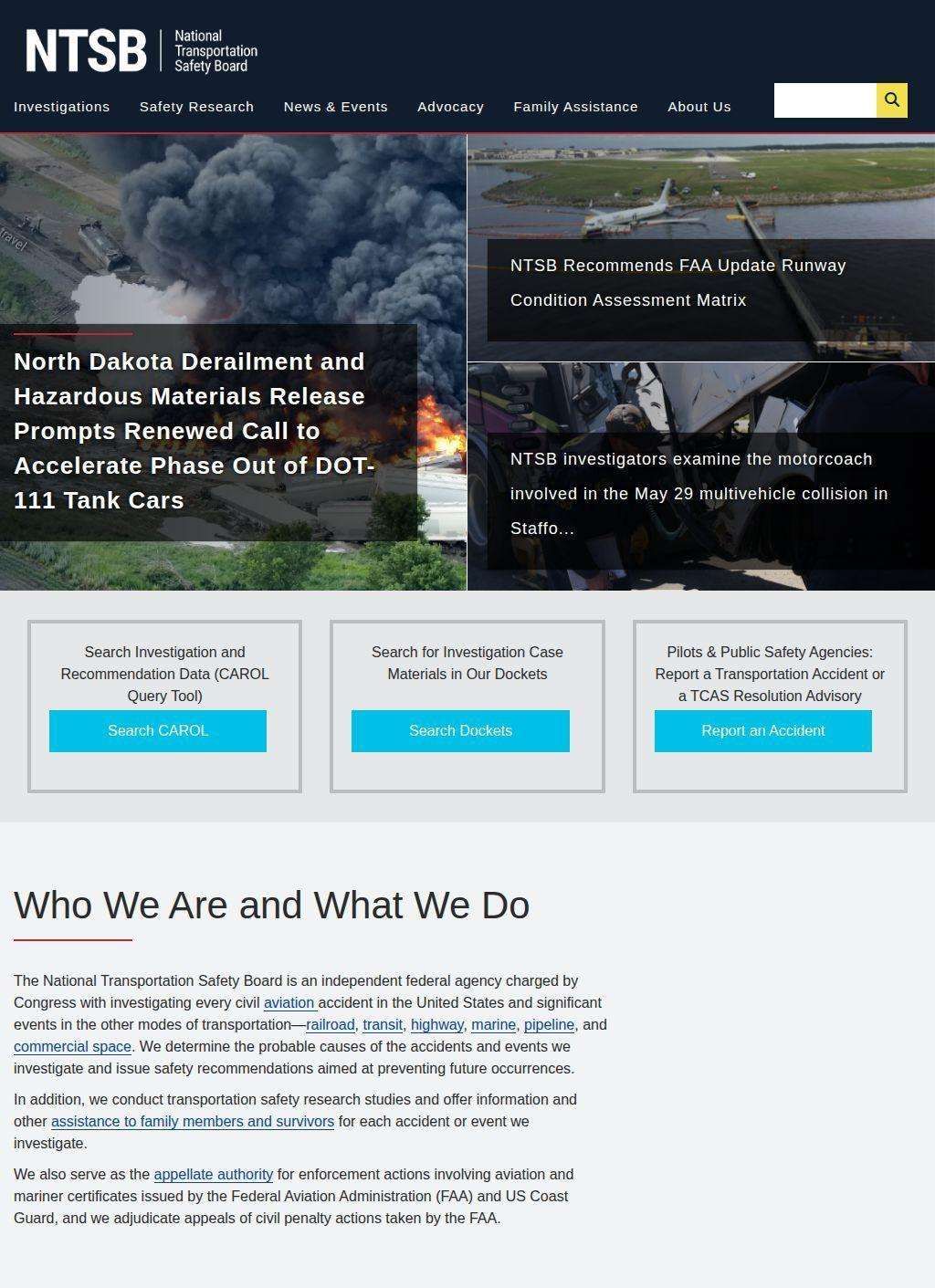
The National Transportation Safety Board is the independent federal agency that Congress charged with investigating every civil aviation accident in the United States, along with significant events in rail, highway, marine, pipeline, and commercial space transportation. For anyone working an aviation injury or wrongful-death case, the NTSB is the starting point, because its investigators are usually first on the scene and its findings shape how the rest of the matter unfolds. The agency has no regulatory or enforcement power. It cannot fine an operator or pull a certificate. What it does instead is determine the probable cause of an accident and issue recommendations meant to keep the same failure from happening again.
Investigation scope and authority
That separation matters more than it first appears. Because the NTSB sits apart from the Federal Aviation Administration and from the operators it examines, its conclusions carry weight that a party-funded report rarely does. The board reconstructs wreckage, reads flight data and cockpit voice recorders, interviews crew and witnesses, examines maintenance logs, and tests components. The result is a public record built by people whose only job is figuring out what went wrong. Attorneys, insurers, manufacturers, and journalists all lean on that record, and so do the families trying to understand how they lost someone.
Accident database and public records
The website is where most of that work becomes accessible. The aviation accident database, queried now through the agency's CAROL system, lets a visitor search decades of investigations by date, location, aircraft make and model, operator, and severity. Each case opens into a record that can include the preliminary report filed within days of the event, the factual reports compiled during the inquiry, and the final report that states the probable cause and any contributing factors. The public docket, hosted through the same portal, often holds hundreds of supporting documents: interview transcripts, photographs, specialist group factual reports on subjects like powerplants or human performance, weather studies, and correspondence. A lawyer building a timeline can pull primary material here long before formal discovery begins.
Safety recommendations and alerts
One feature that sees heavy use is the running list of open safety recommendations and the responses agencies have given them. The NTSB tracks whether the FAA or an operator accepted, rejected, or partially adopted each recommendation, and it publishes a "Most Wanted List" of transportation safety priorities. For a litigator, a recommendation that was issued years before a crash and then left unaddressed can be a meaningful thread to follow. The site also archives Safety Alerts aimed at pilots and mechanics, which translate hard lessons into short, plain-language warnings about recurring hazards such as loss of control in flight or fuel mismanagement.
Family assistance after disasters
The agency runs a Transportation Disaster Assistance program that coordinates support for victims and their families after major accidents. This grew out of the Aviation Disaster Family Assistance Act passed in the 1990s, which assigned the NTSB a role in making sure families receive timely information and humane treatment during an investigation. The program does not provide legal advice or financial settlements, and it is careful to stay in its lane, but it helps families understand the investigative process, arranges briefings, and serves as a point of contact when an event involves many people. For families who later seek counsel, having a clear picture of how the inquiry works tends to make those early conversations less bewildering.
What probable cause means in court?
It helps to be honest about what the board's findings can and cannot do inside a courtroom. Federal law generally bars the NTSB's final report and its probable-cause determination from being admitted as evidence in civil litigation, a rule meant to keep the agency's safety mission separate from the assignment of legal blame. Lawyers work around this by using the underlying factual material in the docket, which is the raw evidence rather than the board's opinion about fault. So the database is enormously useful, but it is not a shortcut to a verdict, and anyone treating a probable-cause statement as if it settles liability is likely to be disappointed. Understanding that line is part of using the resource well.
The depth of the material can also be daunting for someone new to it. A full docket on a complex airline accident may run to thousands of pages spread across many specialist reports, and the language is technical. Investigators write for engineers and regulators, not for the general public, so terms like "angle of attack," "spatial disorientation," or "controlled flight into terrain" appear without much explanation. That is not a flaw so much as a reflection of the audience, and the agency does publish accessible summaries and press materials alongside the technical files. Still, a first-time visitor should expect a learning curve and should plan to spend time before the records start to make sense.
General aviation accident records
Coverage is broad. The database holds investigations into general aviation crashes involving small single-engine aircraft, which make up the large majority of accidents by count, as well as the high-profile airline and helicopter events that draw national attention. Because general aviation is where most aviation injury cases originate, the volume of small-aircraft records is one of the site's quietly valuable assets. A practitioner researching a particular aircraft type, a known mechanical issue, or a pattern of pilot error across similar flights can often find dozens of comparable cases, which helps frame what happened in any single matter.
The board also publishes broader studies and special reports that step back from individual accidents to examine systemic problems, such as fatigue, emergency medical helicopter operations, or the safety of particular aircraft systems. These documents are well sourced and frequently cited in academic and policy work, and they give context that a single accident file cannot. For an attorney trying to explain to a jury why a given failure was foreseeable, a years-old NTSB study describing the same hazard can be persuasive background, even when the report itself stays out of evidence.
The agency also serves as an appellate body in certificate cases. When the FAA takes action against a pilot's certificate, that airman can appeal to an NTSB administrative law judge and then to the full board, which produces a body of decisions that aviation enforcement lawyers follow closely. It is a quieter function than crash investigation, but it is a genuine legal venue, and it is part of why the agency turns up on so many attorney reference lists. The five-member board, nominated by the President and confirmed by the Senate, votes on the probable cause of major investigations in public meetings that are streamed and archived, so the deliberation behind a final report is open to anyone who wants to watch it.
Within this business directory the NTSB belongs in a different tier from the law firms it sits beside. It does not represent clients, take cases, or advertise services. It is the public, primary-source authority that those firms and their experts rely on, and listing it here gives readers a way to reach the underlying record before they ever speak to a lawyer. The site is free, carries no advertising, and is maintained as an official government resource, which is part of why it remains the reference point for aviation safety information in the country.
Anyone scanning this business directory for a place to begin should treat the agency as the obvious first entry. For families, journalists, students, and practitioners alike, ntsb.gov is best understood as the documentary backbone of how the United States learns from aviation accidents. It will not hand anyone a finished argument, and it asks for patience in return for what it offers. But the combination of searchable case history, open dockets full of primary evidence, tracked safety recommendations, and a family-assistance program with real statutory grounding makes it the most authoritative single destination in this corner of the directory, and a sensible first stop for anyone trying to understand a particular crash.
Business address
National Transportation Safety Board
490 L'Enfant Plaza SW,
Washington,
DC
20594
United States
Contact details
Phone: (202) 314-6000