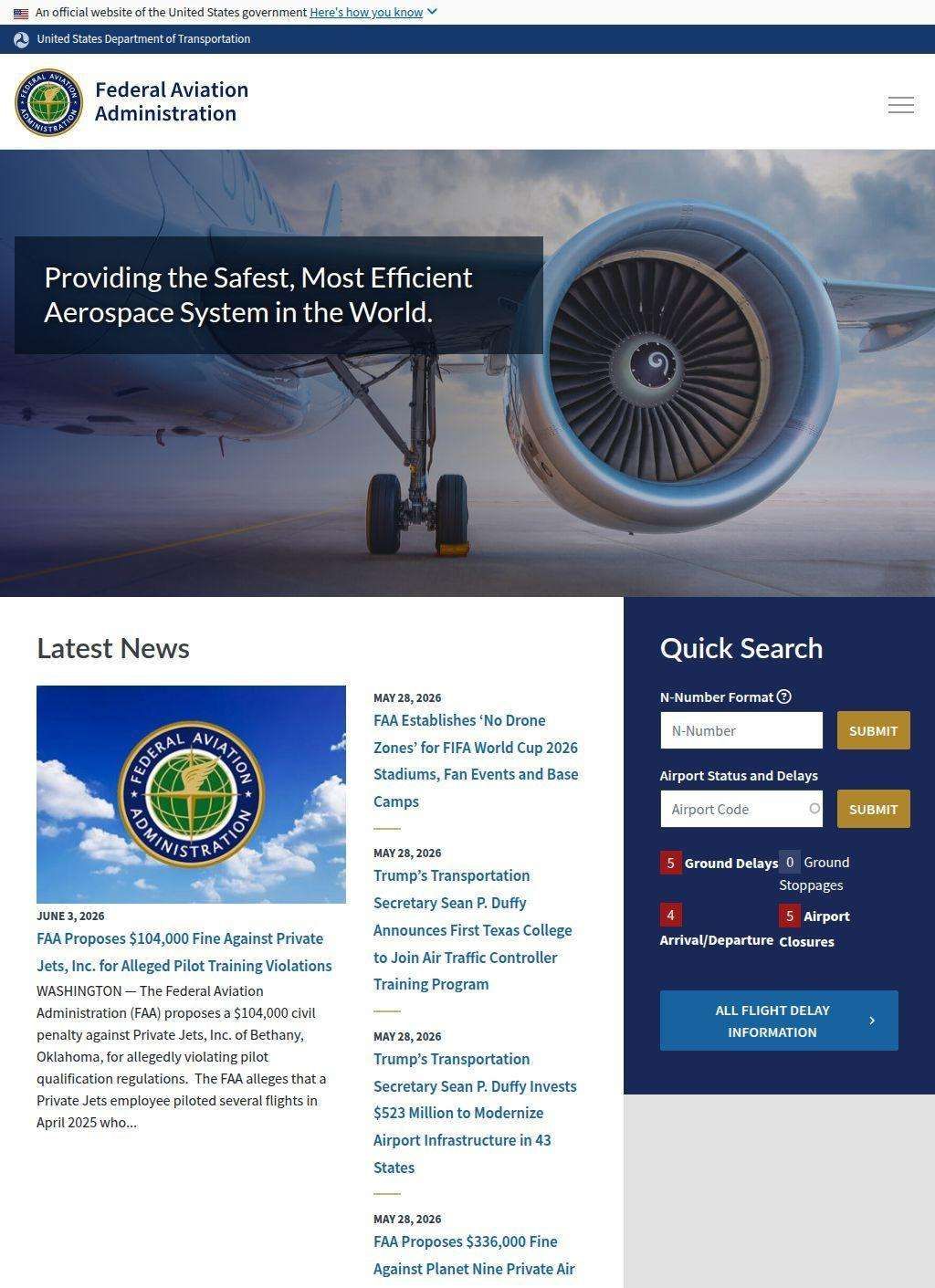
Almost everything that legally keeps a civil aircraft in the air in the United States can be traced back to a database somewhere on faa.gov. That is the first thing worth understanding about the Federal Aviation Administration (FAA): the site is less a public-facing brochure and more a working set of registries, regulations, and lookup tools that pilots, mechanics, and aircraft owners actually use to do their jobs. It sits inside the Department of Transportation and regulates civil aviation across the country and over U.S. international waters, which is a sprawling remit, and the website reflects that sprawl without much attempt to soften it.
Airmen and aircraft registries
Take the Airmen Inquiry database, one of the more quietly important things the Federal Aviation Administration (FAA) runs. Anyone can look up whether a person holds a valid pilot certificate or medical certificate, which is the kind of verification an employer, an insurer, or a flight school relies on. Alongside it runs the aircraft registry, where a tail number resolves to an owner and an airworthiness status. These two tools alone explain a lot about why people come here: it is where claims about credentials and aircraft get checked against the official record, and there is no real substitute for the source. The Federal Aviation Administration (FAA) is the only body that issues those certificates in the first place, so its own database is the controlling answer.
Regulatory requirements for aircraft operations
The regulatory backbone is the Federal Aviation Regulations, the body of rules in 14 CFR that governs how aircraft are built, maintained, and flown. The Federal Aviation Administration (FAA) publishes airworthiness directives through a searchable database, and those are not optional reading for anyone responsible for a machine: an AD can ground a fleet or mandate an inspection on a specific component within a deadline. Type certificates and supplemental type certificates sit nearby, along with specifications for engines and propellers. This is the layer where the agency's authority is most concrete, because compliance is enforceable and the documents are the controlling text.
Pilot certification pathways
Pilot certification gets thorough coverage, walking through the ladder from student and sport ratings up through recreational, private, commercial, airline transport pilot, and the flight instructor certificate. I find the breadth here more useful than most aviation explainer sites precisely because it comes from the body that issues the credentials, so the eligibility rules and the paths between ratings are the real ones rather than a third party's paraphrase. The site also folds in proficiency programs such as WINGS and the FAASTeam safety initiative, which push continuing education at pilots who already hold a certificate. Modernization gets a section too, with the NextGen program describing the long-running shift in how air traffic is managed, though that material reads more like institutional documentation than something a working pilot dips into.
Flight planning tools for active pilots
Day-to-day flight planning leans on a different set of resources. The NOTAM Search tool surfaces Notices to Air Missions, the time-sensitive alerts about closed runways, unlit obstacles, or temporary airspace restrictions. The old Airport/Facility Directory now lives as the Chart Supplement, and the site carries airport data down to the Airport Master Record and IFR charts, plus weather resources and air traffic control publications. None of this is glamorous, but it is the connective material that turns a license into an actual flight, and the Federal Aviation Administration (FAA) keeps it in one place even as the naming conventions shift under your feet.
Drone registration and airspace authorization
Drones get their own corner. The UAS registration portal and DroneZone handle registration and airspace authorization through LAANC, which is how a recreational or commercial operator gets clearance to fly in controlled airspace near an airport. Given how quickly that segment has grown, the Federal Aviation Administration (FAA) treating it as a first-class part of the site rather than an afterthought is the right call, even if the layers of programs and acronyms take some patience to navigate.
Safety data and accident records
For the category this listing sits under, aviation accident work, the relevant material is the safety and data side. The site points to accident and incident statistics, runs the Aviation Safety Hotline, and links out to the National Transportation Safety Board for the actual crash investigations. That distinction matters and the Federal Aviation Administration (FAA) does not blur it: the FAA regulates and certifies, while the NTSB investigates accidents and assigns probable cause. An attorney or researcher building a case will find the certification history, the airworthiness directives, and the registry data here, then cross to NTSB for the investigative report. The Federal Aviation Administration (FAA) also publishes its rulemaking dockets and Federal Register notices, so the paper trail behind a given regulation is open to anyone willing to dig.
Public access to regulatory documents
That openness is real, and it is the strongest quality the Federal Aviation Administration (FAA) brings as a reference. Rulemaking dockets, certification records, registries, and the directives database are all public, and they are authoritative in a way that secondary sources cannot match. For the audiences the site serves, which span pilots, aircraft owners, airlines, mechanics, controllers, drone operators, educators, researchers, attorneys, and ordinary travelers, the value is in going straight to the record. There are also contractor and job postings tucked into the site, a reminder that the Federal Aviation Administration (FAA) is a large employer as well as a regulator.
Navigation challenges for new users
What I keep coming back to, though, is how much the experience depends on already knowing what you are looking for. The Federal Aviation Administration (FAA) packs an enormous amount of authoritative material into faa.gov, and the tools genuinely work, but the organization assumes a reader who can already tell a type certificate from an airworthiness directive and a NOTAM from a Chart Supplement. The certification ladder, the regulatory text, the registries, the drone portal: each is excellent on its own terms and faintly forbidding to a first-timer. Whether the breadth here clarifies or overwhelms depends heavily on who arrives, and for the newcomer wandering in without that vocabulary, I am genuinely unsure the site does enough to meet them where they are.
Business address
Federal Aviation Administration
800 Independence Avenue SW,
Washington,
DC
20591
United States
Contact details
Phone: (866) 835-5322